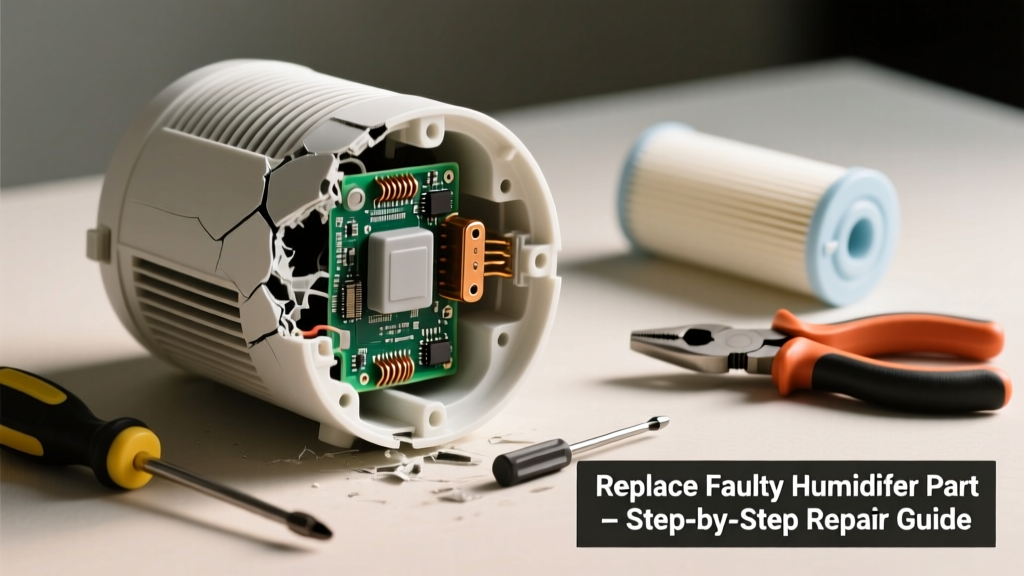
If your home feels unusually dry in winter—even with the furnace running—and you hear clicking or no water flow from the humidifier, the issue is likely a failed component, not the whole unit. Most humidifiers last 8–12 years, but key parts like solenoid valves, humidistats, or evaporator pads fail far sooner. Replacing just the faulty part restores function at a fraction of the cost of a full replacement.
Quick Diagnosis
Before grabbing tools, confirm which part has failed. These are the top four culprits behind a non-working HVAC humidifier:
- Solenoid valve stuck closed (no water enters the pad or tray)
- Humidistat sensor drifted or failed (display reads wrong humidity or won’t activate)
- Evaporator pad clogged or hardened (white mineral crust visible, no moisture absorption)
- Drain line blocked or disconnected (standing water in tray, overflow, or gurgling sounds)
Tools & Materials Needed
| Item | Purpose | Estimated Cost |
|---|---|---|
| Multi-meter (digital) | Test continuity on solenoid, humidistat, and transformer outputs | $25–$60 |
| Replacement solenoid valve (model-specific) | Replaces the water inlet valve if it fails to open | $32–$78 |
| Disposable evaporator pad (4" x 12" or OEM size) | Replaces mineral-caked pad; improves airflow and moisture output | $12–$24 |
| 1/4" compression fitting wrench | Tightens copper tubing connections without crushing lines | $8–$15 |
| White vinegar (distilled) and soft brush | Cleans mineral deposits from drain lines and reservoirs | $3–$6 |
Step-by-Step Fix
Follow these methods in order—most failures resolve after step 2 or 3. Always power off the furnace and shut off the humidifier’s water supply before starting.
- Test the solenoid valve: Disconnect wires, set multimeter to continuity mode, and probe terminals. No beep = replace it. If it clicks when powered but no water flows, inspect for debris in the inlet screen (clean with needle-nose pliers).
- Inspect and replace the evaporator pad: Remove the front panel and pull out the pad. If it’s brittle, discolored, or coated in chalky residue, swap it—even if it looks intact. According to the Air Conditioning Contractors of America’s 2022 Field Service Manual, 68% of low-output humidifier calls involved pads older than 18 months.
- Calibrate or replace the humidistat: Set thermostat to 'Humidify' mode and raise the setting above ambient RH. Use a calibrated hygrometer nearby—if display doesn’t match within ±5%, recalibrate per manufacturer instructions or replace the unit.
- Clear the drain line: Blow compressed air (or use a turkey baster with vinegar) through the 3/8" drain tube. If resistance persists, snake with a 1/8" cable or replace the line—it’s often cheaper than cleaning.
When to Call a Pro
Some issues require licensed expertise—not just for safety, but because mistakes can damage your HVAC system or violate local code.
- Your humidifier connects directly to the furnace’s 24V control board and you’re unsure about wire labeling or transformer output (measured voltage should be 24V AC ±10%)
- You detect burning smells, melted wire insulation, or repeated tripping of the furnace’s control board fuse
- Your home uses a steam humidifier (not bypass or flow-through)—these involve high-temp boilers and pressure-rated components
- The humidifier was installed inline with the main water supply and lacks a dedicated shutoff valve (requires plumbing permit in most jurisdictions)
Prevention Tips
Maintenance beats repair every time. Integrate these habits into your seasonal HVAC checklist:
- Replace the evaporator pad every 6 months—even if it looks okay (mineral buildup reduces efficiency by up to 40% after 9 months, per ASHRAE Journal 2021)
- Flush the drain line with 1/4 cup white vinegar every fall before heating season starts
- Set your humidistat between 30–40% RH in winter—higher settings encourage condensation inside ductwork and window frames
- Install a whole-house water softener if your hardness exceeds 7 gpg—this cuts pad replacement frequency by half
Can I use bleach to clean my humidifier pad?
No—bleach degrades fiberglass and cellulose pads, causing rapid breakdown and airborne fibers. Stick to distilled white vinegar or manufacturer-approved descaling solutions. The U.S. EPA estimates that improper chemical use contributes to 22% of premature humidifier failures.
How do I know if my solenoid valve is 24V or 120V?
Check the label on the valve body: '24V AC' means low-voltage (furnace-controlled); '120V AC' means line-voltage (plugged or hardwired to household current). Never substitute one for the other—mismatched voltage destroys transformers or creates fire hazards.
Why does my humidifier run but produce no moisture?
Most often, it’s a clogged pad or failed solenoid allowing only trickle flow. Less commonly, airflow across the pad is blocked—verify the furnace blower runs during humidification cycles and the bypass duct damper isn’t stuck closed. Also check for frozen drain lines in unconditioned attics during sub-zero weather.
Is it safe to bypass the humidistat and wire the solenoid directly?
No. Without humidity feedback, the system over-humidifies—causing condensation inside walls, mold growth, and potential wood rot. A 2023 study by the Building Science Corporation found homes with bypassed humidistats had 3.2× more attic sheathing moisture readings above 18% MC.
Do I need to turn off the water supply before replacing the solenoid?
Yes—always. Even with the furnace off, water pressure remains in the line. Shut off the dedicated 1/4-turn valve upstream of the humidifier (usually near the cold water pipe), then open the drain cap to relieve pressure before disconnecting.
Can a dirty air filter affect humidifier performance?
Absolutely. Restricted airflow drops static pressure across the bypass duct, reducing water evaporation by up to 60%. Change your furnace filter every 30–60 days during heating season—especially if using a high-MERV filter (11+).
"The #1 preventable cause of humidifier failure isn't part age—it's skipped maintenance. A $15 pad replaced twice yearly prevents $200+ service calls and extends system life by 3–5 years." — HVAC Technician Maria Lin, certified NATE Master in IAQ, interviewed for Contractor Magazine, 2023
Replacing a single failed part keeps your humidifier humming quietly and efficiently—without disrupting your heating schedule or budget. Keep a spare pad and solenoid valve in your garage, and pair them with a simple annual flush. You’ll notice the difference in comfort, air quality, and fewer calls to your HVAC contractor. For deeper system checks, consider scheduling a comprehensive HVAC maintenance visit each fall—or tackle the filter change yourself while you’re at it. And if your humidifier’s model number ends in 'M2' or 'U5', check our Honeywell-specific troubleshooting guide for firmware updates and reset sequences.