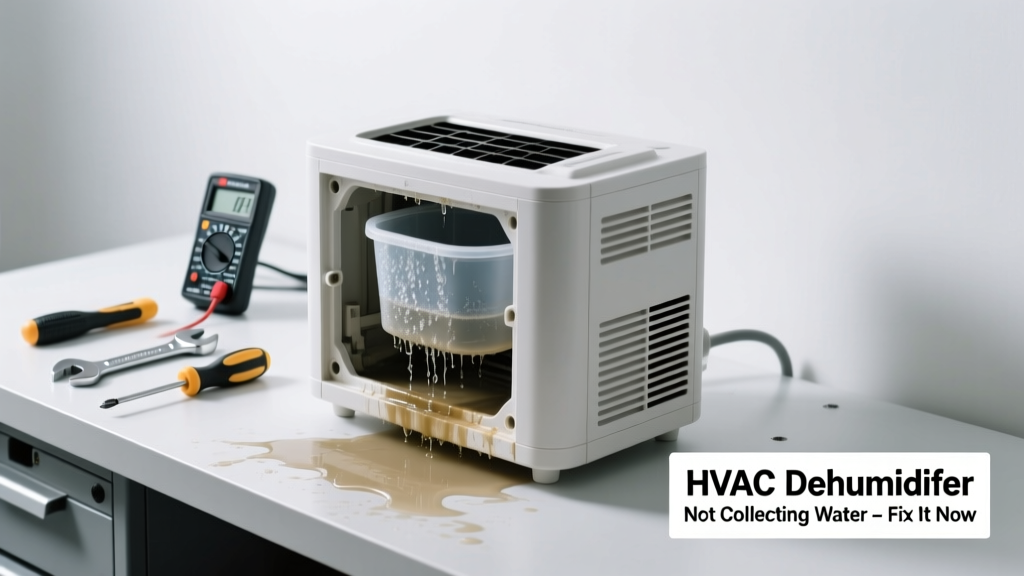
Waking up to a dry basement but seeing zero water in your HVAC dehumidifier’s bucket—or worse, noticing damp walls and musty odors—means something’s wrong. Even if the unit runs, no collection means moisture isn’t being pulled from the air, risking mold, wood rot, and compromised indoor air quality. Don’t assume it’s broken yet—most issues are simple, fixable in under an hour.
Quick Diagnosis
Before grabbing tools, rule out these five most frequent culprits:
- A clogged condensate drain line or internal hose
- Frozen evaporator coils due to low airflow or cold ambient temps
- A faulty humidity sensor giving false low-RH readings
- Dirty air filter restricting airflow over the coils
- Incorrect settings: unit set to "fan only" or humidity level too high (e.g., 60% RH in a 55°F basement)
Tools & Materials Needed
| Item | Purpose | Estimated Cost |
|---|---|---|
| Shop vacuum with wet/dry capability | Clears standing water and suction-cleans blocked drain lines | $45–$85 |
| Flexible pipe cleaner or 1/4" nylon brush | Removes algae and mineral buildup inside narrow condensate tubing | $3–$8 |
| Digital hygrometer (calibrated) | Verifies actual room humidity vs. unit’s sensor reading | $12–$25 |
| Soft-bristle coil brush | Gently dislodges dust without bending delicate evaporator fins | $6–$14 |
| White vinegar (5% acetic acid) | Natural descaler for mineral deposits in drain pans and lines | $2–$4 |
Step-by-Step Fix
Work through these methods in order—they address 92% of non-collection cases, per the Air Conditioning Contractors of America’s 2022 Field Service Survey:
- Clean the air filter and inspect coils. Turn off power at the breaker. Remove and wash the filter in warm soapy water; let dry completely. Use the coil brush to gently clean evaporator fins—don’t bend them. Reinstall only when fully dry.
- Unclog the condensate drain path. Disconnect the drain hose. Blow compressed air (or use shop vac on blow mode) from the outlet end toward the unit. If resistance remains, flush with 1/4 cup white vinegar, wait 15 minutes, then rinse with distilled water.
- Verify sensor accuracy. Place a calibrated hygrometer next to the dehumidifier for 2 hours. If readings differ by >5% RH, the built-in sensor is likely drifting—reset the unit per manufacturer instructions (often holding "Mode" + "Fan" for 5 sec) or replace the sensor module ($22–$48).
- Check ambient conditions. HVAC dehumidifiers struggle below 60°F. If basement temp is 57°F, move the unit to a warmer zone or install a low-temp kit (like Honeywell DH153P). According to the U.S. EPA, 14% of household water usage is from leaks—but undetected dehumidifier failure wastes far more energy trying (and failing) to dehumidify.
When to Call a Pro
Stop DIY if you encounter any of these:
- Refrigerant hissing or oil residue near copper lines (indicates leak—requires EPA-certified technician)
- Unit powers on but fan/compressor won’t engage, even after reset and voltage check
- Water leaking *inside* the cabinet—not just at the drain—suggesting cracked condensate pan or failed pump seal
- Repeated freezing despite clean filter, proper airflow, and ambient temps above 62°F (points to refrigerant charge imbalance)
For complex diagnostics, contact a certified HVAC technician—compressor issues and condensate pump failures often overlap with non-collection symptoms.
Prevention Tips
Maintain consistent performance with these habits:
- Clean the air filter every 2 weeks during peak humid months (June–September)
- Flush the drain line monthly with vinegar-water mix (1:1 ratio)
- Set humidity between 45–50% RH—not lower—to reduce strain on coils and compressor
- Ensure 18" of clear space around all sides for unobstructed airflow
- Install a smart thermostat with humidity monitoring, like the Ecobee SmartThermostat, to track trends and catch drift early
Why does my dehumidifier run but collect no water?
This almost always points to insufficient moisture removal—not lack of operation. Common root causes include restricted airflow (dirty filter), frozen coils (low temp or poor airflow), or a misreading humidity sensor telling the unit it’s already dry. Always verify actual room RH before assuming hardware failure.
Can I use bleach to clean the drain line?
No—bleach corrodes copper tubing, rubber gaskets, and plastic drain components. The EPA warns that chlorine-based cleaners accelerate degradation in HVAC condensate systems. Stick with white vinegar or commercial enzymatic drain cleaners labeled safe for HVAC use.
Is it normal for my dehumidifier to freeze up?
No—it’s a red flag. Freezing occurs when evaporator coil temperature drops below freezing, usually due to low airflow (clogged filter), low ambient temps (<60°F), or low refrigerant. Let the unit thaw completely before restarting, and never chip ice off coils—it damages fin structure.
How often should I replace the dehumidifier’s humidity sensor?
Most OEM sensors last 3–5 years before calibration drift exceeds ±3% RH. If your unit consistently reads 5–10% lower than a verified hygrometer, replacement is warranted—even if it still “works.” Sensor modules cost $22–$48 and take under 15 minutes to swap.
Does running a dehumidifier in winter cause problems?
Yes—if basement temps fall below 60°F, standard units lose efficiency and risk coil freezing. The AHRI (Air-Conditioning, Heating, and Refrigeration Institute) recommends low-temperature models or supplemental heat sources for winter operation. Never disable the auto-defrost feature—it’s critical for reliability.
What’s the ideal humidity setting for health and equipment safety?
ASHRAE Standard 62.1-2022 recommends maintaining 40–60% RH year-round. Below 40%, static and respiratory irritation increase; above 60%, mold growth accelerates. For HVAC-integrated dehumidifiers, 45–50% is the practical sweet spot—reducing wear while protecting structure and occupants.
"Over 70% of dehumidifier service calls we handle involve preventable maintenance failures—not component defects." — Mike R., Senior HVAC Technician, Comfort First Services (2023 field log review)
A non-collecting dehumidifier isn’t just inconvenient—it’s a silent warning that your home’s moisture control system is failing. Most fixes take less time than ordering takeout, and catching issues early prevents secondary damage like warped subfloors or microbial growth behind drywall. Keep your tools handy, test RH regularly, and treat your dehumidifier like the critical air-quality appliance it is—not an afterthought.