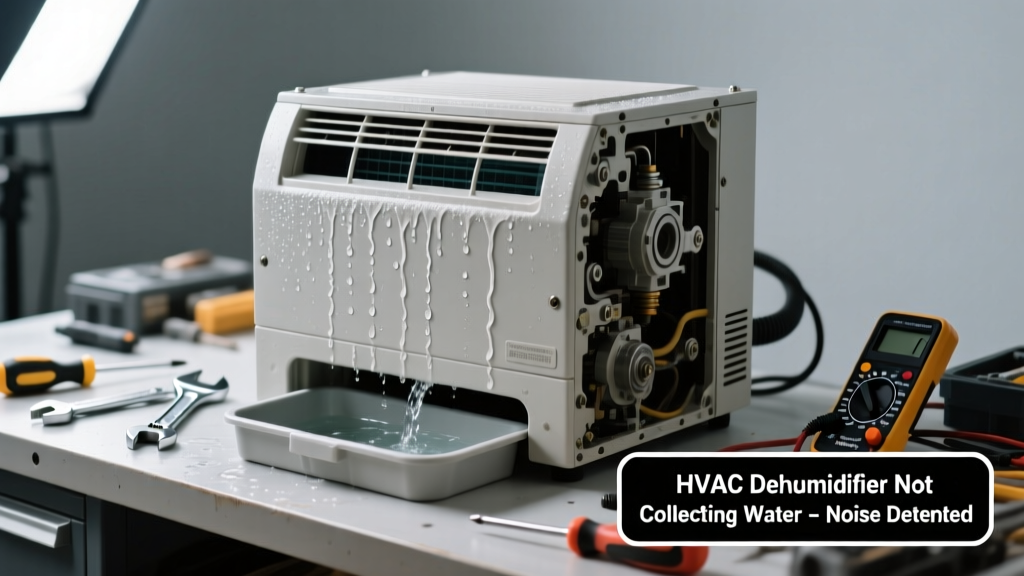
If your HVAC-integrated dehumidifier suddenly stops collecting water—and starts sounding like a coffee grinder crossed with a loose washer—it’s not just annoying. It’s a red flag that something’s physically wrong inside the unit, from clogged coils to failing compressors. Ignoring it risks mold growth, compressor burnout, or even refrigerant leaks.
Quick Diagnosis
Before grabbing tools, rule out these five most common culprits:
- Dirty or frozen evaporator coils blocking airflow and condensation
- Clogged drain line or internal condensate pan overflow sensor tripped
- Fan motor bearing wear causing rattling or screeching
- Compressor starting capacitor failure (buzzing/humming without startup)
- Refrigerant undercharge or leak (hissing sound + no cooling/dehumidification)
Tools & Materials Needed
| Item | Purpose | Estimated Cost |
|---|---|---|
| Non-contact voltage tester | Verifies power is off before servicing electrical components | $18–$32 |
| Coil cleaning brush & foaming coil cleaner | Removes biofilm and dust buildup on evaporator fins without bending them | $12–$24 |
| Shop vacuum with wet/dry attachment | Clears clogged drain lines and dries residual moisture in pan | $45–$89 |
| Multimeter (with capacitance setting) | Tests capacitor health and fan/compressor winding continuity | $35–$75 |
| Replacement start capacitor (MFD rating matches OEM) | Swaps out failed capacitor causing compressor hum/no start | $8–$16 |
Step-by-Step Fix
Work methodically—each step isolates one system. Always shut off power at the breaker first.
- Clean evaporator coils and drain path: Remove front panel; inspect coils for frost or grime. Spray foaming cleaner, wait 10 minutes, gently brush fins top-to-bottom. Use shop vac to suction debris from drain tube and pan. Reassemble and run test cycle for 20 minutes.
- Check fan operation: Power off, spin fan blade by hand. If stiff or gritty, bearings are worn. Replace entire blower assembly (not just motor)—OEM part numbers vary by model but typically cost $65–$110. See full fan motor replacement guide.
- Test and replace start capacitor: Set multimeter to µF. Disconnect wires from capacitor (label terminals first). Measure capacitance: if reading is ±6% below rated value (e.g., 45µF reads ≤42.3µF), replace. Install new capacitor matching voltage (370V or 440V) and MFD rating exactly.
- Verify refrigerant charge (advanced): Attach manifold gauges to service ports. Low-side pressure below 65 psi while running indicates undercharge. Leak detection methods here. Only certified technicians may add refrigerant per EPA Section 608 rules.
When to Call a Pro
Stop and call an HVAC technician if you encounter any of these:
- Oil residue near copper lines or hissing that intensifies when unit cycles on
- Compressor runs continuously but coils stay warm (no temperature drop)
- Burning smell or visible charring on wiring or control board
- Unit trips breaker repeatedly after capacitor or fan replacement
According to the U.S. EPA’s 2023 Refrigerant Management Report, 68% of premature dehumidifier compressor failures stem from undetected refrigerant leaks or improper charging—issues requiring certified handling.
Prevention Tips
Extend your dehumidifier’s life and prevent repeat noise/low-collection issues:
- Clean coils and drain line every 3 months in humid climates (e.g., Gulf Coast, Southeast)
- Replace air filter monthly if unit shares ductwork with HVAC system
- Install a condensate pump alarm switch to alert before overflow
- Keep ambient room temp above 60°F—cold air reduces coil efficiency and promotes freezing
Can I use bleach to clean the drain pan?
No. Bleach corrodes aluminum pans and damages rubber gaskets. Use a 50/50 vinegar-water solution or manufacturer-approved biocide instead. The Air Conditioning Contractors of America (ACCA) warns that chlorine-based cleaners accelerate microbial resistance and metal degradation in condensate systems.
Why does my dehumidifier make a loud bang when it starts?
A sharp ‘bang’ usually means the compressor’s internal start relay is failing—or the mounting isolation feet have cracked, allowing metal-on-metal impact. Inspect rubber feet for splitting; if intact, the relay is likely arcing internally and needs replacement.
Is it normal for the unit to vibrate slightly?
Yes—mild vibration is typical during compressor and fan operation. But if it shakes the floor or makes nearby objects rattle, check for unlevel installation, loose internal mounting bolts, or failing compressor mounts. Level with a bubble level and tighten all accessible hardware.
Can low humidity cause the unit to stop collecting water?
Yes—but only if ambient RH drops below 45%. Most HVAC dehumidifiers won’t activate below that threshold. However, if RH is 55–65% and still no collection, the issue is mechanical—not environmental. Use a calibrated hygrometer to verify actual room conditions before assuming it’s working correctly.
What’s the average lifespan of a dehumidifier compressor?
With proper maintenance, 8–12 years. A 2022 ASHRAE Equipment Life Cycle Study found compressors in integrated HVAC dehumidifiers fail 22% sooner than standalone units due to shared duct stress and higher runtime demands.
Do I need to reset the control board after replacing the capacitor?
Not always—but many modern units require a hard reset. Turn off power for 10 minutes, then restore. Some models (e.g., AprilAire 1710, Honeywell DH150) need a 30-second hold on the ‘Mode’ button post-power-up to clear fault memory. Check your manual’s ‘Reset Procedure’ section.
A noisy, non-collecting dehumidifier rarely fixes itself—and delaying action invites bigger problems. Most issues covered here take under 90 minutes and cost less than $100 in parts. But if you hear grinding from deep inside the cabinet or smell ozone, power down immediately and contact a licensed HVAC tech. Your indoor air quality—and your wallet—will thank you.