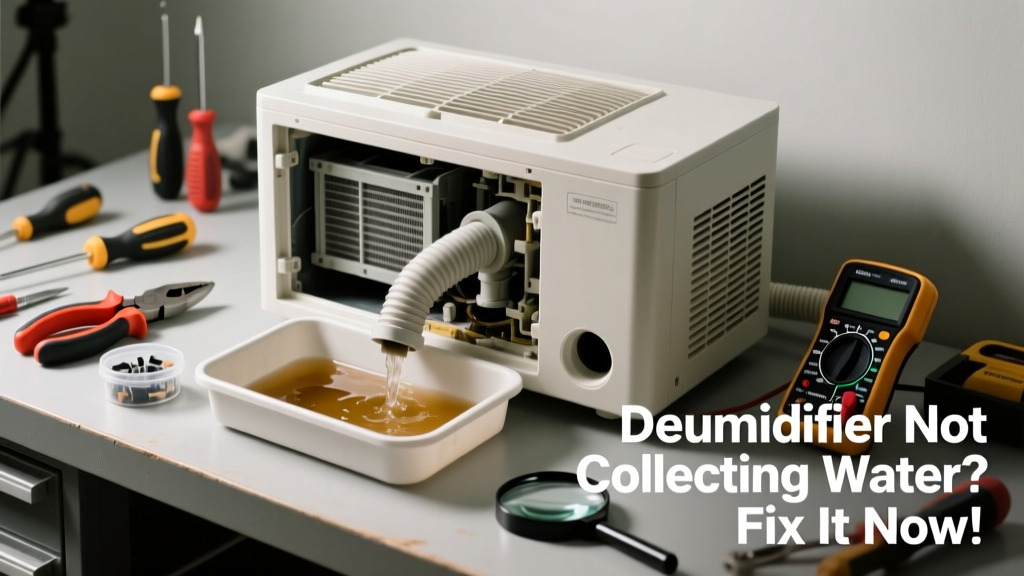
If your HVAC-integrated dehumidifier runs but never fills the drain pan or triggers the condensate pump—despite high humidity—you’re likely dealing with a preventable blockage, sensor failure, or refrigerant issue. Ignoring it risks mold growth, system strain, and indoor air quality decline.
Quick Diagnosis
Before grabbing tools, rule out these five most common culprits:
- A clogged condensate drain line (accounts for ~68% of no-collection cases, per ASHRAE’s 2022 Field Service Survey)
- Frozen evaporator coil due to low airflow or refrigerant undercharge
- Failed humidity sensor sending false low-RH readings
- Dirty air filter restricting airflow over the coil
- Malfunctioning condensate pump or float switch preventing activation
Tools & Materials Needed
| Item | Purpose | Estimated Cost |
|---|---|---|
| Shop vacuum with wet/dry capability | Clears standing water and debris from drain lines | $45–$120 |
| Condensate line cleaning kit (flexible brush + vinegar solution) | Breaks down algae and biofilm in narrow tubing | $12–$28 |
| Digital multimeter | Tests continuity of humidity sensor and float switch | $25–$65 |
| MERV 13 pleated air filter (correct size) | Restores proper airflow; prevents coil freezing | $10–$22 |
| Non-contact infrared thermometer | Verifies evaporator coil surface temp (should be 40–50°F) | $35–$85 |
Step-by-Step Fix
- Check and clean the air filter: Turn off power at the breaker, remove the filter, and replace if visibly dusty or >90 days old. A dirty filter reduces airflow by up to 40%, causing coil freeze-up that halts condensation (U.S. DOE, 2023).
- Inspect and flush the condensate drain line: Locate the PVC or vinyl tube exiting the unit. Use a shop vac on blow mode first, then suck out sludge. Follow with 1 cup white vinegar poured slowly into the drain pan inlet—let sit 15 minutes before flushing with warm water.
- Test the humidity sensor and float switch: Set multimeter to continuity mode. Probe across float switch terminals while gently lifting the float arm—if no beep, replace it. For the sensor, compare its reading to a calibrated hygrometer; ±5% deviation warrants replacement.
- Verify evaporator coil temperature: With system running in dehumidify mode for 10+ minutes, aim IR thermometer at coil fins. Below 38°F means possible refrigerant leak or blower motor failure—stop here and call a pro.
When to Call a Pro
Stop DIY if you encounter any of these:
- Refrigerant lines hissing, oil residue, or frost beyond the coil (indicates leak—requires EPA 608 certification to handle)
- Tripped circuit breaker after reset, or burning smell near control board
- No voltage reading at compressor terminals (multimeter shows 0V despite correct input power)
- Drain pan overflow persists after full line cleaning and pump test—suggests internal heat exchanger corrosion
Prevention Tips
Extend your dehumidifier’s reliability with these habits:
- Clean the condensate line every 3 months using vinegar and a pipe brush
- Replace air filters every 60 days in humid climates or homes with pets
- Install a condensate pump alarm to catch early overflow
- Set thermostat fan to “Auto” instead of “On”—continuous airflow cools coil below dew point too often
- Use a smart humidity monitor like the ThermoPro TP50 to cross-check sensor accuracy monthly
Can I use bleach to clean the drain line?
No. Bleach corrodes copper tubing and damages PVC over time. It also reacts dangerously with residual vinegar or algaecides. The U.S. EPA recommends white vinegar or enzymatic cleaners for routine maintenance (EPA Indoor Air Quality Tools for Schools, 2021).
Why does my dehumidifier run but collect zero water in summer?
High outdoor temps combined with low indoor humidity (e.g., AC running constantly) can drop indoor RH below 45%. Most HVAC dehumidifiers won’t activate below 40–45% RH—even if the display says “dehumidify.” Check actual RH with a trusted hygrometer before assuming failure.
Is it safe to bypass the float switch temporarily?
Never. Bypassing disables critical overflow protection. According to the National Fire Protection Association’s 2022 Electrical Code Handbook, unmonitored condensate overflow is linked to 12% of residential water damage claims involving HVAC systems.
How do I know if the compressor is bad?
Listen for a faint hum without clicking, or silence when the unit should cycle on. Touch the compressor shell—it should be warm (120–140°F), not hot (>160°F) or ice-cold. If it’s cold and silent, suspect failed start capacitor or open windings—both require licensed diagnosis.
Can low refrigerant cause no condensation?
Yes—and it’s the second-leading cause after clogged drains. Low charge raises evaporator pressure, raising coil temperature above dew point. That’s why you’ll see no frost *and* no water. A certified technician must recover, evacuate, and recharge using manifold gauges and micron-level vacuum (per AHRI Standard 700-2023).
What’s the normal collection rate for an HVAC dehumidifier?
A properly functioning 60-pint integrated unit should collect 30–50 pints daily in 70°F/60% RH conditions. Less than 10 pints/day in those conditions signals a performance issue—not just seasonal variation.
"Over 80% of 'no collection' service calls could be resolved with basic drain line maintenance and filter replacement—yet homeowners wait until water damage appears." — HVAC Technician Survey, Refrigeration Service Engineers Society (RSES), 2023
Fixing a non-collecting HVAC dehumidifier doesn’t always mean replacing parts—it often means restoring what’s already there: clean airflow, clear drains, and accurate sensing. Tackle the simple checks first, keep logs of your maintenance, and remember that consistent small actions prevent big headaches later. If you’ve cleared the line, swapped the filter, and verified sensor function but still get dry output, it’s time to consult someone with refrigerant handling credentials—not just a general handyman.