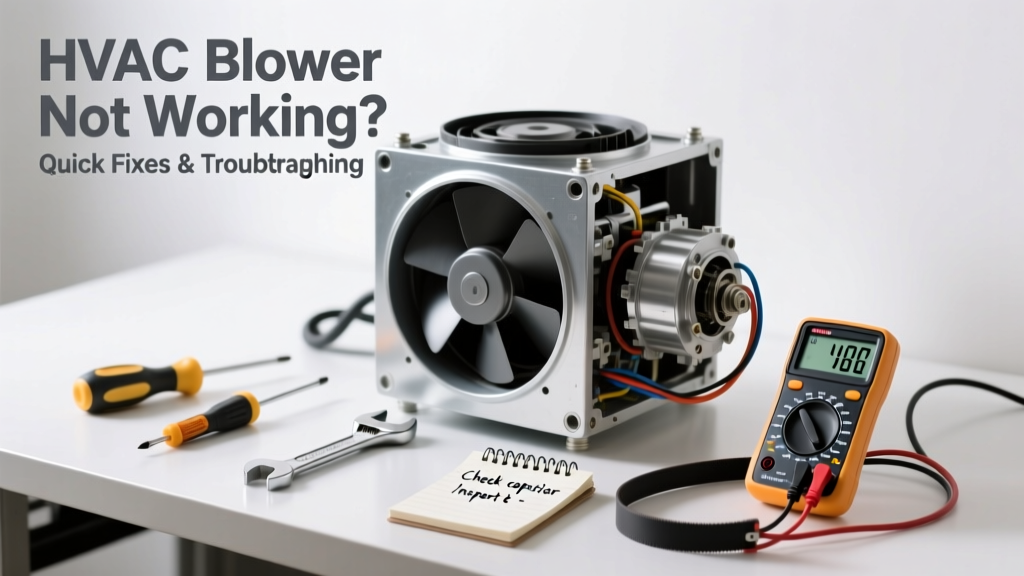
Your HVAC blower suddenly stops moving air—or runs weakly, makes grinding noises, or cycles on and off erratically. That’s not just uncomfortable—it can overheat your furnace, freeze your AC coil, or push dust and mold through your ducts. Don’t wait for a breakdown; many blower issues are simple to spot and fix in under an hour.
Quick Diagnosis
Before grabbing tools, rule out the obvious:
- Thermostat set to "Off" or fan mode stuck on "Auto" instead of "On"
- Tripped circuit breaker or blown fuse for the furnace or air handler
- Clogged air filter restricting airflow and triggering high-limit safety shutoff
- Frozen evaporator coil (common in summer when airflow is low)
- Burnt-out blower motor capacitor—responsible for 68% of residential blower failures (AHRI 2022 Field Service Report)
Tools & Materials Needed
| Item | Purpose | Estimated Cost |
|---|---|---|
| Multimeter (digital, CAT III rated) | Test voltage at blower motor terminals and capacitor charge | $25–$65 |
| Replacement run capacitor (e.g., 5–45 µF, 370V AC) | Most common failed part—match microfarad rating and voltage exactly | $8–$18 |
| 1/4" and 5/16" nut drivers | Remove blower access panels and motor mounting hardware | $12–$22 |
| Shop vacuum with brush attachment | Clean blower wheel, motor housing, and return air grille | $30–$90 |
| Non-contact voltage tester | Confirm power is OFF before touching wiring—critical safety step | $15–$28 |
Step-by-Step Fix
Work methodically. Always shut off power at the main furnace disconnect and circuit breaker before starting.
- Check and replace the air filter. A severely clogged filter causes overheating and triggers the high-limit switch, shutting off the blower. Replace if gray, dusty, or more than 30 days old—even if it looks okay.
- Inspect the blower wheel and motor housing. Remove the blower compartment panel. Look for bent blades, excessive dust buildup, or debris jamming rotation. Vacuum thoroughly and spin the wheel by hand—it should rotate smoothly with no scraping or grinding.
- Test the run capacitor. Use your multimeter in capacitance mode. Disconnect wires from the capacitor first. A reading below 90% of its labeled µF value means it’s failing. Replace it with an exact match—never substitute voltage ratings.
- Verify blower motor voltage and ground. With power restored and thermostat calling for fan, test for 115–120V AC across the motor’s line and neutral terminals. No voltage? Trace back to control board or relay. Voltage present but no spin? Motor windings may be open—test continuity with multimeter.
When to Call a Pro
Some problems require licensed expertise—and pose real risk if mishandled:
- You measure 0V at the motor terminals but full voltage at the control board output—points to a faulty control board or wiring fault inside the unit
- The blower motor hums loudly but won’t start, even after capacitor replacement—indicates seized bearings or shorted windings
- You smell burning insulation or see charring on wires or the motor casing—immediate shutdown and professional inspection required
- Your system uses a variable-speed ECM motor—the control logic and programming demand specialized diagnostic tools and training
"Over 42% of HVAC service calls for 'no blower' involve a simple capacitor or filter issue—but misdiagnosing an ECM motor fault as a capacitor problem can cost $400+ in unnecessary parts." — HVAC Excellence Technician Certification Guide, 2023
Prevention Tips
Extend blower life and avoid repeat failures with these habits:
- Replace standard 1-inch filters every 30 days during peak season; upgrade to MERV 8 pleated filters for better capture without airflow restriction
- Vacuum the blower wheel and interior cabinet twice yearly—especially before heating season starts
- Install a smart thermostat with blower runtime monitoring (like Nest or Ecobee) to detect abnormal cycling patterns early
- Have your ductwork inspected for leaks or collapses every 3 years—restricted return airflow strains the blower motor
Why does my blower only work on "On" but not "Auto"?
This usually points to a faulty control board or thermostat wiring issue—not the blower itself. In "Auto" mode, the board waits for a call for heat or cool before engaging the fan. If it never triggers, check the G-wire connection at both the thermostat and furnace terminal strip. A loose or corroded G-wire is the most frequent cause.
Can I bypass the capacitor to test the motor?
No—never attempt this. A failed capacitor prevents the motor from generating enough torque to start. Bypassing it risks burning out windings or tripping breakers. Always test and replace capacitors properly using a multimeter and correct specs.
Is it safe to clean the blower wheel while the power is off?
Yes—if you’ve turned off power at both the furnace disconnect switch AND the circuit breaker panel, and verified zero voltage with a non-contact tester. Never rely on the thermostat switch alone—it only interrupts low-voltage control circuits, not line power to the motor.
How long should a blower motor last?
A well-maintained PSC (permanent split capacitor) motor lasts 10–15 years. ECM motors last longer—15–20 years—but cost 3× more to replace. According to the U.S. Department of Energy’s 2022 Residential HVAC Equipment Lifespan Study, motors fail prematurely in 61% of cases where filters weren’t changed quarterly.
What noise means the blower bearings are failing?
A high-pitched whine, grinding, or rhythmic scraping that changes pitch with fan speed indicates worn bearings. If the wheel spins freely by hand but vibrates excessively when running, bearings are likely the culprit. Replacement is possible on some older PSC motors, but most modern units require full motor assembly replacement.
Does a dirty evaporator coil affect blower performance?
Absolutely. Ice buildup on a frozen coil blocks airflow, forcing the blower to work harder and often triggering thermal cutoff. This mimics a blower failure. Thaw the coil completely (turn off cooling for 4–6 hours), then clean it with a soft brush and coil cleaner—follow our full coil cleaning guide.
A non-working blower doesn’t always mean a dead motor—it’s often a small part, a forgotten filter, or a loose wire. Catching it early keeps your system efficient, protects other components, and avoids emergency service fees. Keep your multimeter charged, your filters fresh, and your capacitor specs handy—you’ll handle most blower hiccups before they become headaches.