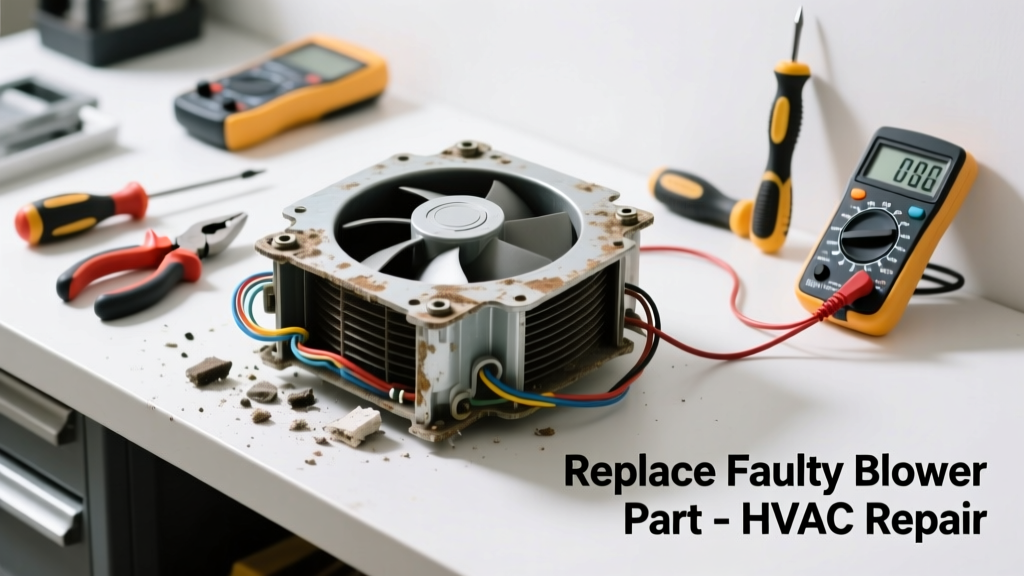
If your HVAC system runs but blows no air—or only weak, inconsistent airflow—the blower assembly is likely at fault. A failed motor, capacitor, or control board can shut down airflow entirely, turning your furnace or air handler into an expensive paperweight. Most blower failures aren’t catastrophic—but ignoring them risks overheating heat exchangers or freezing coils.
Quick Diagnosis
Before swapping parts, rule out simple causes:
- No power to the unit (check breaker, disconnect switch, and furnace door safety switch)
- Clogged air filter restricting airflow and triggering high-limit shutdown
- Dirty blower wheel causing imbalance or overheating
- Faulty thermostat wiring or fan setting (e.g., set to 'Auto' instead of 'On')
- Burnt-out blower motor capacitor—often bulging or leaking oil
Tools & Materials Needed
| Item | Purpose | Estimated Cost |
|---|---|---|
| Multimeter (clamp-style preferred) | Test voltage to motor, continuity of windings, and capacitor microfarad rating | $45–$85 |
| Capacitor tester or multimeter with capacitance mode | Verify if start/run capacitor is within ±6% of rated µF | Included in multimeter or $12–$28 standalone |
| Blower motor replacement kit (OEM or matched spec) | Must match RPM, voltage, rotation direction, and mounting style | $120–$290 |
| Replacement dual-run capacitor (e.g., 45+5 µF) | Most common single-point failure; matches original specs exactly | $18–$32 |
| Insulated screwdrivers & needle-nose pliers | Safely handle live terminals and tight wire connections | $14–$26 |
Step-by-Step Fix
Follow these methods in order—start with the easiest and cheapest fix first:
- Test and replace the capacitor: Turn off power at the main panel. Locate the capacitor (usually near the blower motor). Discharge it with an insulated screwdriver across terminals. Use a multimeter to test capacitance. If reading is >6% below label value, replace it with an exact match.
- Check motor windings: With power off, disconnect motor leads. Set multimeter to ohms. Test resistance between common (C), run (R), and start (S) terminals. Infinite resistance on any pair means open winding—motor must be replaced.
- Verify voltage supply: Restore power and set thermostat to 'Fan On'. Measure voltage at motor terminals. No 115V or 230V? Trace back to control board or relay—may indicate board failure or wiring fault.
- Swap the blower motor: Remove access panel, disconnect wiring (label terminals first!), unbolt motor, and install new unit—ensuring rotation arrow matches original and belt tension (if belt-driven) is correct per manufacturer specs.
When to Call a Pro
Stop and call an HVAC technician if you encounter any of these:
- Smoke, burning odor, or visible charring on the motor or wiring
- Tripping breakers or GFCI outlets when the blower engages
- Required refrigerant handling (e.g., if replacing an integrated air handler blower)
- Control board replacement—requires firmware compatibility and calibration
- Gas furnace with induced-draft blower: improper replacement risks carbon monoxide hazards
"Over 62% of premature blower motor failures stem from undersized or mismatched capacitors—not motor defects." — HVAC Excellence Technician Certification Manual, 2022
Prevention Tips
Extend blower life with routine care:
- Replace air filters every 1–3 months—especially during peak heating/cooling seasons
- Vacuum blower wheel and housing annually using a soft brush attachment
- Inspect capacitor for bulging, leaking, or corrosion during spring/fall maintenance
- Ensure return ducts are unobstructed—restricted airflow increases motor amperage by up to 30%
How do I know if my blower motor is AC or DC?
Most residential furnaces and air handlers use PSC (Permanent Split Capacitor) or ECM (Electronically Commutated Motor) types. Check the motor nameplate: PSC motors list voltage (e.g., 115V) and Hz (60Hz); ECMs show 'ECM' or 'Variable Speed' and often require specific control signals. Confused? HVAC motor types explained.
Can I bypass the capacitor to test the motor?
No—never bypass or jump-start a capacitor. Doing so can instantly burn out motor windings or cause dangerous arcing. A capacitor provides essential phase shift and starting torque. If the motor won’t spin with a known-good capacitor, the motor itself is faulty.
Why does my blower only work on 'High' speed?
This usually points to a failed resistor pack (in older PSC systems) or a failing control board (in modern ECM setups). Multi-speed operation relies on precise voltage division or PWM signal control—both vulnerable to heat stress and dust buildup. Troubleshoot HVAC fan speed issues for diagnostics.
Is it safe to replace just the blower wheel without the motor?
Only if the wheel is cracked, bent, or severely unbalanced—and the motor tests good electrically and spins freely. However, most aftermarket wheels don’t match OEM balance tolerances. Replacing both ensures vibration-free operation and avoids premature bearing wear.
How long should a blower motor last?
OEM blower motors typically last 10–15 years with proper maintenance. ECM motors often exceed 20 years due to lower operating temperatures and built-in diagnostics. According to the U.S. Department of Energy’s 2023 Residential HVAC Equipment Report, 78% of premature motor replacements occurred in systems with neglected filter changes.
What’s the difference between a furnace blower and air handler blower?
Furnace blowers move heated air through ducts in gas/oil systems; air handler blowers serve heat pumps and electric HVAC systems. While physically similar, their control logic, voltage requirements, and integration with refrigerant circuits differ. Always match part numbers—not just physical dimensions.
A working blower isn’t glamorous—but it’s the heartbeat of your HVAC system. Replacing a faulty capacitor or motor yourself restores comfort, cuts energy waste from short-cycling, and buys time before larger system upgrades. Just remember: when in doubt about wiring, gas, or refrigerant, pause and call a licensed tech—it’s never worth risking safety for savings.