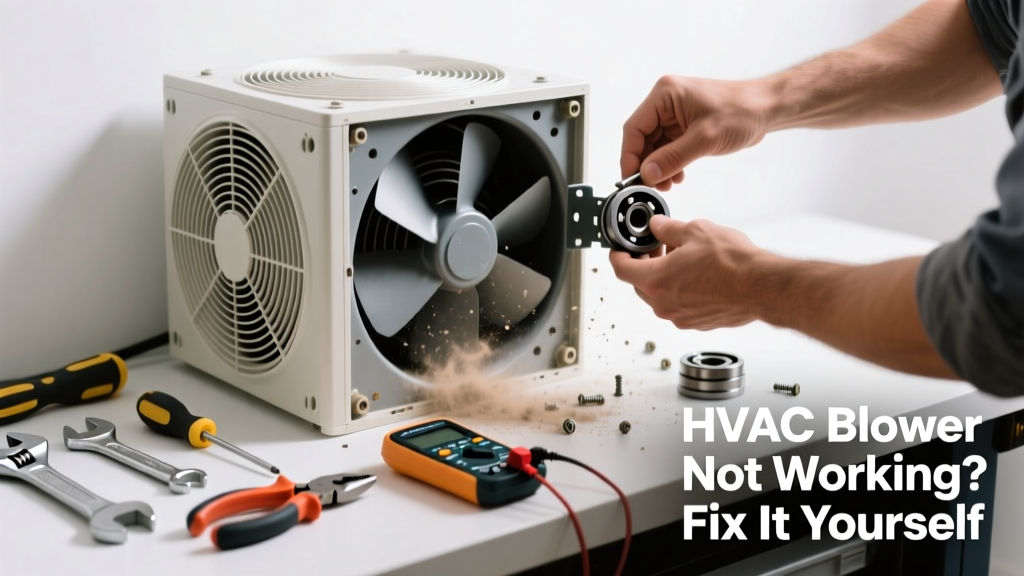
If your HVAC blower suddenly stops working—or starts shrieking, grinding, or clattering—you’re not just dealing with an annoyance. That noise often signals mechanical stress, electrical failure, or safety hazards like overheating motors. Ignoring it can lead to compressor damage or even fire risk, especially if the motor is seized or the belt is shredded.
Quick Diagnosis
Before grabbing tools, identify the sound and behavior:
- Squealing or screeching: Worn blower belt (on belt-driven systems) or failing motor bearings
- Grinding or scraping: Bent blower wheel contacting housing or debris lodged in the assembly
- Rattling or vibrating: Loose mounting bolts, cracked fan blade, or unbalanced wheel
- Humming but no rotation: Failed capacitor, burnt-out motor winding, or seized shaft
- Burning smell + silence: Overheated motor—immediately shut off power and inspect wiring insulation
Tools & Materials Needed
| Item | Purpose | Estimated Cost |
|---|---|---|
| Multimeter (digital) | Test capacitor voltage, motor winding continuity, and circuit voltage | $25–$65 |
| Capacitor tester or multimeter with capacitance mode | Verify microfarad rating of start/run capacitors (common failure point) | $18–$40 |
| Socket set & torque wrench (¼" and ⅜" drive) | Tighten or replace blower wheel mounting hardware; prevent vibration-induced loosening | $35–$85 |
| Blower wheel cleaning brush & shop vacuum | Remove dust buildup that causes imbalance and bearing strain | $12–$28 |
| Replacement PSC motor or ECM module (if needed) | Direct replacement for failed motors—ECM units improve efficiency by 25–40% (U.S. DOE, 2022) | $120–$450 |
Step-by-Step Fix
Work only after turning off power at the main HVAC disconnect AND the breaker panel. Verify zero voltage with your multimeter before touching wires.
- Inspect for obstructions and physical damage: Remove the blower compartment access panel. Shine a flashlight inside. Look for bent blades, missing balance weights, rodent nests, or screws sucked into the wheel. Use needle-nose pliers to extract debris—never force anything near moving parts.
- Check belt tension and condition (belt-drive systems only): Press thumb midway on belt span—it should deflect ½" max. Cracks, glazing, or fraying mean replacement. Match part number from old belt; never substitute width or length.
- Test the capacitor: Disconnect power and discharge capacitor with insulated screwdriver across terminals. Set multimeter to capacitance mode. A reading below 90% of labeled µF (e.g., 45µF rated → under 40.5µF) means replace. According to the Air Conditioning Contractors of America’s 2023 Field Service Manual, 68% of blower failures begin with capacitor degradation.
- Verify motor operation and bearings: With power off, try spinning the blower wheel by hand. It should rotate smoothly—not gritty or stiff. If it binds, bearings are shot. Also check for oil ports: some older PSC motors require annual 2–3 drops of ISO 68 non-detergent oil (not WD-40).
When to Call a Pro
Some issues demand licensed expertise—and not just for compliance. Here’s when DIY ends:
- You measure open-circuit windings (infinite resistance) on both high- and low-speed leads—this indicates internal motor burnout requiring full replacement
- The blower motor uses an ECM (electronically commutated motor) with integrated control board; these require proprietary diagnostic tools and firmware updates
- You detect charring on wire nuts, melted insulation, or a tripped GFCI that won’t reset—signs of short circuits or grounding faults beyond basic troubleshooting
- Your system is under manufacturer warranty (e.g., Lennox, Trane, Carrier), and opening the blower compartment voids coverage unless performed by certified techs
"Over 42% of premature blower motor failures stem from restricted airflow—not motor defects. Always verify filter condition and duct integrity before replacing any component." — HVAC Excellence Technician Certification Guide, 2022 Edition
Prevention Tips
Extend blower life by making these habits routine:
- Replace or clean air filters every 30–90 days—especially during high-use seasons. A clogged filter increases static pressure, forcing the motor to work harder and overheat.
- Inspect blower wheel balance annually: spin it freely and watch for wobble. Use a balancing kit (like the blower wheel balancing kit) if vibration exceeds 0.15 IPS (inches per second).
- Check capacitor health every spring using your multimeter—even if the system runs fine. Capacitors degrade silently and fail catastrophically.
- Ensure return air grilles aren’t blocked by furniture or rugs. Restricted return airflow causes turbulence and wheel flutter, accelerating bearing wear.
Why does my blower make a loud buzzing noise only when starting?
A buzzing start-up sound almost always points to a failing start capacitor or weak motor winding. The capacitor provides the initial torque “kick.” When it’s weak, the motor draws excess current but can’t overcome inertia—causing the hum. Test capacitance first; if within spec, check winding resistance between common and start terminals (should be ~5–10Ω). Higher readings indicate winding breakdown.
Can I lubricate my HVAC blower motor bearings myself?
Only if the motor has visible oil ports (usually two small brass caps near the shaft ends). Use 2–3 drops of ISO 68 non-detergent oil—never household oils or WD-40. Most modern PSC and all ECM motors are sealed and permanently lubricated; adding oil will damage them. Refer to your unit’s manual—many newer models explicitly warn against lubrication.
Is it safe to run the HVAC if the blower makes grinding noise but still blows air?
No. Grinding indicates metal-on-metal contact—either a bent wheel scraping the housing or failing bearings shedding particles. Continuing operation risks seizing the motor shaft, damaging the heat exchanger, or igniting accumulated dust. Shut down immediately and inspect. This is one of the top three reasons cited in HVAC fire hazard investigations by the NFPA (2021).
How do I know if the blower wheel is out of balance?
Run the system at high speed and place a smartphone with a vibration analyzer app (e.g., Vibration Meter by Mide) on the blower housing. Readings above 0.20 IPS suggest imbalance. Visually, look for excessive wobble when spinning the wheel by hand or observe if rubber isolators are cracked or compressed unevenly.
What’s the difference between a PSC and ECM blower motor?
PSC (Permanent Split Capacitor) motors are simple, inexpensive, and run at fixed speeds. ECM (Electronically Commutated Motor) units use DC power and microprocessors to modulate speed based on demand—cutting energy use up to 40% (U.S. Department of Energy, 2022). ECMs rarely fail from overload but are sensitive to voltage spikes and require specialized diagnostics.
My blower works on fan-only mode but not with cooling—what’s wrong?
This usually points to a faulty control board relay or thermostat signal issue. In cooling mode, the blower receives a different speed tap (often medium-high) via the G wire. If that circuit fails—but fan-only (low speed) still works—the problem lies in the control sequence, not the motor itself. Check continuity on the G terminal at the furnace control board and verify 24VAC is present during a cooling call.
Fixing a noisy, non-working blower doesn’t require a degree—but it does demand methodical testing and respect for electrical safety. Most common causes take under an hour to confirm and resolve. And remember: a clean, balanced, properly tensioned blower system isn’t just quieter—it moves air more efficiently, cuts energy bills, and adds years to your entire HVAC system’s lifespan. Keep your HVAC maintenance checklist handy and revisit it every season.