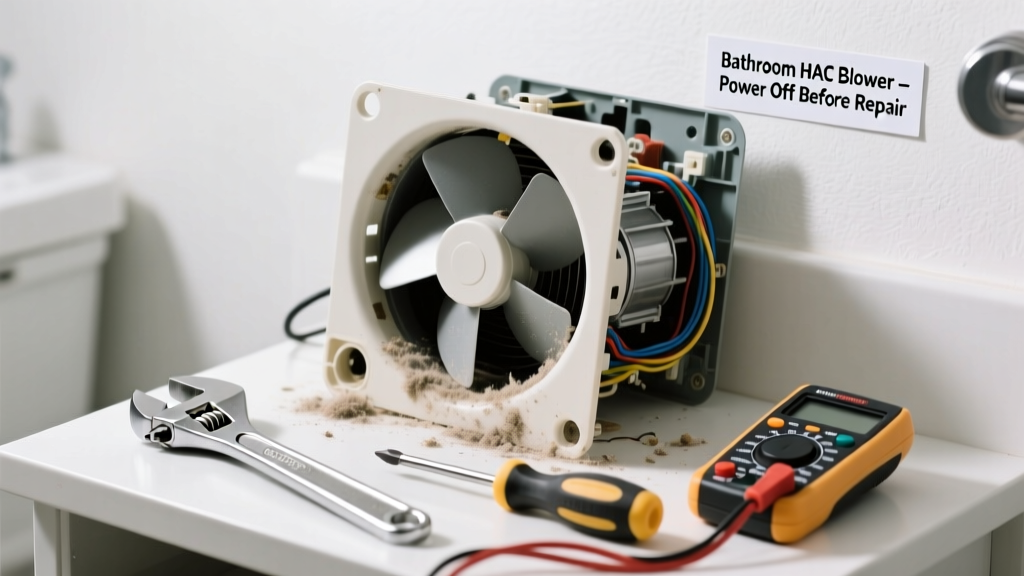
If your bathroom HVAC blower suddenly stops moving air — especially during or after a shower — it’s rarely just a coincidence. Humidity, moisture buildup, and undersized ductwork make bathroom blowers uniquely vulnerable. Ignoring it risks mold growth behind walls and poor ventilation that violates local building codes.
Quick Diagnosis
Before grabbing tools, rule out the obvious culprits:
- Tripped GFCI outlet or circuit breaker powering the unit
- Humidity sensor or timer switch stuck in 'off' mode
- Clogged inline duct filter (often hidden behind the grille)
- Corroded wiring connections at the blower motor terminals
- Faulty wall-mounted humidity-sensing switch (common in newer homes)
Tools & Materials Needed
| Item | Purpose | Estimated Cost |
|---|---|---|
| Digital multimeter | Test voltage at motor leads and switch output | $25–$45 |
| 1/4" hex screwdriver set | Remove grille and access panel screws (many bathroom units use security bits) | $8–$15 |
| Microfiber brush + vacuum crevice tool | Clean dust and lint from squirrel-cage fan blades and housing | $12–$20 |
| Replacement humidity sensor (e.g., Broan 68W) | Direct-fit replacement for common bathroom models | $22–$34 |
| Dielectric grease | Prevent future corrosion on low-voltage terminals | $6–$10 |
Step-by-Step Fix
Follow these methods in order — most issues resolve in under 20 minutes:
- Reset the GFCI and check the dedicated 15A circuit: Bathroom exhaust circuits often share breakers with outlets. Flip the breaker fully off, wait 10 seconds, then back on. Test the GFCI reset button near the sink or mirror.
- Clean the blower assembly: Remove the grille, unscrew the housing, and gently vacuum dust from the squirrel-cage fan. Use the microfiber brush to dislodge hair wrapped around the shaft. Never use compressed air — it forces debris deeper into the motor windings.
- Test the humidity sensor or timer switch: Set your multimeter to AC voltage. With power on, probe the switch’s output wires while triggering the sensor (breathe on it or hold a warm damp cloth nearby). No voltage? Replace the switch.
- Check motor capacitor (if applicable): Some bathroom blowers use a 2–5 µF start capacitor. If the motor hums but doesn’t spin, the capacitor is likely failed. Replace only with same µF rating and voltage (usually 250VAC).
When to Call a Pro
Stop and call an HVAC technician if you encounter any of these:
- No voltage reading at the blower’s input wires — suggests a fault in the branch circuit or junction box upstream
- Burning smell or visible charring on the motor housing or wiring
- Blower runs continuously even when humidity drops below 50% (indicates failed control board)
- Your home uses a central HVAC system with zone-controlled bathroom ducting — tampering may void warranty or unbalance airflow elsewhere
According to the National Fire Protection Association’s 2023 Electrical Safety Report, 22% of residential electrical fires originate in bathrooms — often linked to moisture-damaged fans and improper grounding.
Prevention Tips
Maintain proper airflow and extend blower life with these habits:
- Clean the grille and fan blades every 3 months — especially if you use hair spray or oil-based soaps
- Run the blower for at least 20 minutes after each shower, even if humidity seems low
- Replace disposable inline filters (if equipped) every 6 months — they’re often overlooked but critical in high-moisture zones
- Install a timer switch with adjustable delay (e.g., bathroom exhaust timer install) to ensure post-shower runtime without relying on memory
Can I replace the blower motor myself?
Yes — if it’s a plug-in module like those in Panasonic WhisperGreen or Broan Ultra Silent units. Match the model number exactly; cross-referencing with the manufacturer’s parts diagram is essential. Most motors cost $45–$85 and require only 4 screws and a 3-wire connector. Always disconnect power at the breaker first — not just the wall switch.
Why does my bathroom blower only work when the light is on?
This points to a shared neutral or miswired combo switch. In older homes, electricians sometimes daisy-chained the fan to the light circuit to avoid running new wire. Check the switch box: if both devices are controlled by one toggle, it’s likely wired hot-to-light-to-fan. A dedicated switch or smart relay like the smart bathroom fan control fixes this permanently.
Is it safe to run the blower while the bathroom door is closed?
Yes — and recommended. Closed doors create negative pressure that pulls air from other rooms, including potentially from attics or crawlspaces. The U.S. EPA estimates that 14% of household water usage is from leaks, but poor ventilation contributes just as heavily to hidden moisture damage. Running the fan with the door closed ensures full air exchange per ASHRAE 62.2 standards.
How do I know if my duct is blocked?
Hold a tissue 2 inches from the grille while the fan runs. If it doesn’t flutter steadily — or flutters weakly only at the edges — suspect a blockage. Common spots: flexible duct kinks behind the ceiling, bird nests in roof vents, or insulation sucked into the duct collar. Inspect the exterior vent cap for flapper movement; if it’s frozen open or stuck shut, replace it.
Can I use bleach on the blower housing to kill mold?
No. Bleach corrodes aluminum housings and damages motor windings. Instead, wipe down non-electrical surfaces with a 50/50 white vinegar-water solution, then dry thoroughly. For confirmed mold inside ductwork, hire a certified IAQ specialist — the EPA’s Indoor Air Quality Tools for Schools Guide (2022) prohibits biocides in occupied spaces without containment.
What’s the average lifespan of a bathroom blower?
7–10 years with regular cleaning, but drops to 3–5 years in high-humidity, poorly ventilated bathrooms. Units installed over tubs or showers fail fastest due to direct steam exposure. Upgrade to a humidity-sensing model with sealed bearings (e.g., Panasonic FV-0511VKS) for longer service life and quieter operation.
A working bathroom blower isn’t just about comfort — it’s your first line of defense against hidden rot, peeling paint, and airborne spores. Most failures stem from preventable neglect, not component failure. Keep a small vacuum attachment and spare humidity sensor in your utility drawer, and test the fan weekly by holding your hand near the grille. That 20-second habit catches 80% of developing issues before they escalate.