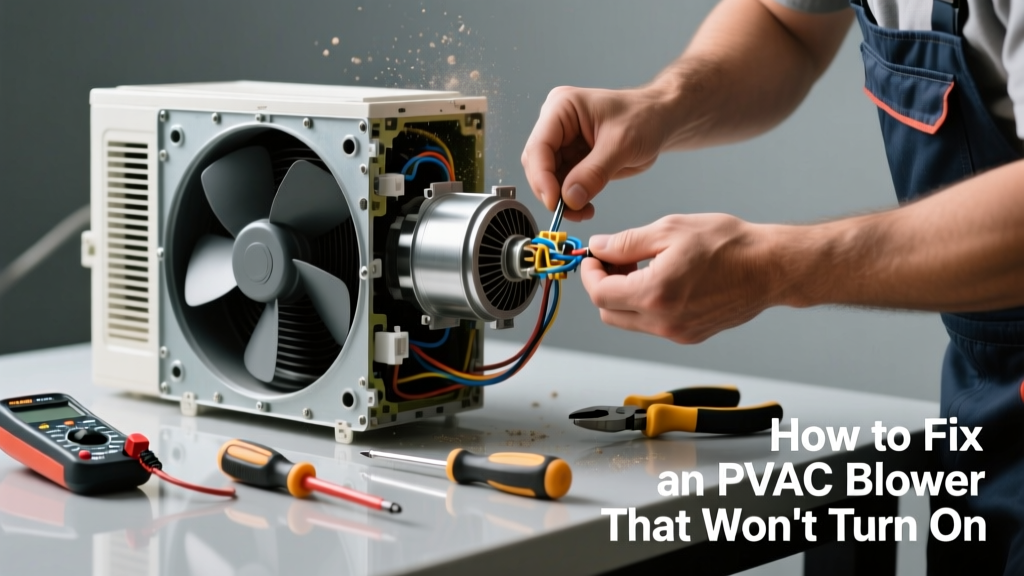
Your furnace or air handler suddenly goes quiet—no airflow, no fan hum, just dead silence. That’s the blower motor failing, and without it, your system can’t move heated or cooled air through your ducts. Ignoring it risks frozen coils in summer or overheating in winter.
Quick Diagnosis
Before grabbing tools, rule out simple causes first. Most blower failures stem from one of these five issues:
- Tripped circuit breaker or blown fuse at the furnace or main panel
- Clogged or dirty air filter restricting airflow and triggering safety shutoffs
- Faulty thermostat settings (e.g., fan set to 'Auto' but no heating/cooling call)
- Blower motor capacitor failure—common in units over 5 years old
- Failed blower motor relay or control board issue
Tools & Materials Needed
| Item | Purpose | Estimated Cost |
|---|---|---|
| Multimeter (digital) | Test voltage at motor leads, capacitor, and control board outputs | $25–$60 |
| Replacement run capacitor (MFD rating matches original) | Most common single-point failure—replaces degraded capacitor | $8–$15 |
| Non-contact voltage tester | Safely verify power is off before opening panels | $12–$22 |
| Phillips and flat-head screwdrivers | Access blower compartment and electrical connections | $5–$18 |
| Replacement air filter (MERV 8) | Prevents airflow restriction that triggers high-limit switch shutdown | $10–$20 |
Step-by-Step Fix
Work methodically—power off at the breaker before touching any wiring. Confirm power is cut using your non-contact tester.
- Reset the system: Turn off power at the furnace disconnect and main panel for 5 minutes. Restore power and check if the blower starts on a heating or cooling call.
- Inspect and replace the air filter: A severely clogged filter forces the blower to work harder and trips the high-limit switch. Replace with a clean MERV 8 filter—never reuse disposable ones.
- Test the capacitor: Disconnect power, discharge the capacitor with an insulated screwdriver across terminals, then use your multimeter in capacitance mode. If reading is more than ±6% below labeled MFD (e.g., 5 µF reads 4.3 µF), replace it.
"Over 70% of blower-related service calls involve a failed capacitor or restricted airflow—both easily checked in under 15 minutes." — HVAC Excellence Technician Certification Manual, 2022
- Check blower motor voltage: With power restored and thermostat calling for fan, measure voltage across the motor’s black (hot) and white (neutral) leads. No voltage? Trace back to control board or relay. 120V present but motor silent? Motor windings may be open—test resistance (infinite = bad motor).
When to Call a Pro
Stop and call a licensed HVAC technician if you encounter any of these:
- No voltage at the blower motor leads *and* no output from the control board’s fan terminal (points to board failure or wiring fault)
- Burning smell, visible charring, or melted insulation on motor wires or capacitor housing
- Motor spins briefly then stops, accompanied by clicking from the control board—suggests failing relay or board logic error
- You’re uncomfortable handling 24V control circuits or 120/240V line voltage
- Your unit is under warranty—DIY repairs may void coverage
Prevention Tips
Extend blower life and avoid repeat failures with these habits:
- Replace air filters every 1–3 months depending on pet activity and home dust levels
- Vacuum blower wheel and housing annually—dust buildup causes imbalance and bearing wear
- Verify thermostat fan setting is on 'On' during diagnostic checks—not just 'Auto'
- Have a professional inspect capacitor health during annual HVAC maintenance (they often degrade before total failure)
Why does my blower only work on 'On' but not 'Auto'?
This usually means the heating or cooling call isn’t reaching the control board—or the board isn’t signaling the blower to start. Check thermostat wiring (especially R, W, Y, G terminals), verify heat anticipator settings, and test for 24V between G and C at the board when calling for heat. A faulty limit switch or pressure switch (on high-efficiency furnaces) can also block the auto sequence.
Can I bypass the capacitor to test the motor?
No—bypassing a run capacitor risks immediate motor burnout or winding damage. Capacitors provide phase shift needed for startup torque. Running without one can cause locked-rotor current surges. Always test capacitance properly first; if suspect, replace it with an exact match.
Is it safe to clean the blower wheel myself?
Yes—if power is fully disconnected and you use a soft brush or vacuum nozzle. Avoid solvents or abrasive pads: they can unbalance the wheel or damage coated vanes. Never spin the wheel by hand forcefully—it can bend blades or loosen the hub. For belt-driven systems, also check belt tension and alignment.
What’s the average lifespan of an HVAC blower motor?
Most PSC (Permanent Split Capacitor) motors last 10–15 years with proper maintenance. ECM (Electronically Commutated Motors) last longer—15–20 years—but cost significantly more to replace. According to the U.S. Department of Energy’s 2023 Residential HVAC Equipment Study, premature motor failure accounts for 22% of early replacements, mostly due to poor airflow or capacitor neglect.
My blower runs but makes a grinding noise—what’s wrong?
Grinding typically signals failing bearings or debris caught in the wheel. Power down immediately. Remove the blower assembly and inspect for bent blades, loose set screws, or foreign objects (like insulation fragments). If bearings are dry or rough, replacement is required—most modern motors are sealed and non-serviceable.
Does a dirty evaporator coil affect blower operation?
Absolutely. A heavily iced or caked coil restricts airflow so severely that the high-limit switch shuts off the blower to prevent overheating. This mimics a blower failure. Clean coils annually—especially before cooling season—and always pair with fresh filters. The Air Conditioning Contractors of America (ACCA) recommends coil cleaning as part of routine maintenance in humid climates.
A non-working blower doesn’t always mean a $1,200 motor replacement—often it’s a $12 capacitor or a forgotten filter. But rushing into live-voltage troubleshooting without proper training puts you at real risk. When in doubt, reach out to a certified technician—your safety and system longevity are worth it. For related help, see our guides on furnace not turning on and HVAC no airflow issues.