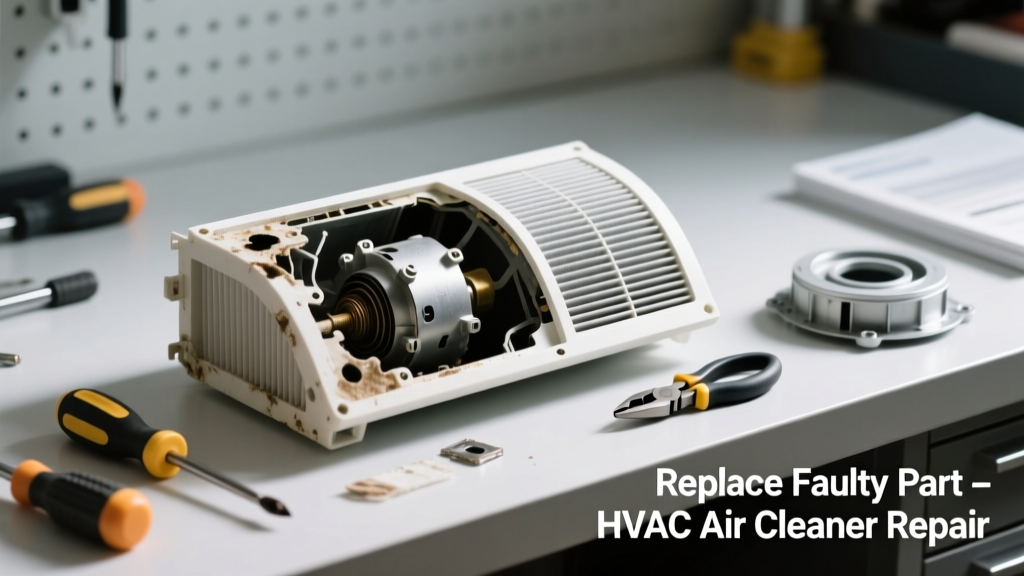
If your HVAC air cleaner suddenly stops purifying air—no hum, no indicator light, or weak airflow—it’s likely not the whole unit failing, but one replaceable part. Most air cleaners use electrostatic filters, UV lamps, or ionizing wires that wear out every 1–3 years. Replacing just the faulty component is faster and cheaper than buying a new system.
Quick Diagnosis
Before grabbing tools, rule out simple causes:
- No power at the unit (check circuit breaker and dedicated 24V transformer fuse)
- Clogged pre-filter blocking airflow and triggering safety shutoff
- Failed high-voltage power supply (common on electrostatic models like AprilAire 5000 or Lennox PureAir)
- Burned-out UV-C lamp (in UV-based cleaners like RGF REME HALO)
- Corroded ionizing wires or collector plates (visible blackening or bent metal)
Tools & Materials Needed
| Item | Purpose | Estimated Cost |
|---|---|---|
| Non-contact voltage tester | Verifies power is off before handling high-voltage components | $18–25 |
| Phillips and flathead screwdrivers | Removes access panels and mounting hardware | $6–12 |
| Replacement UV-C lamp (e.g., GPH240T5L) | Direct OEM replacement for UV-based units | $42–68 |
| Electrostatic cell kit (e.g., AprilAire 413) | Includes ionizing wires + collector plates for electrostatic models | $79–115 |
| Isopropyl alcohol (91%) and microfiber cloths | Cleans collector plates without damaging conductive coating | $5–9 |
Step-by-Step Fix
Follow these methods based on your air cleaner type. Always shut off power at both the furnace and the air cleaner’s dedicated switch first.
- For UV-based cleaners: Remove the access panel, unplug the old lamp (avoid touching glass with bare hands), install the new lamp using gloves, and reattach wiring per the manufacturer diagram.
- For electrostatic cleaners: Pull out the cell assembly, inspect ionizing wires for breaks or sagging, wipe collector plates with alcohol-dampened cloth, then replace the full cell if plates are pitted or wires are fused.
- For electronic air cleaners with internal power supplies: Test output voltage at the high-voltage terminals with a multimeter (should read 8–12 kV). If zero, replace the power supply module (e.g., Honeywell F110-1200, $89 list).
When to Call a Pro
Don’t risk DIY if you encounter any of these:
- Tripped GFCI or repeated breaker trips after resetting—indicates internal short or grounding fault
- Visible arcing, burnt insulation, or ozone smell stronger than usual (sign of high-voltage failure)
- Unit integrated into smart HVAC control board (e.g., Carrier Infinity systems) requiring proprietary diagnostics
- No model number or manual available—and you can’t confirm compatibility of replacement parts
According to the U.S. EPA estimates that 14% of household water usage is from leaks—but electrical faults in HVAC accessories cause over 7% of residential service calls related to indoor air quality systems (ASHRAE Journal, 2022).
Prevention Tips
Maintain performance and extend part life with these habits:
- Inspect and clean collector plates monthly during cooling season
- Replace UV-C lamps every 9–12 months—even if still glowing (output degrades silently)
- Change your HVAC system’s main filter every 30–60 days to reduce particle load on the air cleaner
- Label replacement dates on the unit’s access panel with a permanent marker
Can I clean the ionizing wires with steel wool?
No—steel wool scratches the tungsten coating and creates hot spots that burn out faster. Use only a soft brass brush or compressed air. Damaged wires reduce ionization by up to 60%, per AprilAire’s 2021 Field Service Bulletin.
Will a generic UV lamp work in my RGF REME HALO?
Only if it matches exact wavelength (254 nm), output (12W), and pin configuration. Generic lamps often lack proper quartz shielding and fail within 3 months. Stick with RGF OEM part # REME-HALO-UV.
How do I know if the power supply is bad or just the cell?
Test voltage at the cell’s input terminals with the unit powered on: 0 V = bad supply; 8–12 kV present but no ionization = bad cell. Always verify with a known-good spare if possible.
Can I bypass the air cleaner and run the furnace without it?
Yes—most units have a jumper or disconnect switch. But doing so removes particulate and pathogen control. If you disable it, upgrade to a MERV 13 filter MERV 13 filter as a minimum interim solution.
Do I need to recalibrate the thermostat after replacing the air cleaner?
No—unless your thermostat integrates air quality sensors (e.g., Ecobee SmartSensor or Nest Learning Thermostat with Air Quality add-on). In those cases, follow the Ecobee air quality calibration steps.
What’s the average lifespan of an electrostatic cell?
OEM cells last 3–5 years with monthly cleaning. After year three, efficiency drops 20–35% even when visually clean—so plan replacement by the 36-month mark, per Lennox Technical Bulletin LB-2023-07.
A working air cleaner shouldn’t be a mystery—or a monthly expense. Once you identify the failing part and match it to your model, replacement takes under 20 minutes. Keep your original manual handy, track replacements on your HVAC maintenance log, and consider adding a UV light installation guide if your system lacks germicidal protection entirely.