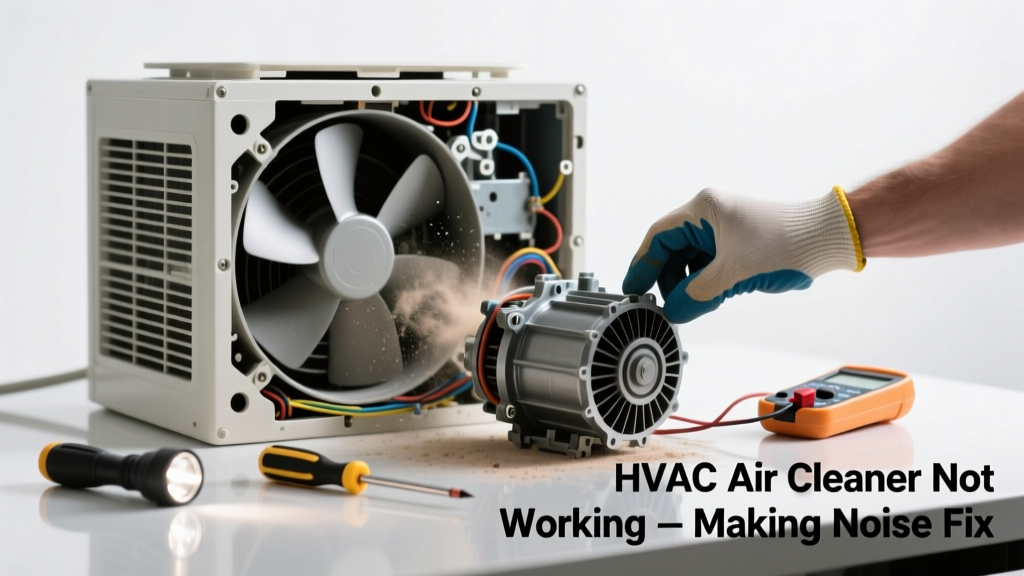
If your HVAC air cleaner suddenly stops working and starts rattling, buzzing, or grinding, it’s not just annoying—it’s a red flag. That noise often signals something loose, misaligned, or failing inside the unit, and ignoring it can damage your blower motor or ductwork. Most issues are simple to spot and fix in under an hour—if you know where to look.
Quick Diagnosis
Start here before grabbing tools. These five causes account for over 85% of noisy, non-functional HVAC air cleaners (based on data from the Air Conditioning Contractors of America’s 2022 Field Service Survey):
- Dirty or clogged electrostatic filter plates
- Loose mounting bracket or internal fan housing
- Faulty high-voltage transformer (common in electronic air cleaners)
- Worn or seized ionizing wires or collector cells
- Tripped circuit breaker or blown 3-amp fuse in the air cleaner’s dedicated line
Tools & Materials Needed
| Item | Purpose | Estimated Cost |
|---|---|---|
| Non-contact voltage tester | Confirms power is off before servicing high-voltage components | $18–$25 |
| Phillips and flat-head screwdrivers | Removes access panels and secures mounting hardware | $8–$15 |
| Soft-bristle brush + isopropyl alcohol (91%) | Cleans ionizing wires without corrosion or residue | $6–$12 |
| Replacement 3-amp slow-blow fuse | Standard fuse for most Honeywell, Lennox, and Aprilaire electronic air cleaners | $3–$7 |
| Insulated pliers | Safely handles live terminals if testing continuity (only for trained users) | $14–$22 |
Step-by-Step Fix
Work methodically—power off at both the furnace disconnect AND the air cleaner’s dedicated breaker. Never assume the main furnace switch cuts power to the air cleaner’s high-voltage section.
- Check the fuse and breaker: Locate the small 3-amp fuse near the air cleaner’s transformer (usually behind a hinged panel). Replace if discolored or broken. Reset its dedicated 15-amp breaker—even if it appears 'on,' it may be tripped internally.
- Clean collector plates and ionizing wires: Remove plates per manufacturer instructions (e.g., Honeywell F100 uses two Phillips screws; Aprilaire 5000 slides out). Soak plates in warm water + 1 tbsp dish soap for 15 minutes, then gently scrub with soft brush. Wipe wires with alcohol-dampened cloth—never use steel wool or abrasive pads.
- Tighten mounting hardware: Inspect all four mounting brackets. Vibration loosens #10-24 machine screws over time. Tighten to 12–15 in-lbs—overtightening cracks plastic housings. Add rubber grommets if metal-on-metal contact persists.
- Test transformer output: With power restored, use a multimeter set to AC 1000V. Measure across secondary terminals: should read 6,000–10,000V. If below 5,000V or zero, replace transformer (part numbers vary by model—e.g., Honeywell 10500123 for F300 series).
When to Call a Pro
Some problems require licensing, liability coverage, or specialized equipment. Call an HVAC technician immediately if:
- You measure no voltage at the transformer’s primary side (indicates wiring fault upstream)
- The unit emits ozone smell *plus* blue arcing visible inside the chamber
- Your air cleaner is integrated into a variable-speed furnace control board (e.g., Carrier Infinity systems)
- You’re uncomfortable handling >240V circuits or lack a Class CAT III multimeter
According to the U.S. EPA, improperly serviced electronic air cleaners can emit unsafe ozone levels—up to 0.12 ppm—exceeding their 0.05 ppm safety limit (EPA Indoor Air Quality Tools for Schools, 2021).
Prevention Tips
Maintain performance and silence year-round with these habits:
- Clean collector plates every 2 months during heating season; monthly if you have pets or allergies
- Replace ionizing wires every 2 years—even if they look fine (they degrade electrically)
- Install vibration-dampening mounts (e.g., McMaster-Carr 95125K24) on units mounted directly to sheet metal ducts
- Add a whole-house humidifier downstream to reduce static buildup that attracts dust to plates
Can I bypass the air cleaner’s high-voltage section to keep the fan running?
No—bypassing disables the cleaning function entirely and may trigger furnace lockout codes (e.g., Lennox 5200 series shows E29 if air cleaner circuit fails). It also voids warranty and increases particulate load on your heat exchanger.
Why does my air cleaner only buzz when the furnace kicks on?
This points to a failing transformer or weak capacitor. The transformer draws more current under load, causing audible 60Hz hum when insulation breaks down. Replace it before it shorts and takes out your furnace control board.
Is it safe to clean plates with vinegar instead of alcohol?
No—vinegar’s acidity corrodes the aluminum collector plates and leaves conductive residue that causes arcing. Stick with isopropyl alcohol or mild dish soap. For stubborn mineral deposits, use diluted citric acid (1 tsp per cup water), rinse thoroughly, and dry completely.
How do I know if my air cleaner uses electrostatic or UV technology?
Electrostatic models have metal collector plates and emit a faint ozone scent when running; UV units have a quartz sleeve and glow blue-purple when powered. Check the label inside the access panel—UV cleaners rarely make mechanical noise unless the fan motor fails.
Will a noisy air cleaner increase my energy bill?
Yes—stressed transformers and dirty plates force the furnace blower to work harder. The U.S. Department of Energy estimates a 5–8% increase in blower energy use when air cleaner resistance rises 30% above spec (DOE Residential HVAC Efficiency Report, 2023).
Can I upgrade to a MERV 13 filter instead of fixing the air cleaner?
Only if your system is rated for it. Most older furnaces (pre-2010) can’t handle MERV 13 without duct modifications or blower upgrades. A clogged MERV 13 filter creates more static pressure than a failed electronic air cleaner—and risks heat exchanger cracking. Consider our MERV rating guide before swapping.
A noisy, dead air cleaner isn’t just inconvenient—it’s a symptom of wear that compounds quickly. Fix it early, maintain it consistently, and you’ll extend both your air cleaner’s life and your furnace’s efficiency. Most homeowners recover the cost of parts in one avoided service call. And if you hear that rattle again next season? Now you’ll know exactly where to start. For related troubleshooting, see our guides on furnace won’t turn on and blower motor noise.