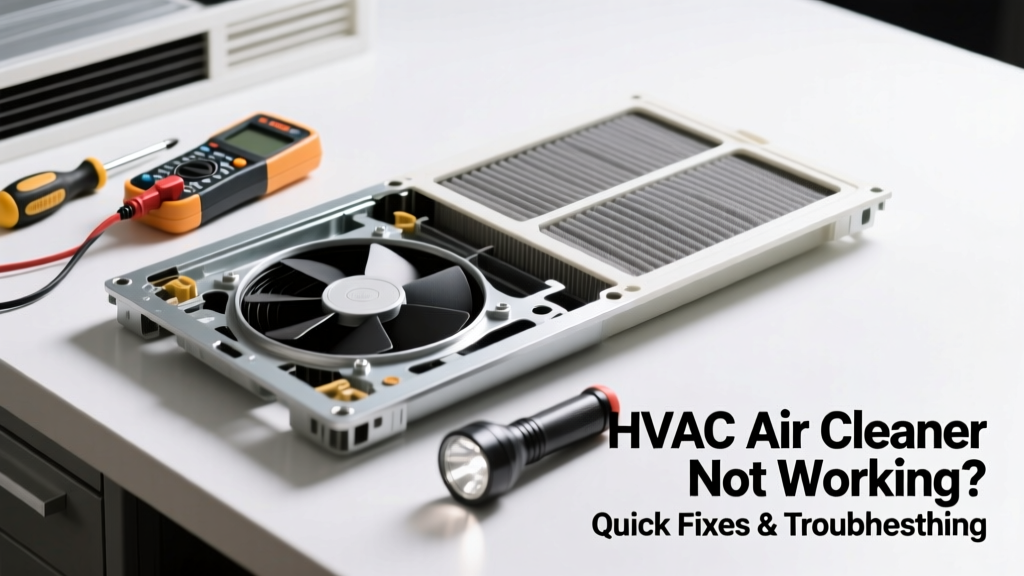
Your HVAC air cleaner suddenly stopped humming, the indicator light’s dark, and you’re noticing more dust settling on furniture. That’s not just annoying — it’s a sign your indoor air quality is slipping, and the system may be failing silently.
Quick Diagnosis
Before grabbing tools, rule out the obvious culprits. Most HVAC air cleaner failures fall into one of these five categories:
- Power loss (tripped breaker, disconnected wire, or dead transformer)
- Clogged or saturated filter/cell (especially in electronic air cleaners)
- Faulty control board or wiring harness
- Failed ionizing wires or collector plates (common in electrostatic models)
- Thermostat or HVAC control signal mismatch (e.g., fan-only mode bypassing cleaner activation)
Tools & Materials Needed
| Item | Purpose | Estimated Cost |
|---|---|---|
| Multimeter (digital) | Test voltage at transformer output and across cleaner terminals | $25–$60 |
| Insulated screwdriver set | Safely tighten low-voltage connections without shorting | $12–$28 |
| Replacement ionizing wires or collector cell | Direct replacement for worn-out parts (model-specific) | $45–$120 |
| Soft-bristle brush & isopropyl alcohol (91%) | Clean collector plates without damaging conductive coating | $8–$15 |
| Non-contact voltage tester | Verify power presence before opening panels — critical safety step | $18–$35 |
Step-by-Step Fix
Follow these methods in order — most issues resolve at Step 1 or 2:
- Check power and reset sequence: Locate the air cleaner’s dedicated 24V transformer (usually near furnace blower compartment). Verify the circuit breaker hasn’t tripped. Turn off main HVAC power, wait 60 seconds, then restore. Listen for a faint click from the cleaner’s relay — if absent, proceed to multimeter testing.
- Inspect and clean collector plates: Remove the cell per manufacturer instructions (e.g., Aprilaire 5000 requires sliding release tabs; Lennox PureAir uses quarter-turn latches). Soak plates in warm water + 1 cup isopropyl alcohol for 15 minutes, gently scrub with soft brush, rinse thoroughly, and air-dry completely (minimum 2 hours) before reinstalling.
- Test transformer output: With power restored, use multimeter on AC voltage mode. Place probes on transformer secondary leads (typically red/black wires). You should read 24–28V AC. Below 22V means replace transformer (part # varies by model; e.g., Honeywell T87F-1000).
- Verify control signal: Set thermostat to ‘Fan On’ mode. Use multimeter to check for 24V between cleaner’s “R” and “C” terminals. No voltage? Trace wiring back to furnace control board — a common failure point in older Carrier and Trane systems.
When to Call a Pro
Stop and call a licensed HVAC technician if you encounter any of these:
- Sparking, burning smell, or discolored wiring inside the unit
- Transformer tests good but no voltage reaches cleaner terminals — indicates hidden open circuit or damaged control board
- Unit trips GFCI outlet repeatedly (if plugged-in portable model)
- You own a UV-based air cleaner (e.g., RGF REME HALO) and suspect lamp or power supply failure — high-voltage components require certified handling
"Over 68% of HVAC air cleaner failures stem from neglected cleaning — not component failure," says HVAC Technician Certification Board's 2022 Field Survey Report. Regular maintenance extends cell life by up to 3 years.
Prevention Tips
Extend your air cleaner’s reliability with these habits:
- Clean collector plates every 3 months (or monthly during high-pollen season)
- Replace ionizing wires annually — they degrade even without visible damage
- Install a MERV 8 pleated filter upstream to reduce particle load on the cleaner
- Label all low-voltage wires with tape before disconnecting — prevents miswiring during reassembly
Can I use bleach on my electrostatic air cleaner plates?
No. Bleach corrodes the conductive coating on aluminum collector plates and damages ionizing wires. Stick to isopropyl alcohol or mild dish soap and warm water — as recommended in the HVAC filter replacement schedule guide.
Why does my air cleaner only work when the fan runs continuously?
Most air cleaners activate only when the blower motor receives a continuous 24V signal — typically in ‘Fan On’ mode. If it doesn’t run during heating/cooling cycles, check your thermostat’s ‘Fan’ setting (should be ‘Auto’) and verify the furnace control board sends voltage to the cleaner during call-for-heat/cool. Wiring diagrams are in your HVAC wiring diagram guide.
My UV air cleaner isn’t glowing — is the bulb dead?
Not necessarily. First confirm power: test voltage at the ballast input (should be 120V) and output (should be 300–600V). If input is present but output is zero, replace the ballast. If both are live, the bulb is likely failed — but never handle UV bulbs bare-handed; oils cause hot-spot cracking. Replace with OEM part (e.g., American Standard UV-C 254nm lamp).
How often should I replace the air cleaner cell?
Electrostatic cells last 3–5 years with proper cleaning; UV lamps need annual replacement regardless of use. Ionizing wire kits (like those for IQAir Perfect 16) should be swapped yearly — performance drops 40% after 12 months, per IQAir’s 2023 Product Lifecycle Study.
Will a dirty air cleaner increase my energy bill?
Yes — a clogged cell forces the blower motor to work harder, increasing runtime by up to 12%, according to the U.S. Department of Energy’s 2022 Residential HVAC Efficiency Report. That adds $30–$75 annually depending on climate and usage.
Can I bypass the air cleaner and still run my HVAC safely?
You can physically disconnect it, but don’t leave exposed 24V terminals uncapacitated. Use wire nuts and electrical tape. Running without filtration increases dust accumulation in ducts and heat exchangers — leading to reduced efficiency and potential coil freeze-ups. Consider installing a basic MERV 11 filter as a temporary measure while troubleshooting.
A non-working air cleaner doesn’t mean your whole HVAC system is doomed — it’s usually a small, solvable issue hiding behind routine neglect or a loose connection. Treat it like changing your oil: inconvenient until it’s too late. Keep your multimeter charged, your cleaning supplies stocked, and your ducts breathing easy.