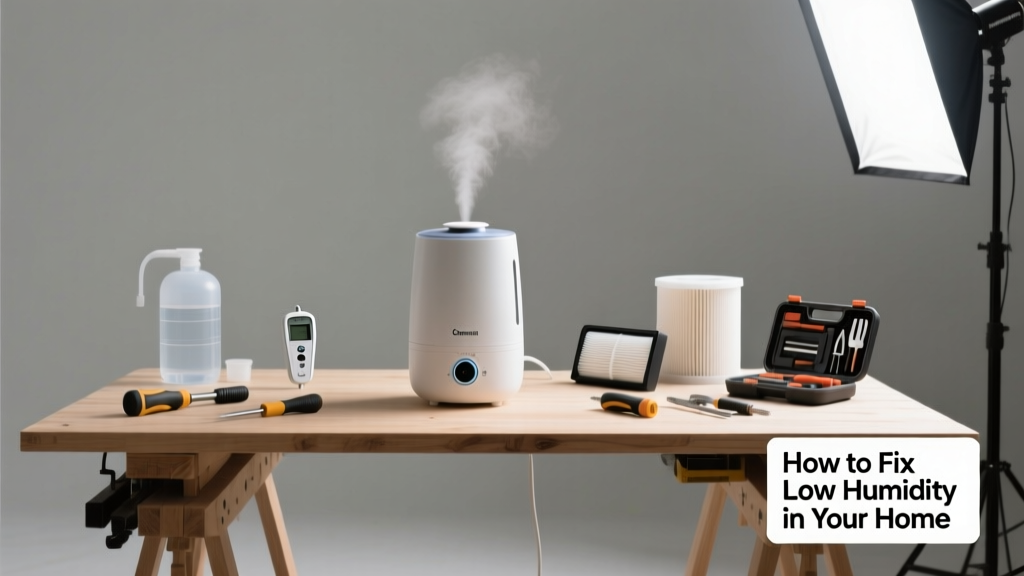
Waking up with cracked lips, static shocks from doorknobs, or peeling paint on window trim? You’re likely dealing with indoor humidity below the ideal 30–50% range—especially common in winter when cold air holds less moisture and heating systems dry out the air. Left unaddressed, low humidity damages wood floors, triggers respiratory irritation, and increases energy bills as your body perceives cooler temps.
Quick Diagnosis
Before adding moisture, confirm it’s truly low humidity—not just a symptom of another issue. Use a hygrometer (under $15) to measure relative humidity in multiple rooms at different times of day. Then check these common root causes:
- Overactive or oversized furnace blower running constantly
- Exhaust fans (bathroom, kitchen, dryer) venting indoors or running excessively
- Cracks or gaps around windows, doors, and ductwork allowing dry outdoor air infiltration
- Whole-house humidifier disconnected, clogged, or set to off
- Heating system lacking a built-in humidifier (common in heat pump or electric baseboard setups)
Tools & Materials Needed
| Item | Purpose | Estimated Cost |
|---|---|---|
| Digital hygrometer | Accurately measures current RH levels; essential for verifying problem and tracking progress | $8–$25 |
| Portable ultrasonic humidifier (4–6L capacity) | Targets dry zones like bedrooms or home offices; quiet and energy-efficient | $45–$120 |
| Whole-house humidifier bypass kit (if adding to forced-air system) | Connects to furnace ductwork to distribute moisture evenly throughout home | $180–$320 |
| Weatherstripping + caulk | Seals air leaks that introduce dry outdoor air; reduces load on humidification systems | $12–$35 |
| Distilled water (for ultrasonic units) | Prevents white dust buildup and mineral scaling inside humidifier tanks and mist nozzles | $1–$3 per gallon |
Step-by-Step Fix
Start with the lowest-risk, highest-impact actions first. Most homes see measurable improvement within 24–48 hours using one or more of these methods:
- Run a portable humidifier in high-use rooms: Place a 5L ultrasonic unit on an elevated, non-carpeted surface in your bedroom or living room. Fill with distilled water, set to 45% RH, and run continuously for 3 days. Monitor with your hygrometer—adjust output if RH climbs above 50%.
- Install or service a whole-house humidifier: If you have a forced-air furnace, check whether a bypass or steam humidifier is already installed (look near the return duct or furnace cabinet). Clean the evaporator pad annually and replace it every 12–18 months. According to the American Society of Heating, Refrigerating and Air-Conditioning Engineers’ 2022 HVAC Applications Handbook, properly maintained whole-house units maintain consistent 35–45% RH across all zones.
- Reduce uncontrolled air exchange: Seal gaps around exterior doors with adhesive-backed foam weatherstripping ($9/roll), caulk cracks along window frames and baseboards ($7/tube), and ensure bathroom/kitchen exhaust fans vent outdoors—not into attics or crawlspaces. The U.S. EPA estimates that sealing air leaks can reduce required humidification by up to 25%.
- Add passive moisture sources: Place shallow water trays on radiators or near heat vents. Add pebble-filled bowls with water on sunny sills. While modest, these raise localized RH by 2–5%—enough to ease throat dryness in small spaces.
When to Call a Pro
Some low-humidity scenarios signal deeper system issues that require licensed expertise:
- Your whole-house humidifier runs but delivers no visible mist and shows error codes (e.g., Honeywell HE360 “E1” or Aprilaire 700 “H1”) — indicates solenoid valve failure or wiring fault
- Humidity stays below 25% despite running a correctly sized humidifier at full output for 72+ hours — points to excessive infiltration or undersized equipment
- You smell musty odors or see condensation inside ductwork while running the humidifier — suggests microbial growth or improper drainage
- Your home uses a heat pump without auxiliary heat strips and lacks humidification capability — retrofitting requires electrical upgrades and duct modifications best handled by an HVAC technician
Prevention Tips
Maintaining healthy humidity isn’t seasonal—it’s systemic. Build these habits into your routine:
- Check hygrometer readings weekly November–March; reset humidifier settings when outdoor temps drop below 20°F
- Replace evaporator pads or clean steam chamber components every heating season (even if unit seems functional)
- Set your furnace fan to “Auto” instead of “On” — continuous airflow disperses moisture unevenly and over-dries air
- Install a smart thermostat with integrated humidity control (e.g., Ecobee SmartThermostat with remote sensors) to auto-adjust based on real-time RH data
How low is too low for indoor humidity?
Below 30% RH consistently increases risk of nosebleeds, aggravated eczema, and electrostatic discharge. The National Institutes of Health recommends maintaining 30–50% RH for optimal respiratory health and material preservation.
Can I use tap water in my humidifier?
No—especially not in ultrasonic or cool-mist models. Tap water contains calcium, magnesium, and iron that aerosolize as fine white dust, coating surfaces and potentially irritating lungs. Distilled or demineralized water prevents scaling and meets ASTM Standard D1193 Type IV purity requirements for medical-grade humidification.
Will a humidifier help with static electricity?
Yes—consistently. Static shocks occur most often when RH drops below 35%. Raising humidity to 40–45% neutralizes surface charges. A 2021 study in Indoor Air found participants reported 72% fewer static incidents after maintaining 42% RH for two weeks.
Why does humidity drop when I turn up the heat?
Cold outdoor air holds very little moisture. When that air enters your home and warms up, its relative humidity plummets—even if absolute moisture content stays the same. For example, outside air at 20°F and 60% RH becomes just 12% RH when heated to 70°F indoors. That’s physics—not a broken system.
Do houseplants significantly raise humidity?
Not meaningfully. A dozen healthy peace lilies release ~0.5 liters of water per day—equivalent to ~2% RH increase in a 300 sq ft room. They’re lovely, but rely on mechanical humidification for measurable impact.
How often should I clean my humidifier?
Every 3 days during active use. Empty the tank, wipe interior with white vinegar, rinse thoroughly, and air-dry. Biofilm buildup in stagnant water harbors Legionella and Pseudomonas—a risk confirmed in CDC outbreak investigations linked to poorly maintained residential units.
"Low humidity is the silent stressor in modern homes—often misdiagnosed as 'allergies' or 'dry skin' until wood floors start gapping or piano soundboards crack." — Dr. Lena Cho, Indoor Environmental Specialist, Building Science Corporation, 2023
Fixing low humidity isn’t about chasing perfect numbers—it’s about restoring balance. Start small: verify your actual RH, seal obvious leaks, and run a quality humidifier where you sleep. You’ll notice softer skin, quieter woodwork, and fewer midnight coughs within days. Once baseline comfort returns, shift focus to maintenance—because stable humidity protects both your health and your home’s structure for years to come. For related guidance, see our guides on how to clean furnace humidifier and signs of high humidity.