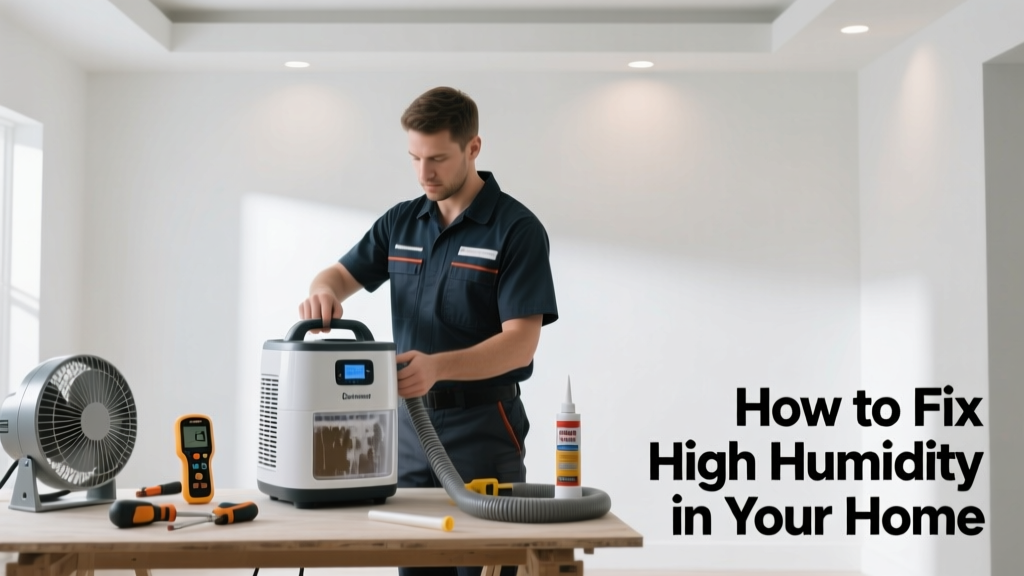
That sticky, clammy feeling in your basement—or the fogged-up windows in your bathroom—isn’t just annoying; it’s a red flag. Relative humidity above 60% encourages mold growth, warps wood floors, and worsens allergies. The good news? Most causes are fixable in under a day with basic tools and clear troubleshooting.
Quick Diagnosis
Before grabbing tools, confirm the source. High humidity rarely comes from one thing—it’s usually a combo. Start here:
- Leaky plumbing or roof penetrations (check attic vents, shower pans, and supply lines)
- Inadequate ventilation—especially in kitchens, bathrooms, and laundry rooms
- A malfunctioning or undersized HVAC system (e.g., oversized AC units that short-cycle)
- Poor insulation around windows, crawlspaces, or foundation walls
- Unvented gas heaters or dryers exhausting indoors
Tools & Materials Needed
| Item | Purpose | Estimated Cost |
|---|---|---|
| Digital hygrometer | Accurately measures relative humidity (not analog dials—they drift) | $12–$25 |
| Exhaust fan timer switch | Ensures bathroom/kitchen fans run long enough post-use (minimum 20 min) | $18–$32 |
| Dehumidifier (50–70-pint capacity) | Removes excess moisture from basements or damp rooms; look for auto-drain and humidistat | $220–$450 |
| Vapor barrier (6-mil polyethylene) | Blocks ground moisture in crawlspaces; overlaps seams by 6 inches and seals with tape | $0.15–$0.30/sq ft |
| Insulated duct wrap | Prevents condensation on cold AC ducts in unconditioned spaces | $14–$28/25-ft roll |
Step-by-Step Fix
Try these methods in order—from fastest to most involved. Test humidity with your hygrometer before and 24 hours after each step.
- Replace or upgrade exhaust fans: Install ENERGY STAR-rated fans (≥80 CFM for bathrooms, ≥100 CFM for kitchens) with timers or humidity-sensing switches. Verify ducts vent outside—not into attics.
- Run your dehumidifier strategically: Place it on the lowest level, away from walls, with doors closed. Set to 45–55% RH. Empty the tank daily—or connect a hose for continuous drain if your unit supports it.
- Seal crawlspace entry points and install vapor barrier: Lay 6-mil poly over bare soil, overlapping seams 6 inches, taping edges to foundation walls. Seal rim joists with closed-cell spray foam or rigid foam board.
- Check HVAC ductwork: Inspect supply and return ducts in garages, attics, or crawlspaces for gaps, disconnected joints, or uninsulated sections. Seal leaks with mastic (not duct tape) and wrap cold lines with R-6 duct insulation.
When to Call a Pro
Don’t risk safety or structural integrity. Call a licensed HVAC technician or home performance contractor if:
- Your AC runs constantly but never lowers humidity below 65%—this often signals refrigerant loss or coil freezing
- You find standing water or persistent dampness behind drywall, under flooring, or in insulation
- Mold covers more than 10 square feet (EPA recommends professional remediation beyond this threshold)
- Humidity spikes only during rain—and you suspect foundation drainage failure or failing footing drains
Prevention Tips
Humidity control is maintenance, not magic. Build habits that last:
- Run bathroom fans for at least 20 minutes after every shower—even if the mirror doesn’t fog
- Cover pots while cooking and use range hood exhaust on medium-high
- Keep indoor plants to a minimum in humid rooms; they release moisture through transpiration
- Inspect gutters and downspouts twice yearly—clogs force water toward foundations
- Set your smart thermostat to maintain 45–55% RH year-round (many newer models support this via add-on sensors)
Can high humidity damage my hardwood floors?
Yes—consistently high humidity causes wood to swell, leading to cupping, buckling, or gaps as seasons shift. The National Wood Flooring Association warns that RH fluctuations above ±5% per month accelerate wear. Keep levels between 35–55% for optimal longevity.
Why does my dehumidifier ice up?
Icing happens when ambient air is too cold (below 60°F) or airflow is restricted—dirty filters, blocked intake grilles, or cramped placement near walls. Clean the filter weekly and elevate the unit off cold concrete floors using a 2×4 platform.
Will opening windows lower humidity?
Only if outdoor RH is lower than indoors—and only briefly. In summer, outside air is often *more* humid. According to the U.S. EPA, 14% of household water usage is from leaks, but outdoor air infiltration contributes unpredictably to moisture load. Use windows sparingly and monitor with a hygrometer.
Can I use bleach on mold caused by humidity?
No—bleach only kills surface spores and doesn’t penetrate porous materials like drywall or wood. The CDC advises against bleach for mold remediation on absorbent surfaces. Instead, use a detergent solution for small areas (<10 sq ft), then address the moisture source. For larger infestations, hire an IICRC-certified firm.
How often should I replace my HVAC air filter to help with humidity?
Every 30–90 days—but check monthly during peak cooling season. A clogged filter restricts airflow across the evaporator coil, reducing its ability to condense moisture. According to ASHRAE Standard 52.2, MERV 8–11 filters balance efficiency and airflow for most homes.
Does a whole-house dehumidifier integrate with my existing HVAC?
Yes—most ducted models (like Santa Fe or Ultra-Aire) connect to your return air duct and use your thermostat’s humidistat or a dedicated control. They’re especially effective in tightly sealed new construction where standard AC can’t keep up. Installation requires professional ductwork integration and electrical wiring.
"A home with 70% RH has three times the mold growth rate of one at 50% RH—measured in lab-controlled studies by the Building Science Corporation (2022)."
Fixing high humidity isn’t about chasing perfection—it’s about consistency and catching problems early. Once you’ve sealed the leaks, upgraded the fans, and dialed in your dehumidifier, retest weekly for a month. You’ll notice quieter HVAC cycles, less dust, and clothes that dry faster on the line. And if you spot condensation on windows again? Grab your hygrometer first—not the mop.