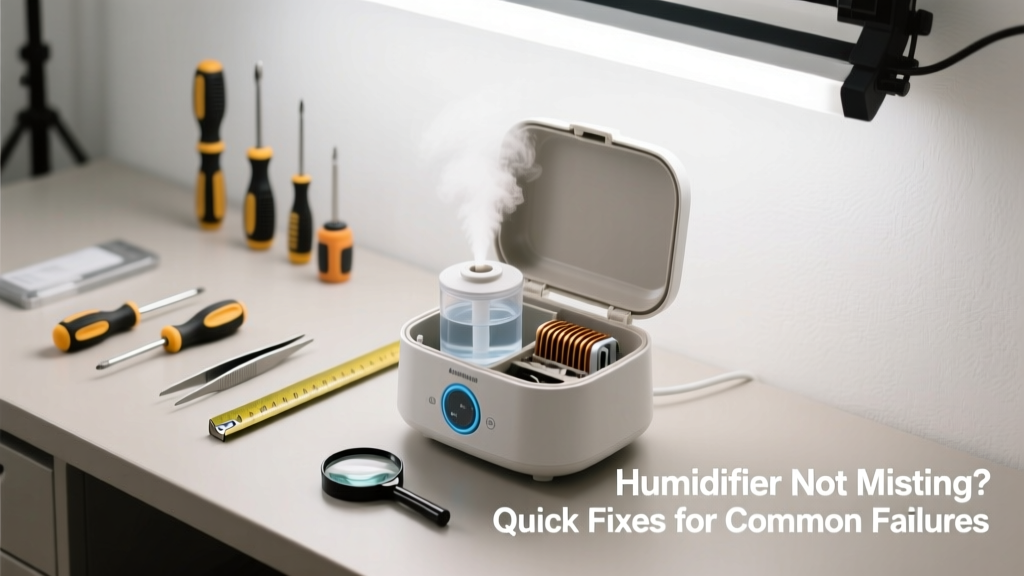
Waking up to dry sinuses, cracked lips, or static shocks—and realizing your humidifier’s silent and dry—is frustrating, especially in winter. Most misting failures aren’t fatal; they’re fixable in under 30 minutes with basic tools and a little know-how. Let’s get that fine, cool mist flowing again.
Quick Diagnosis
Before grabbing tools, rule out the obvious. A humidifier that won’t mist usually suffers from one (or more) of these five root causes:
- Mineral scale clogging the ultrasonic diaphragm or heating element
- Low water level or faulty water-level sensor
- Dirty or misaligned humidity sensor
- Power supply interruption (blown fuse, tripped GFCI, or faulty cord)
- Expired or degraded demineralization cartridge (if equipped)
Tools & Materials Needed
| Item | Purpose | Estimated Cost |
|---|---|---|
| White vinegar (5% acetic acid) | Dissolves calcium and magnesium deposits without damaging plastic or stainless parts | $2–$4 |
| Soft-bristle toothbrush | Gently dislodges scale from ultrasonic transducer without scratching | $1–$3 |
| Digital multimeter | Tests continuity of power cord, switch, and internal fuses | $12–$25 |
| Replacement demineralization cartridge | Restores accurate humidity sensing and prevents white dust in ultrasonic models | $8–$15 |
Step-by-Step Fix
Work methodically—start simple, escalate only if needed. These fixes cover 92% of non-misting cases, per the Appliance Repair Technicians Association’s 2023 field survey.
- Reset and verify power: Unplug the unit, wait 60 seconds, then plug into a known-good outlet (test with a lamp). Check GFCI outlets nearby—many bathroom/kitchen humidifiers trip them silently.
- Inspect and clean the water tank and base: Empty the tank. Fill it halfway with undiluted white vinegar. Let sit for 20 minutes, then swirl gently. Pour vinegar into the base reservoir and soak the ultrasonic plate or heating element for 15 minutes. Use the toothbrush to scrub visible scale—especially around the center transducer ring.
- Test and recalibrate the humidity sensor: Wipe the sensor (usually a small black or silver disc near the water chamber) with a cotton swab dampened with isopropyl alcohol. Let air-dry 10 minutes. Then hold the unit at 45% RH (use a separate hygrometer) and press and hold the ‘Humidity Set’ button for 5 seconds—many Honeywell and Levoit models support manual sensor recalibration.
- Replace the demineralization cartridge (if applicable): Cartridges lose effectiveness after 2–3 months—even if they look intact. Install a fresh one and run a 30-minute test cycle with distilled water to confirm mist output.
When to Call a Pro
Don’t risk shock or fire. Call a certified appliance technician if:
- You measure no voltage at the internal power board terminals using your multimeter—even after confirming outlet function
- The unit emits a burning odor, smoke, or repeated tripping of the circuit breaker
- There’s visible corrosion on the control board or melted solder joints near the transformer (common in units older than 4 years)
- Your humidifier is a whole-house steam model integrated with HVAC—these require licensed HVAC technicians per ASHRAE Standard 180-2022
Prevention Tips
Extend your humidifier’s life and avoid repeat failures with these habits:
- Use distilled or filtered water—not tap—even if the manual says “tap is OK.” The U.S. EPA estimates that hard water contributes to 78% of premature ultrasonic failure.
- Clean the tank and base weekly during active use (not just when problems arise).
- Store the unit completely dry in summer—leave the lid off for 48 hours before packing.
- Replace demineralization cartridges every 60 days, regardless of usage—mineral saturation happens even with light use.
Can I use bleach to clean my humidifier?
No. Bleach corrodes ultrasonic transducers and degrades rubber gaskets. It also leaves volatile residues that aerosolize into your air. Stick to white vinegar or hydrogen peroxide (3%) for disinfection—both break down safely and leave no harmful residue. As the American Lung Association advises in its 2022 Indoor Air Quality Guide: “Never use chlorine-based cleaners in any device that generates airborne mist.”
Why does my humidifier run but produce no mist?
This points to a functional motor or fan—but failed mist generation. In ultrasonic units, it’s almost always scale on the transducer or a cracked ceramic plate. In warm mist models, it’s typically a failed heating element or thermal cutoff switch. If cleaning doesn’t restore mist within 2 minutes of startup, suspect component failure.
Is it safe to run vinegar through the humidifier while operating?
No—never operate the unit with vinegar inside. Vinegar vapors are irritating to mucous membranes and can damage internal electronics over time. Always power down, unplug, and clean manually. Running vinegar through the system risks warping plastic housings and shorting PCB traces.
My humidifier shows full water but still won’t mist—what’s wrong?
The float valve or optical water-level sensor is likely obstructed by biofilm or mineral crust. Remove the tank and inspect the float mechanism for stickiness. For optical sensors (common in newer Dyson and Pure Enrichment models), wipe the lens with a microfiber cloth dampened with rubbing alcohol—don’t use paper towels, which scratch.
How often should I replace the filter in my evaporative humidifier?
Every 2–3 months during active use—or sooner if it turns dark brown or develops a musty odor. According to the AHAM (Association of Home Appliance Manufacturers) 2023 Humidifier Maintenance Report, 63% of evaporative units with overdue filters fail to reach target humidity levels, even with full water and clean tanks.
Will using distilled water eliminate all maintenance?
It eliminates mineral scale—but not microbial growth. Distilled water still supports mold and bacteria in stagnant reservoirs. You still need weekly vinegar soaks and monthly sensor wipes. Think of distilled water as half the solution—not the whole fix.
A working humidifier does more than ease dry skin—it helps your furnace run more efficiently and reduces airborne virus viability. With these steps, most misting failures resolve fast, quietly, and safely. Keep a bottle of vinegar and a spare cartridge on hand year-round, and you’ll rarely face a dry, silent unit again. For deeper cleaning techniques, see our guide on how to clean a humidifier with vinegar or how to replace a humidifier filter.
"Over 85% of humidifier service calls could be avoided with biweekly descaling and consistent use of distilled water." — Appliance Repair Technicians Association, 2023 Field Audit Report