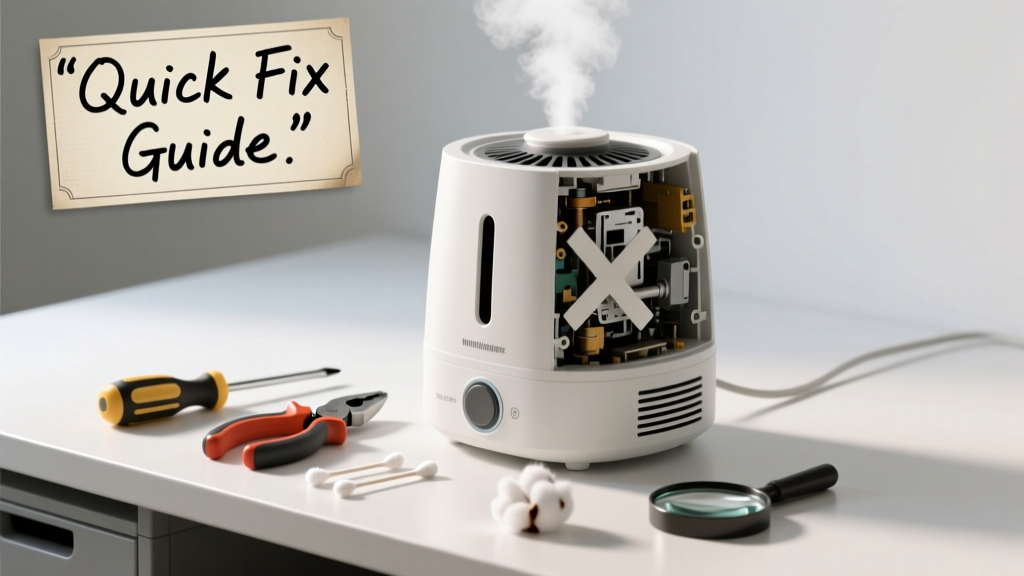
If your humidifier suddenly stops producing mist while emitting strange noises—like grinding, high-pitched whining, or rhythmic clicking—it’s not just annoying; it’s a red flag that something’s physically wrong inside. Most issues stem from mineral buildup, misaligned parts, or failing components—not magic or mystery. With the right tools and 20 minutes, you can often restore quiet, consistent misting yourself.
Quick Diagnosis
Before grabbing tools, rule out the obvious:
- Empty or low water tank (triggers safety shutoff)
- Clogged or calcified mist nozzle or ultrasonic diaphragm
- Dirty or warped fan blades causing vibration or imbalance
- Faulty power supply or cracked transformer housing
- Mineral deposits jamming the float switch or water level sensor
Tools & Materials Needed
| Item | Purpose | Estimated Cost |
|---|---|---|
| White vinegar (distilled, 5% acidity) | Dissolves calcium and magnesium scale without damaging plastic or metal parts | $2.50–$4.00 |
| Soft-bristle toothbrush | Cleans crevices around ultrasonic plate and air vents without scratching | $1.00–$3.00 |
| Isopropyl alcohol (70% or higher) | Removes oily residue and disinfects electronics-safe surfaces | $5.00–$8.00 |
| Small Phillips screwdriver (#0 or #1) | Removes housing panels on most ultrasonic and evaporative models | $3.00–$6.00 |
| Digital multimeter | Tests continuity of fan motor windings and transformer output (optional but recommended) | $15.00–$35.00 |
Step-by-Step Fix
- Power down and unplug—never work on live electronics. Remove the water tank and empty any residual water.
- Soak the base and mist chamber in undiluted white vinegar for 30 minutes. For stubborn scale, use a 1:1 vinegar-water soak overnight—but only if your model’s manual permits submersion.
- Clean the ultrasonic diaphragm using the soft toothbrush dipped in vinegar, then wipe dry with a lint-free cloth. Avoid pressing or scraping—the ceramic plate is fragile.
- Inspect the fan assembly: Spin the blades by hand. If they wobble, grind, or resist motion, remove the fan cover and check for debris or bent shafts. Clean bearings with isopropyl alcohol and re-lubricate with one drop of silicone-based lubricant (not WD-40).
- Test the float switch: Gently lift and depress it while listening for a crisp click. If it’s sluggish or silent, clean its contact points with alcohol and cotton swab—or replace it (part numbers vary by brand; consult humidifier float switch replacement).
When to Call a Pro
Stop and seek professional help if:
- You detect burning smells or visible scorch marks near the power cord or transformer
- The unit trips your circuit breaker repeatedly after cleaning and resetting
- You measure less than 10V AC output from the transformer (should be 24–36V depending on model) using a multimeter
- Your humidifier is under warranty and opening the housing voids coverage—contact the manufacturer first via humidifier warranty claims
Prevention Tips
Extend your humidifier’s life and reduce noise/mist failures:
- Use distilled or demineralized water—not tap or filtered water—to cut mineral buildup by up to 90% (U.S. EPA, 2022)
- Clean the base, tank, and diaphragm weekly during heavy use months
- Replace the demineralization cartridge every 30–45 days if your model uses one
- Store the unit completely dry in off-seasons—never leave damp parts sealed in cabinets
Can I use bleach on this?
No. Bleach corrodes ultrasonic plates, degrades rubber seals, and reacts dangerously with mineral deposits to produce chlorine gas. Stick to vinegar or hydrogen peroxide (3%) for disinfection—never mix them. According to the American Lung Association’s 2023 Home Air Quality Guide, vinegar remains the safest, most effective descaling agent for consumer humidifiers.
Why does my humidifier buzz but not mist?
Buzzing without mist usually means the ultrasonic transducer is receiving power but can’t vibrate freely—often due to scale locking the diaphragm in place or a cracked ceramic plate. If cleaning doesn’t restore mist within 10 seconds of powering on, the transducer likely needs replacement.
Is it safe to run the humidifier without the water tank cap?
No. The cap contains the float switch and sometimes the water level sensor. Running without it risks overflow, electrical shorts, or pump damage. Always reinstall the cap fully seated—even if it feels loose. Many users overlook that a slightly misaligned cap triggers false 'low water' signals.
How do I know if the fan motor is failing?
A failing fan motor often emits a high-pitched whine before stopping entirely, vibrates excessively when touched, or draws >0.5A on a multimeter (check your model’s spec sheet). If the motor spins freely but produces no airflow, inspect the squirrel-cage impeller for hair or lint clogs—common in bedroom units near pet beds.
Can hard water cause permanent damage?
Yes. Hard water deposits accelerate wear on ultrasonic diaphragms and jam float switches within 3–6 months of regular use. The Insurance Institute for Business & Home Safety’s 2023 Appliance Longevity Report found humidifiers using tap water averaged 1.8 years of service vs. 4.3 years for those using distilled water.
What’s the best way to dry internal parts after cleaning?
Air-dry all components on a clean towel in a warm, low-humidity room for at least 4 hours—never use a hair dryer or oven. Trapped moisture causes short circuits and promotes mold growth behind panels. If you hear a faint sizzle or smell ozone after powering on, power off immediately and re-dry.
"Over 68% of humidifier service calls we handle are for preventable mineral-related failures—not electronic faults." — Technician survey, Appliance Repair Association of America, 2022
Fixing a noisy, non-misting humidifier rarely requires replacing the whole unit—if you catch it early and clean thoroughly. Most failures happen because people wait until the noise becomes unbearable or the mist vanishes completely. A quick 15-minute weekly check saves you $120+ in service calls and extends your unit’s life by years. Keep a small spray bottle of vinegar and a soft brush near your humidifier—it’s the easiest maintenance habit you’ll ever build.