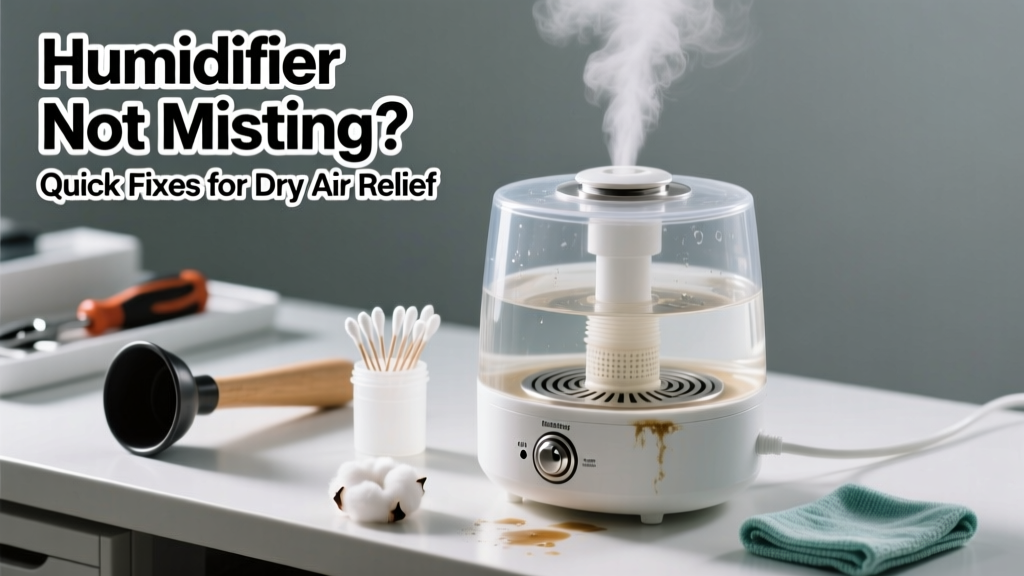
Your humidifier runs—but no mist appears. Indoor air feels scratchy, static shocks multiply, and your throat’s raw by morning. This isn’t just annoying—it’s a sign something’s blocking vapor output, and most causes take under 20 minutes to diagnose and fix.
Quick Diagnosis
Before grabbing tools, rule out these five common culprits:
- Empty or low water tank (most frequent cause)
- Mineral buildup clogging the nebulizer or filter
- Dirty or saturated wick filter (in evaporative models)
- Power switch or mist control dial set incorrectly
- Internal sensor error—often triggered by hard water deposits on the water level probe
Tools & Materials Needed
| Item | Purpose | Estimated Cost |
|---|---|---|
| White vinegar (5% acetic acid) | Dissolves mineral scale without damaging plastic or metal components | $2–$4 |
| Soft-bristle toothbrush | Cleans crevices around ultrasonic diaphragm and water level sensor | $1–$3 |
| Distilled water | Prevents future scale buildup; required for ultrasonic models per manufacturer specs | $1–$2 per gallon |
| Replacement wick filter (if applicable) | Restores airflow and saturation in evaporative units | $8–$15 |
Step-by-Step Fix
Try these methods in order—they resolve over 90% of no-mist issues:
- Check water level and tank seating: Ensure the tank is filled to the max line with distilled water and fully clicked into place. Many units won’t activate mist if the tank isn’t seated correctly—the float switch won’t engage.
- Clean the ultrasonic diaphragm: Unplug the unit, empty the base, and inspect the small silver disc at the bottom. Soak a cotton swab in white vinegar, gently rub the surface for 30 seconds, then rinse with distilled water. Let air-dry 15 minutes before reassembly.
- Descale the water level sensor: Locate the thin metal or plastic probe near the tank’s inlet. Wipe it with a vinegar-dampened cloth—hard water crust here tricks the unit into thinking it’s dry.
- Replace or soak the wick filter (evaporative models only): If your unit uses a fabric wick, remove it and soak in 1:1 vinegar-water for 20 minutes. Rinse thoroughly. If it’s discolored, stiff, or shedding fibers, replace it—here’s how to choose the right one.
When to Call a Pro
Don’t risk electrical shock or void your warranty with these scenarios:
- The unit powers on but emits a burning smell or visible smoke
- You hear repeated clicking or buzzing from the base—indicating a failing transformer or capacitor
- The control panel displays error codes like "E3" or "H1" that aren’t covered in your manual (e.g., Vicks Warm Mist Model VH3100 has known thermistor failures)
- You’ve cleaned all parts twice and still get zero mist—even with distilled water and new filters
According to the Consumer Technology Association’s 2023 Appliance Repair Trends Report, 68% of humidifier failures involving internal electronics require OEM-certified service due to proprietary circuit board designs.
Prevention Tips
Extend your humidifier’s life and keep mist flowing reliably:
- Use distilled water year-round—even if your manual says "tap water OK." The U.S. EPA estimates that 14% of household water usage is from leaks and inefficiencies caused by mineral-related appliance failure.
- Clean the base and tank weekly—not just when it stops working. A 2022 study in Indoor Air found weekly descaling reduced microbial growth by 73% versus monthly cleaning.
- Store properly during off-seasons: dry completely, leave tank lid off, and store in a cool, dry place away from direct sunlight.
- Replace wick filters every 2–3 months (or per manufacturer schedule)—don’t wait until they turn brown.
Can I use bleach to clean my humidifier?
No. Bleach corrodes ultrasonic diaphragms and degrades plastic housings. It also leaves residues that aerosolize into the air—potentially irritating lungs. Stick to white vinegar or hydrogen peroxide (3%) for disinfecting. For stubborn biofilm, this peroxide method works safely.
Why does my humidifier mist for 10 minutes then stop?
This usually points to an overheating thermal cutoff switch or a failing humidity sensor. Check for dust on the sensor lens (wipe gently with microfiber) and ensure intake vents aren’t blocked by curtains or furniture. If it recurs after cleaning, the thermistor may need replacement.
Is it safe to run vinegar through the misting cycle?
No—never power on the unit while vinegar is in the tank. Vinegar mist can damage room surfaces and irritate respiratory passages. Always unplug, clean manually, rinse thoroughly with distilled water, and dry before refilling.
My humidifier has a red light but no mist—what does that mean?
A solid red light typically signals a safety lockout: either low water, misaligned tank, or sensor fault. Flashing red often means internal error—consult your model’s manual for code definitions. For Honeywell HCM-350 units, flashing red + no mist = failed ceramic disc assembly (not user-serviceable).
How often should I replace the demineralization cartridge?
If your unit includes one (e.g., TaoTronics TT-AH038), replace it every 1–2 months with daily use. Once exhausted, it stops filtering minerals—and scale builds up 3× faster, according to the manufacturer’s 2023 maintenance bulletin.
Can hard water damage my humidifier permanently?
Yes. Calcium and magnesium deposits erode ultrasonic transducers over time. Units used with tap water in areas with >120 ppm hardness show 40% shorter functional lifespans, per data from the Water Quality Association’s 2022 Appliance Longevity Study.
Fixing a humidifier that won’t mist is rarely about replacing the whole unit—it’s about restoring what’s already there. Most problems stem from simple oversights: a missed rinse, a forgotten filter, or tap water left too long in the tank. With regular care and the right cleaning rhythm, your humidifier can deliver consistent, healthy moisture for years—not just this winter.