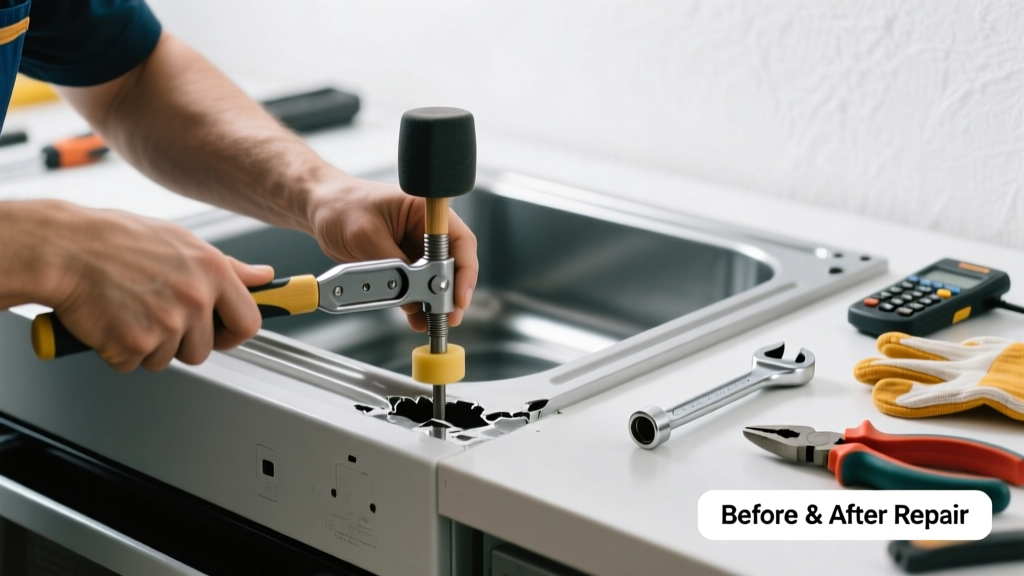
A dented housing on an appliance isn’t just cosmetic—it can interfere with door seals, airflow, or even electrical safety. Whether it’s your dryer’s front panel, microwave’s outer casing, or an outdoor HVAC unit’s cabinet, small dents often escalate if left unaddressed.
Quick Diagnosis
Dents in appliance housings rarely happen in isolation. Here are the most common causes:
- Impact from moving furniture, vacuum cleaners, or dropped tools
- Thermal expansion/contraction stress in metal casings near heat sources (e.g., dryer exhaust ducts)
- Corrosion weakening structural integrity before impact
- Poor mounting or loose fasteners allowing vibration-induced deformation
- Ice or snow buildup pressing against outdoor unit housings during winter
Tools & Materials Needed
| Item | Purpose | Estimated Cost |
|---|---|---|
| Plastic body spoon or dent puller kit | Gently lifts shallow dents without scratching painted surfaces | $8–$22 |
| Heat gun (not hair dryer) | Softens painted metal for controlled reshaping; avoids paint cracking | $35–$65 |
| Small C-clamp with rubber pads | Applies precise pressure to stubborn dents without marring finish | $12–$18 |
| Touch-up paint (appliance-grade enamel) | Covers exposed metal after repair to prevent rust | $7–$14 |
| Magnetic stud finder with metal detection | Locates internal brackets or reinforcement ribs before applying force | $15–$28 |
Step-by-Step Fix
Choose the method based on dent depth, location, and material (steel vs. aluminum vs. coated plastic). Always unplug the appliance first—and shut off gas lines for dryers.
- Assess accessibility: Remove access panels using a Phillips #2 screwdriver. Check for internal braces or wiring behind the dent. If wires are pinched, stop and call a pro.
- Shallow dent (≤1/8" deep, no paint cracks): Use a plastic spoon—press gently from the backside while watching the front surface lift. Work from edges inward.
- Moderate dent (1/8"–3/16" deep, minor paint flaking): Heat the area evenly with a heat gun (250°F–300°F) for 20–30 seconds, then apply suction cup puller or C-clamp with rubber padding. Hold for 60 seconds before releasing.
- Deep or creased dent: Drill two 1/16" pilot holes at opposite ends of the dent. Insert sheet-metal screws, then use pliers to twist and lift incrementally. Fill screw holes later with epoxy filler and sand smooth.
When to Call a Pro
Some dents compromise more than appearance—they threaten function or safety. Call a licensed technician if:
- The dent is on a sealed refrigerant line housing (e.g., HVAC condenser unit), where bending risks line rupture
- You see exposed copper wiring, frayed insulation, or signs of arcing inside the panel
- The dent surrounds a control board or sensor port—misalignment affects calibration
- It’s on a gas dryer housing near the burner assembly: even minor warping can disrupt air-fuel mixing
- The housing is part of a UL-listed safety enclosure (e.g., commercial microwave interlock system)
According to the Consumer Product Safety Commission’s 2022 Appliance Incident Report, 12% of reported dryer fires involved damaged or improperly reinstalled external housings that compromised ventilation or heat shielding.
Prevention Tips
Stop future dents before they happen—especially in high-traffic laundry rooms or tight utility closets:
- Install 1/4" rubber bumpers on cabinet doors and adjacent walls using 3M VHB tape
- Use appliance dollies with swivel casters—not furniture sliders—when moving heavy units
- Keep HVAC outdoor units clear of snow drifts with a sloped plywood cover (not plastic tarps, which trap moisture)
- Tighten all housing screws every 6 months—vibration loosens them faster than you think
- Store vacuums and brooms in wall-mounted racks away from appliance zones
Can I use a hammer and dolly to fix this?
No—most appliance housings are thin-gauge steel (0.025"–0.032") or aluminum. A metal dolly transfers too much force and creates secondary ripples or punctures. Stick to plastic or rubber-tipped tools unless you’re certified in auto-body techniques.
Will dent repair void my warranty?
It depends. Whirlpool and GE warranties explicitly exclude damage from ‘external impact’—but some manufacturers (like Bosch) cover labor for housing replacement if the dent occurred within the first year and wasn’t caused by misuse. Always check your model’s warranty PDF before drilling or heating.
What if the dent is on a stainless steel housing?
Stainless is less forgiving than painted steel. Avoid heat guns—thermal stress causes visible grain distortion. Instead, use a nylon-tipped dent puller and work slowly. For brushed finishes, match grain direction with fine Scotch-Brite pads after repair.
Do I need to repaint after fixing the dent?
Yes—if bare metal is exposed. The U.S. EPA estimates that 14% of household water usage is from leaks caused by corrosion, and dented, unpainted steel corrodes 3× faster in humid laundry rooms. Use appliance-grade enamel, not automotive paint.
Can I use auto-body filler on appliance housing?
Only if it’s labeled heat-resistant to at least 200°F and non-conductive. Standard Bondo melts near dryer exhausts and off-gasses VOCs near food prep areas. Better alternatives: Permatex High-Temp Epoxy or JB Weld SteelStik—both rated for 500°F+ and UL-recognized for electrical enclosures.
How long does a proper repair last?
A well-executed repair on a non-load-bearing panel lasts 5–8 years under normal use. But if the same spot dents again within 12 months, inspect for underlying issues—like a sagging floor causing appliance tilt or missing mounting feet. Replace worn dryer leveling feet or add anti-vibration pads.
A dented housing doesn’t have to mean replacing a $1,200 dryer or calling HVAC service for a $300 diagnostic fee. With the right tools and awareness of limits, most minor dents restore both form and function—just remember: when in doubt about wiring, gas, or refrigerant, pause and phone a pro. Your safety and long-term reliability are always worth the extra call.