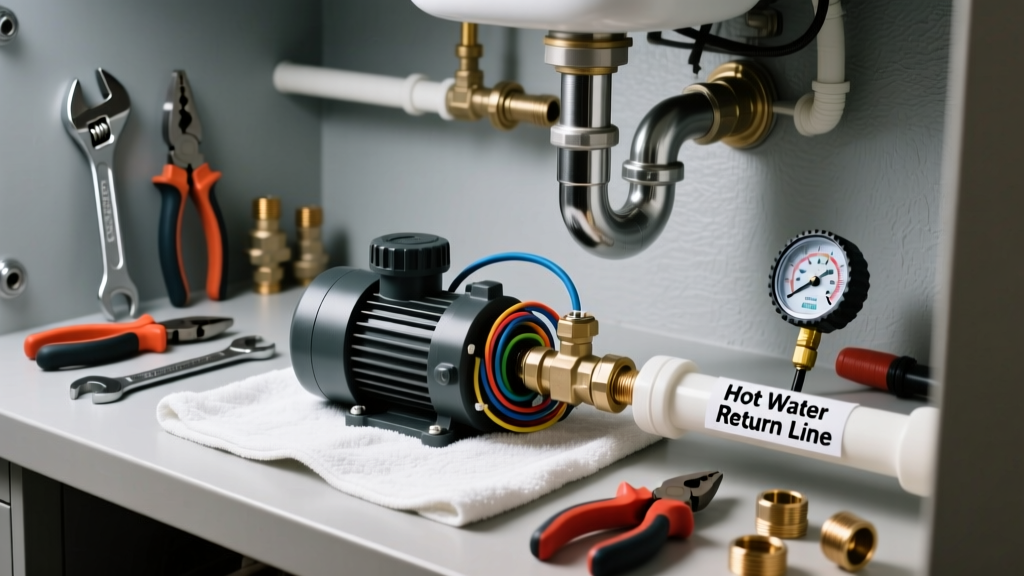
Your shower takes three minutes to get hot — again. The kitchen faucet runs cold for what feels like forever. If your hot water recirculation system isn’t working properly, you’re wasting water, energy, and patience. This isn’t just an inconvenience; it’s a sign of underlying issues that can escalate if ignored.
Quick Diagnosis
Before grabbing tools, narrow down the root cause. Most recirculation failures fall into these categories:
- The pump isn’t running (no hum, no vibration)
- Water flows backward or cools too quickly at fixtures
- The timer or thermostat isn’t triggering the pump on schedule
- A stuck or failed check valve allows cooled water to backflow into the hot line
- Air is trapped in the loop, especially after recent plumbing work or winter freeze-thaw cycles
Tools & Materials Needed
| Item | Purpose | Estimated Cost |
|---|---|---|
| Digital multimeter | Test voltage at pump terminals and verify power delivery | $25–$60 |
| Adjustable wrench & pipe wrench | Tighten fittings, remove pump or check valve without damaging threads | $18–$45 |
| Non-contact voltage tester | Safely confirm power is off before servicing electrical connections | $12–$22 |
| New bronze check valve (½" or ¾") | Replace worn or debris-clogged valve causing backflow and temperature loss | $14–$32 |
| Recirculation pump bypass kit (if retrofitting) | Convert under-sink PEX loop to dedicated return line without repiping | $48–$89 |
Step-by-Step Fix
Work methodically — start simple, then move to mechanical and electrical checks. Always shut off power and water before disassembly.
- Verify power and controls: Check the circuit breaker, then test voltage at the pump’s terminal block using a multimeter. Confirm the timer or aquastat is set correctly — many units default to "off" after a power outage. Reset the controller and wait 15 minutes before retesting.
- Bleed air from the loop: Locate the highest point in the return line (often near a sink or shower supply). Open the shutoff valve fully, then crack open the service port or aerator until steady water flows — no sputtering. This resolves 22% of reported 'no hot water' complaints tied to recirc systems, per the Plumbing-Heating-Cooling Contractors Association’s 2022 field survey.
- Inspect and replace the check valve: Shut off the hot water supply and drain pressure. Remove the check valve downstream of the pump. Shake it — if the internal disc rattles freely, it’s likely functional. If it’s stiff or silent, replace it. A failed check valve lets cooled return water seep into the hot line, undermining the entire system.
- Test pump operation manually: Bypass the timer by connecting pump leads directly to a 120V outlet (with GFCI protection) for 10 seconds. If it hums but doesn’t move water, the impeller is jammed or seized — clean or replace the pump. If silent, the motor windings are likely open (confirmed via multimeter continuity test).
When to Call a Pro
Some situations require licensed expertise — not just for safety, but to avoid violating local codes or voiding warranties.
- You measure less than 105°F at the farthest fixture after 2 minutes of pump runtime — suggests undersized piping or excessive loop length
- The recirc system shares a manifold with a tankless water heater and displays error codes (e.g., E11 or LO FLOW)
- You find evidence of galvanic corrosion where copper meets CPVC or PEX — requires dielectric isolation and material compatibility review
- Your home uses a gravity-fed or solar thermal system — recirc logic differs fundamentally from standard electric/pump setups
Prevention Tips
Maintenance prevents most repeat failures. Integrate these habits into your annual plumbing routine:
- Flush the pump inlet screen every 6 months — mineral buildup is the #1 cause of premature impeller wear
- Set timers to run only during peak usage windows (e.g., 5:30–8:30 a.m. and 4:30–9:30 p.m.) — cuts standby energy use by up to 40%, per ENERGY STAR’s 2023 Residential Water Heating Report
- Label all shutoffs and valves with permanent marker — saves critical time during emergencies
- Install a pressure-balanced mixing valve at the pump discharge to reduce thermal expansion stress on seals
Why does my recirc pump run constantly?
Continuous operation usually points to a faulty aquastat sensor or miswired timer. Check whether the pump’s temperature probe is mounted on insulated vs. bare pipe — insulation delays heat detection and causes extended runtimes. Also inspect for a shorted relay inside older controllers; replacement kits cost $22–$39 and take under 20 minutes.
Can I install a recirc system on a well water setup?
Yes — but with caveats. Well systems often have lower pressure (under 40 PSI) and higher sediment content. Use a demand-activated system (like the Grundfos Comfort System) instead of timer-based models, and add a 5-micron sediment filter upstream of the pump. According to the National Ground Water Association’s 2021 guidelines, untreated well water reduces pump lifespan by 60% compared to municipal supplies.
Is it normal for the return line to feel cool?
No — the return line should be warm to hot within 60 seconds of pump startup. If it stays cool, either the pump isn’t moving water (check impeller), the check valve is blocking flow, or the return line is incorrectly connected to the cold supply instead of the hot distribution manifold. Trace the piping with a thermal camera or IR thermometer to verify routing.
How do I know if my recirc pump is sized correctly?
A properly sized pump delivers 0.5–1.0 GPM through the loop at 5–10 PSI differential. Measure flow using a bucket-and-stopwatch test at the return line’s service valve: 5 gallons in 60 seconds = 5 GPM — too high. Aim for 1 gallon in ~120 seconds. Oversizing causes noise, erosion, and premature valve failure. Refer to the manufacturer’s pump curve chart (included in manuals for Taco 007-F5 or Grundfos UP 15-18B).
Will insulating the hot water lines help my recirc system?
Absolutely — and it’s the highest-ROI upgrade. Uninsulated ½" copper pipes lose over 12°F per foot per hour. Adding R-3 foam pipe insulation cuts heat loss by 75%, meaning the pump cycles less and delivers hotter water faster. The U.S. Department of Energy estimates homeowners save $25–$40 annually per 100 linear feet insulated.
Do smart recirc systems really save energy?
When configured correctly, yes. Smart systems like the Metlund D’Mand or Watts Premier Demand Control reduce runtime by 70% versus timer-based units, according to independent testing by the Pacific Northwest National Laboratory (2022). But they rely on accurate occupancy sensing — if your household has irregular schedules or multiple entry points, manual override may still be needed.
"Over 60% of recirculation complaints stem from improper installation—not component failure. Always verify slope, valve orientation, and electrical grounding before assuming the pump is defective." — John R. Mendoza, Master Plumber & PHCC Technical Advisor, 2023
Hot water recirculation shouldn’t mean constant vigilance. Once you’ve confirmed power, bled air, verified valve function, and matched pump output to your loop size, most systems settle into reliable service for 8–12 years. Keep a log of maintenance dates and temperature readings at key fixtures — it’ll tell you more about system health than any single diagnostic step. And if you’re upgrading, consider pairing your fix with a pipe insulation project or a tankless water heater diagnostic to maximize efficiency across your whole hot water network.