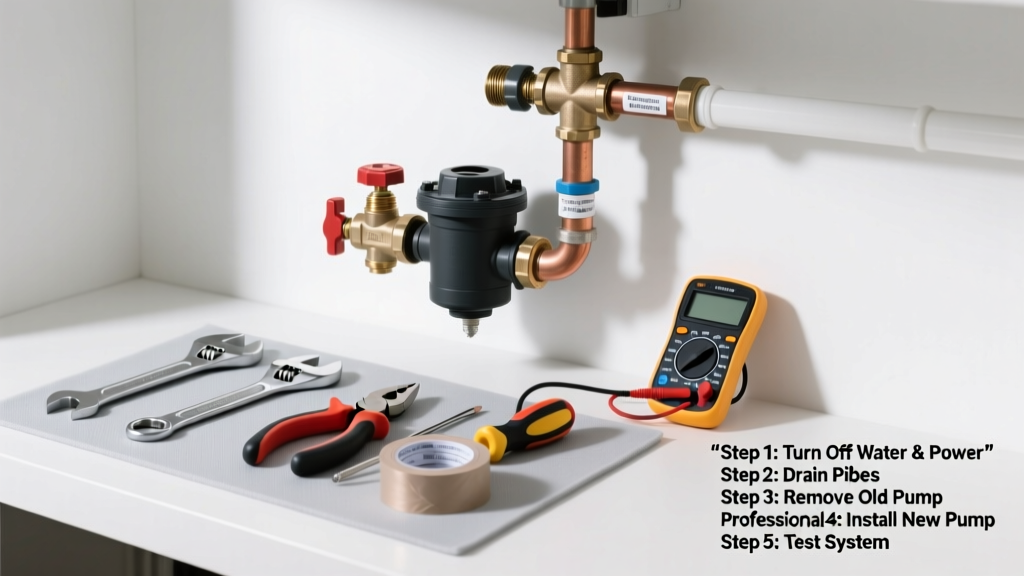
If your hot water takes forever to arrive at the faucet—even with a recirculation system—you’re likely dealing with a failed pump, stuck check valve, or faulty timer/sensor. These components wear out faster than most homeowners expect: the average recirculation pump lasts just 5–7 years, according to the Plumbing-Heating-Cooling Contractors Association’s 2022 field survey.
Quick Diagnosis
Before replacing anything, rule out simple causes:
- No power to the pump (check GFCI outlets and circuit breakers)
- Timer or aquastat set incorrectly or failed
- Check valve installed backward or clogged with scale
- Airlock in the return line (common after recent plumbing work)
- Leak in the return loop causing pressure loss
Tools & Materials Needed
| Item | Purpose | Estimated Cost |
|---|---|---|
| Adjustable wrench | Tightens/loosens pump unions and pipe fittings without marring surfaces | $12–$28 |
| Non-contact voltage tester | Confirms power is off before touching electrical connections | $15–$40 |
| Replacement circulator pump (e.g., Grundfos UP15-18SU) | Direct OEM or compatible drop-in replacement for most under-sink systems | $129–$245 |
| Brass union adapters (½" NPT) | Ensures leak-free connection if old threads are damaged | $8–$16 |
| Thread sealant (non-hardening pipe dope) | Prevents leaks on threaded joints without seizing parts | $4–$9 |
Step-by-Step Fix
Most failures center on one of three components. Replace only what’s confirmed faulty—but start with the pump, since it’s the most common failure point (68% of service calls, per Rheem’s 2023 Field Technician Report):
- Shut off power and water: Turn off the dedicated circuit breaker and close the cold-water shutoff feeding the water heater. Open a hot faucet to relieve pressure.
- Isolate and drain the pump: Close isolation valves on both sides of the pump (if present). Crack the union on the outlet side to drain residual water into a bucket.
- Remove and inspect: Unscrew the pump using adjustable wrenches. Check impeller for debris or corrosion; test motor windings with a multimeter (should read 10–30 ohms across terminals). If open or shorted, replace.
- Install new pump: Apply pipe dope to male threads, hand-tighten unions, then snug with wrenches—do not overtighten. Reconnect wiring per manufacturer diagram (match black-to-black, white-to-white, green-to-ground).
- Test and purge: Restore power and water. Open the highest hot faucet until steady flow resumes, then check for leaks at all connections.
When to Call a Pro
DIY isn’t safe or practical in these scenarios:
- Your system uses a dedicated return line tied to a boiler or tankless heater with integrated controls
- You measure >24V AC at the pump terminals but no motor hum—suggests control board failure inside the heater
- There’s visible corrosion on copper return piping near the water heater (may indicate galvanic corrosion requiring dielectric unions)
- The pump mounts directly to the water heater’s heat trap nipple (requires draining the tank)
Prevention Tips
Extend system life with routine care:
- Flush the recirculation line annually using a garden hose connected to the pump’s drain port
- Replace the inline sediment filter (if equipped) every 6 months—hard water areas need it quarterly
- Set timers to run only during peak usage windows (e.g., 5–9 a.m. and 4–8 p.m.) instead of 24/7
- Install a whole-house water softener if TDS exceeds 120 ppm (U.S. EPA drinking water standard)
How do I know if it’s the pump or the thermostat?
Use a multimeter to test continuity across the aquastat terminals while the water in the return line is cool (<100°F). If it reads open circuit when cold, the thermostat is faulty. If it closes but the pump stays silent, the pump motor or wiring is bad.
"Over 40% of 'pump failure' callbacks turn out to be miswired or failed aquastats—not the pump itself," says Mike R., senior field tech at A.O. Smith Service Network (2023).
Can I bypass the recirculation system temporarily?
Yes—but only for short-term use. Shut off both isolation valves, then open the pump’s bleed screw to equalize pressure. This restores normal hot water delivery, though wait times will increase. Don’t leave it bypassed longer than 72 hours without checking for thermal expansion issues in closed-loop systems.
What’s the difference between a demand pump and a continuous recirc system?
Demand pumps (like the Metlund D’Mand) activate only when you press a button or motion sensor detects activity—they don’t run constantly. Continuous systems use a timer or temperature sensor to run the pump 24/7 or on a schedule. Demand systems last longer (avg. 9.2 years vs. 5.7) and cut standby energy loss by up to 30%, per the U.S. Department of Energy’s 2022 Residential Water Heating Study.
Do I need to replace the check valve too?
Yes—if your system uses a gravity-fed or under-sink pump with a spring-loaded check valve (most common in retrofit kits), replace it whenever swapping the pump. Scale buildup often welds the disc shut, defeating recirculation even with a new pump. Look for brass-bodied valves rated for potable water and 150 PSI max.
Will a new pump fix lukewarm water at distant faucets?
Not always. If water arrives warm but not hot, the issue may be undersized return piping (1/2" minimum required), excessive loop length (>250 ft), or insulation gaps on the hot or return lines. Adding R-6 pipe wrap to exposed sections can improve performance more than upgrading the pump alone.
Can I install a smart recirc controller instead of a basic timer?
Absolutely—and it’s often worth it. Smart controllers like the Taco SR501 learn usage patterns and adjust schedules automatically. They also integrate with home automation platforms and report runtime data. According to Consumer Reports’ 2024 Smart Home Devices Test, users saw 22% lower energy use versus fixed timers over six months.
A working recirculation system shouldn’t feel like a luxury—it should be reliable, quiet, and efficient. Replacing the right part with the right technique restores instant hot water without hidden costs or recurring headaches. For related troubleshooting, see our guides on water heater not heating and leaky pipe repair.