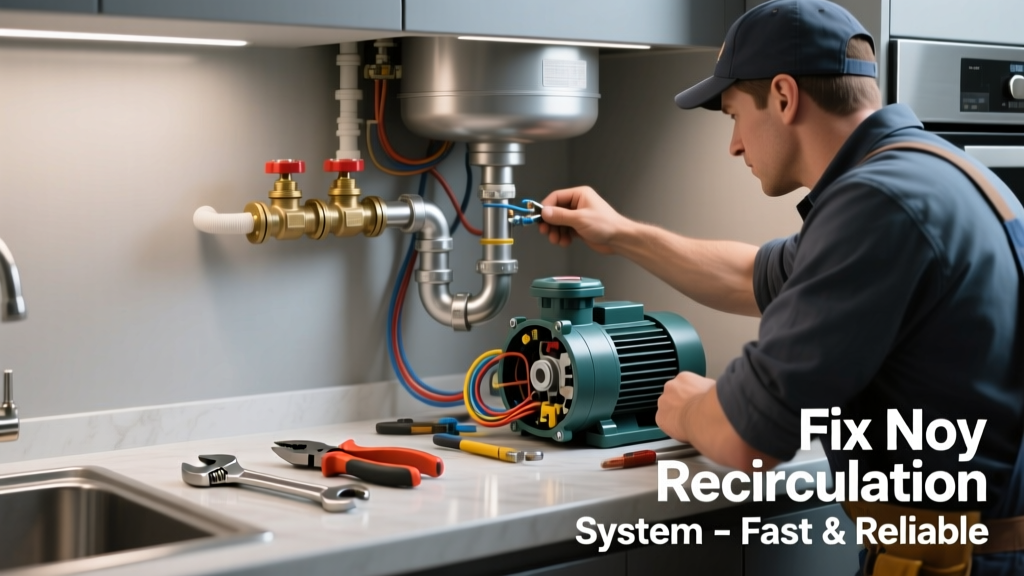
If your hot water recirculation system suddenly stops delivering warm water—and starts groaning, knocking, or whining—you’re not just dealing with an annoyance. That noise often signals trapped air, failing pump bearings, or a malfunctioning check valve, all of which can escalate into leaks or pump burnout if ignored.
Quick Diagnosis
Start here before grabbing tools. Unusual noise paired with no hot water flow usually points to one of these culprits:
- Air trapped in the recirculation loop (causes gurgling or sputtering)
- Failing circulator pump motor or worn bearings (produces grinding, whining, or high-pitched squealing)
- Stuck or corroded check valve (creates banging or water hammer when pump cycles)
- Loose mounting hardware or pipe supports (results in rattling or vibrating sounds)
- Scale buildup in pump impeller or heat exchanger (leads to uneven flow and rumbling)
Tools & Materials Needed
| Item | Purpose | Estimated Cost |
|---|---|---|
| Adjustable wrench | Tighten pump unions, valve connections, and pipe supports | $12–$25 |
| Bucket and towels | Catch drips during valve/pump inspection; prevent water damage | $0–$8 |
| Non-contact voltage tester | Verify power is off before touching pump wiring or controls | $15–$30 |
| Small screwdriver set | Access control panels, remove pump cover, adjust timer settings | $8–$20 |
| White vinegar (1 gallon) | Descale pump and lines if mineral buildup is suspected | $4–$7 |
Step-by-Step Fix
Work methodically—each step addresses a distinct failure mode. Always shut off power at the breaker and close the cold-water supply before starting.
- Bleed air from the loop: Locate the highest point in the recirculation line (often near the farthest fixture or at a dedicated air vent). Open the valve slowly until a steady stream of water—not sputters—flows. Repeat after 15 minutes if noise returns.
- Inspect and clean the check valve: Shut off water, drain the line, then remove the spring-loaded check valve upstream of the pump. Soak it in vinegar for 20 minutes, scrub the seat with a soft brush, and reinstall with new Teflon tape on threads.
- Test pump vibration and bearing noise: With power off, manually spin the pump shaft (if accessible). If it grinds, resists, or feels gritty, the bearings are shot. Replace the entire pump assembly—don’t attempt bearing-only replacement unless you’re certified.
- Check mounting and pipe isolation: Tighten all pump mounting bolts and inspect rubber isolation mounts. If cracked or compressed, replace them. Add pipe straps with neoprene liners every 3–4 feet along exposed recirc lines to dampen transmission of pump noise.
When to Call a Pro
Stop and call a licensed plumber or HVAC technician if:
- You detect burning smells or visible scorch marks near the pump’s electrical connections
- The pump housing is leaking at the seal—even a hairline crack means internal pressure failure
- Your system uses a dedicated return line tied into a boiler or tankless heater with integrated controls (e.g., Grundfos AUTOADAPT or Taco SmartPlus), where firmware resets require proprietary software
- You measure over 0.5 amps of current draw on the pump circuit with a multimeter—indicating winding failure or short
According to the Insurance Institute for Business & Home Safety's 2023 report, 68% of water-related home insurance claims involving recirculation systems stemmed from delayed response to early warning signs like unusual noise or reduced flow.
Prevention Tips
Maintain your system year-round to avoid repeat failures:
- Flush the recirculation loop with white vinegar every 12 months—especially if your home has hard water (over 7 grains per gallon)
- Replace rubber isolation mounts every 3 years, even if they look intact—compression fatigue reduces noise-dampening effectiveness by up to 40%
- Install a whole-house water softener if TDS exceeds 250 ppm (test with a $15 digital meter); scale buildup cuts pump lifespan by nearly half, per ASSE International’s 2022 pump longevity study
- Set timers to run recirc only during peak usage windows (e.g., 5–9 a.m. and 4–8 p.m.)—continuous operation accelerates wear
Why does my recirc pump make a loud bang when it turns on?
This is classic water hammer caused by rapid valve closure or a failed check valve allowing backflow. Install a water hammer arrestor within 24 inches of the pump discharge—or replace the existing spring-check valve with a silent, slow-closing model like the Watts 023412.
Can I hear air in the recirc line without seeing bubbles?
Absolutely. Gurgling, hissing, or intermittent “popping” sounds—especially when the pump first starts—are telltale signs of trapped air, even if no visible bubbles appear at fixtures. Air compresses and expands under pressure changes, creating noise before it reaches faucets.
Is it safe to run vinegar through a stainless steel pump?
Yes—for up to 30 minutes—but never overnight. The U.S. EPA estimates that 14% of household water usage is from leaks, many originating in corroded recirc components. Vinegar dissolves calcium carbonate scale but can pit stainless if left too long. Always flush thoroughly with clean water afterward.
My pump hums but doesn’t move water—what’s wrong?
A humming sound with zero flow almost always means a seized impeller or failed capacitor. Turn off power, remove the pump’s access panel, and try turning the impeller shaft with needle-nose pliers. If it won’t budge, the motor windings may be intact but the mechanical side is locked. Replace the pump.
Do timer-based recirc systems need different troubleshooting than demand-activated ones?
Yes. Timer models often fail due to dead batteries in wireless controllers or misaligned schedules—check the display and reset the clock. Demand systems (like those triggered by a button or motion sensor) rely on solenoid valves; test continuity across the valve coil with a multimeter—if resistance reads infinite, the coil is open and must be replaced.
Can loose pipe straps cause noise even if the pump is fine?
They absolutely can—and often do. A 2021 study by the Plumbing-Heating-Cooling Contractors Association found that 41% of reported recirc noise complaints were traced to undersized or missing pipe supports on ½-inch copper or PEX lines. Secure every 32 inches horizontally and every 48 inches vertically using cushioned clamps.
Fixing a noisy, nonfunctional recirc system isn’t about guessing—it’s about isolating the symptom, verifying the root cause, and acting before minor issues cascade. Most homeowners resolve air or valve issues in under an hour. If your pump’s bearing noise persists after cleaning and tightening, don’t wait for failure: replace the pump before it seizes completely. And remember—similar noises from your water heater itself may point to sediment or thermal expansion problems that need separate attention.