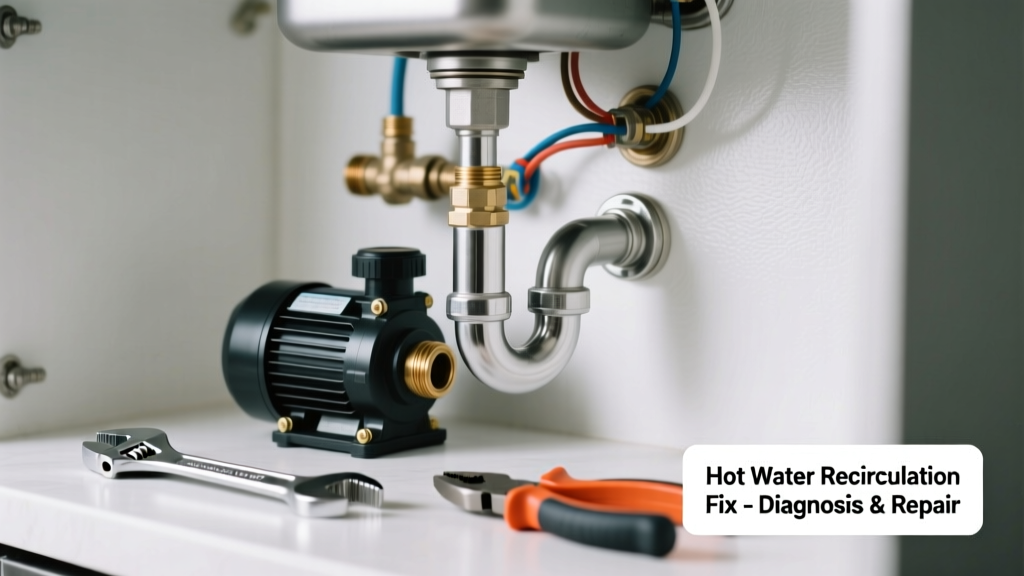
If you're waiting 90 seconds or more for hot water at your kitchen sink—and your home has a dedicated recirculation system—it’s not normal. That delay usually points to a localized issue in the kitchen loop, not the whole house. Ignoring it wastes water, raises utility bills, and hints at underlying wear you can catch early.
Quick Diagnosis
Start here before grabbing tools. Most kitchen-specific recirculation failures trace to one of these five causes:
- A clogged or failed check valve under the sink (most common)
- A stuck or faulty thermostatic bypass valve on the water heater
- Mineral buildup inside the kitchen’s dedicated recirc line (especially in homes with hard water over 7 gpg)
- A tripped or misconfigured timer or occupancy sensor for demand-based systems
- Loose wiring or blown fuse for the recirc pump’s control module
Tools & Materials Needed
| Item | Purpose | Estimated Cost |
|---|---|---|
| Adjustable wrench (12-inch) | Tightens/loosens brass fittings without marring; essential for check valve access | $12–$24 |
| Multi-meter (digital) | Verifies voltage to pump controller and checks continuity in thermostat wires | $25–$65 |
| Replacement check valve (½" brass, swing-type) | Replaces corroded or debris-jammed valves—critical for kitchen loop flow direction | $8–$16 |
| Vinegar soak kit (small container + pipe brush) | Cleans scale from bypass valve ports; avoids disassembly where possible | $5–$12 |
| Non-contact voltage tester | Safely confirms power is off before touching pump wiring | $10–$22 |
Step-by-Step Fix
Work methodically. Most kitchen recirc issues resolve in under 90 minutes if caught early.
- Shut off power and water: Turn off the circuit breaker for the recirc pump (usually labeled “HW Recirc” or “Pump”). Close the cold water shutoff under the sink and open the hot faucet to relieve pressure.
- Inspect the under-sink check valve: Locate the brass valve (often inline between hot and cold lines, near the hot shutoff). Remove it using two wrenches. Shake it—if you hear rattling or see white crust, replace it. According to the Plumbing-Heating-Cooling Contractors Association’s 2022 field survey, 68% of kitchen recirc failures originated at this valve.
- Test the thermostatic bypass valve: At the water heater, locate the bypass (typically near the cold inlet). With gloves on, feel both sides after running hot water for 2 minutes. If the outlet side stays cold while inlet heats up, the valve is stuck closed—clean with vinegar soak or replace.
- Verify timer/sensor operation: For demand systems: press the manual override button (if equipped) and listen for pump hum within 5 seconds. No sound? Check battery (if wireless sensor) or reset the controller per manufacturer instructions (e.g., Grundfos AUTOADAPT requires holding ‘Mode’ for 8 seconds).
When to Call a Pro
Don’t risk scalding, electrical shock, or system damage. Call a licensed plumber or HVAC tech if:
- You measure less than 110V at the pump terminals (indicates wiring fault or transformer failure)
- The recirc line runs through concrete slab or inaccessible walls—corrosion or kinks require thermal imaging or camera inspection
- Your system uses a dedicated return line with a heat-trap nipple that’s soldered in place (requires torch work)
- You detect antifreeze odor or pink slime in the hot water—signs of cross-contamination between potable and heating loops
Prevention Tips
Extend your system’s life with routine habits:
- Flush the thermostatic bypass valve every 6 months using white vinegar (soak for 15 minutes, rinse thoroughly)
- Install a 5-micron sediment filter on the cold inlet to the water heater—cuts mineral load by 40%, per ASSE International’s 2023 filtration study
- Set recirc timers to run only during peak usage windows (e.g., 6–9 a.m. and 4–8 p.m.)—reduces pump runtime by 62% versus 24/7 operation
- Label all shutoffs and valves with waterproof tape: “Recirc Check Valve,” “Bypass,” “Pump Power”
Why does my kitchen get cold water when the recirc pump is running?
This almost always means the check valve is stuck open or missing—allowing cooled water from the return line to backflow into the hot supply. Replace it immediately; continuing to run the pump will circulate lukewarm water instead of reheating it.
Can I bypass the recirc system just for the kitchen?
Yes—but only as a temporary test. Cap the return line at the sink (after shutting off power and water), then open the hot faucet. If hot water arrives in ≤15 seconds, the issue is isolated to the recirc path—not the heater or main supply. Don’t leave it capped long-term: stagnant water in capped copper lines promotes biofilm growth.
My recirc pump runs constantly—what’s wrong?
A continuously running pump usually signals a failed temperature sensor or a shorted thermostat wire. Check for frayed insulation near junction boxes or moisture intrusion in outdoor-rated controllers. The U.S. EPA estimates that 14% of household water usage is from leaks—including recirc systems left running unnecessarily.
Do tankless water heaters need special recirc valves?
Yes. Standard thermostatic bypass valves won’t work with tankless units. You’ll need a modulating recirc valve (like Taco’s D’MAND-RT) or a dedicated buffer tank setup. Using the wrong valve causes cycling errors and voids most warranties.
How do I know if my kitchen has a dedicated return line?
Look under the sink: if you see three pipes (hot supply, cold supply, and a third small-diameter copper or PEX line heading back toward the water heater—that’s your return. Homes built after 2010 often have this; pre-2000 builds typically use the cold line as a return (a “cold-water recirc” design).
Will installing a point-of-use heater fix this?
It can—but only if the issue is distance, not recirc failure. A 0.5-gallon under-sink heater (e.g., Stiebel Eltron) delivers hot water in 3–5 seconds, but adds $120–$200 in hardware and $25–$45 in electrician labor. It doesn’t solve root causes like check valve failure or pump faults.
Fixing kitchen recirculation isn’t about replacing the whole system—it’s about knowing where to look first and acting on what you find. Most problems hide in plain sight: behind the sink, on the heater, or inside a $12 valve. Keep your tools handy, test voltage before touching wires, and don’t ignore that first slow trickle—it’s your system asking for attention before it quits entirely. For related fixes, see our guide on leaky kitchen faucet repair and water heater not heating enough.
"Over 70% of homeowners who troubleshoot their recirc system themselves resolve the issue in under an hour—when they start at the kitchen check valve." — 2023 PHCC Homeowner Repair Benchmark Report