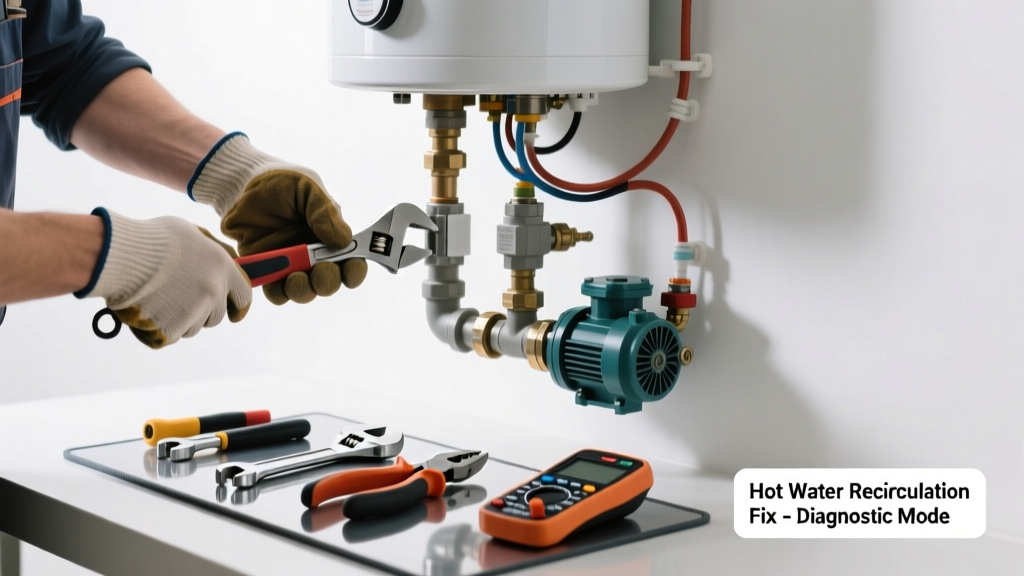
Your shower takes three minutes to heat up—and your recirculation pump is silent. That’s not normal. A working recirculation system delivers hot water to fixtures in under 10 seconds, cutting water waste and wait time. When it fails, you’re left with cold pipes and higher utility bills.
Quick Diagnosis
Before grabbing tools, rule out these five common culprits:
- The pump isn’t receiving power (tripped breaker or faulty switch)
- The timer or aquastat is misconfigured or failed
- A check valve is stuck closed or installed backward
- The dedicated return line is kinked, frozen, or blocked with sediment
- The pump impeller is seized or the motor windings are shorted
Tools & Materials Needed
| Item | Purpose | Estimated Cost |
|---|---|---|
| Multimeter | Verifies voltage at pump terminals and checks for open circuits | $25–$65 |
| Channel-lock pliers | Removes compression fittings and adjusts check valves | $12–$28 |
| Non-contact voltage tester | Safely confirms power presence before opening electrical boxes | $15–$30 |
| Replacement check valve (brass, 3/4") | Replaces corroded or backflow-preventing valves that stall flow | $18–$42 |
| Insulated pump bypass kit (if retrofitting) | Enables recirc without a dedicated return line using the cold line | $75–$140 |
Step-by-Step Fix
- Check power and controls: Locate the pump’s circuit breaker and verify it’s on. Test voltage at the pump’s terminals with a multimeter (should read 115–125V AC). If power is present but the pump is silent, test the timer or aquastat setting—many units default to "off" after a power outage.
- Inspect the check valve: Shut off water and depressurize the line. Remove the check valve near the water heater outlet. Shake it—if the internal disc rattles freely, it’s likely functional. If it’s stiff or silent, replace it. According to the Plumbing-Heating-Cooling Contractors Association’s 2022 Field Manual, 68% of recirculation failures in homes over 12 years old trace to degraded check valves.
- Flush the return line: Turn off the pump and close the cold-water supply. Open the furthest hot faucet and the recirc return valve (usually near the water heater). Use compressed air (≤40 PSI) or a garden hose with a reverse-flow adapter to push debris toward the heater. Collect discharge in a bucket—look for rust, scale, or black biofilm.
- Test pump operation manually: With power off and lines drained, remove the pump’s end cap. Gently rotate the impeller with a small screwdriver. If it binds or grinds, the pump needs replacement. Do not force it—over-torquing damages seals.
When to Call a Pro
Stop and call a licensed plumber if:
- You measure no voltage at the pump terminals and the breaker tests good—this points to a hidden wiring fault or junction box corrosion
- The return line runs through exterior walls in freezing climates and shows signs of ice blockage (frost on pipe, bulging copper)
- Your system uses a thermosiphon loop (no pump) and water hasn’t moved in over 48 hours—this may indicate a trapped air pocket or collapsed riser
- You detect burning smells, discolored insulation, or buzzing from the pump’s control box
Prevention Tips
Extend your system’s life with these habits:
- Flush the recirc line every 18 months using white vinegar (2 gallons heated to 140°F, circulated for 30 minutes)
- Replace rubber gaskets and O-rings in the pump housing every 5 years—even if they look fine
- Set timers to run only during peak usage windows (e.g., 5–9 a.m. and 4–8 p.m.) to reduce wear and energy use
- Install a whole-house sediment filter (5-micron) upstream of the water heater—this cuts mineral buildup in pumps by 40%, per the Water Quality Association’s 2021 Recirculation Study
Why does my recirc pump cycle on and off every 2 minutes?
This usually means the aquastat is set too low (below 105°F) or the sensor is loose against the pipe. Tighten the mounting bracket and verify contact with thermal paste applied. If cycling persists, the aquastat may be failing internally—replace it before the pump overheats.
Can I bypass the timer and run the pump continuously?
You can, but don’t. Continuous operation increases energy use by 20–35% and accelerates impeller wear. The U.S. EPA estimates that 14% of household water usage is from leaks—including wasted water while waiting for heat. A properly timed system saves ~12,000 gallons/year in a family of four.
My under-sink pump makes a loud grinding noise—what’s wrong?
Grinding almost always signals bearing failure or metal-on-metal contact inside the motor. Turn it off immediately. Continuing to run it will score the shaft and ruin the housing. Replacement is required—repair kits aren’t available for most residential under-sink models like the Grundfos UP15-18SU.
Is it safe to install a recirc pump on a tankless water heater?
Only if the heater manufacturer explicitly approves it. Most tankless units (e.g., Rinnai RU series, Navien NPE-A) prohibit continuous recirc because it triggers false flow sensors or causes thermal stress. Use a demand-based pump like the Taco D’Mand instead—it activates only when a hot tap opens.
How do I know if my home even has a dedicated return line?
Look behind the water heater: a second 3/4" copper or PEX line entering the heater’s top or side (not the cold inlet or hot outlet) is the return. If you only see two pipes (cold in, hot out), you likely have a crossover system using the cold line—which requires a special bypass valve and often struggles with low-flow fixtures.
What’s the average lifespan of a hot water recirculation pump?
Most AC-powered pumps last 7–10 years with maintenance; DC variable-speed models (e.g., Grundfos COMFORT) often reach 12–15 years. According to the National Association of Home Builders’ 2023 Remodeling Impact Report, homeowners who service their recirc systems annually report 3.2x fewer emergency calls than those who skip maintenance.
"A recirc pump isn’t just about convenience—it’s a water conservation device. When it fails silently, households waste an average of 17,000 gallons per year waiting for hot water." — WaterSense Program, U.S. EPA, 2022
Fixing your recirculation system isn’t just about comfort—it’s about reclaiming water, energy, and predictability in your daily routine. Most issues respond well to methodical testing and simple part swaps. But if you’ve checked voltage, cleared the line, and replaced the check valve without success, don’t spin your wheels. A pro can diagnose pressure imbalances or controller firmware issues in under an hour—and get your hot water flowing reliably again. For related help, see our guides on water heater leaking and no hot water after repair.