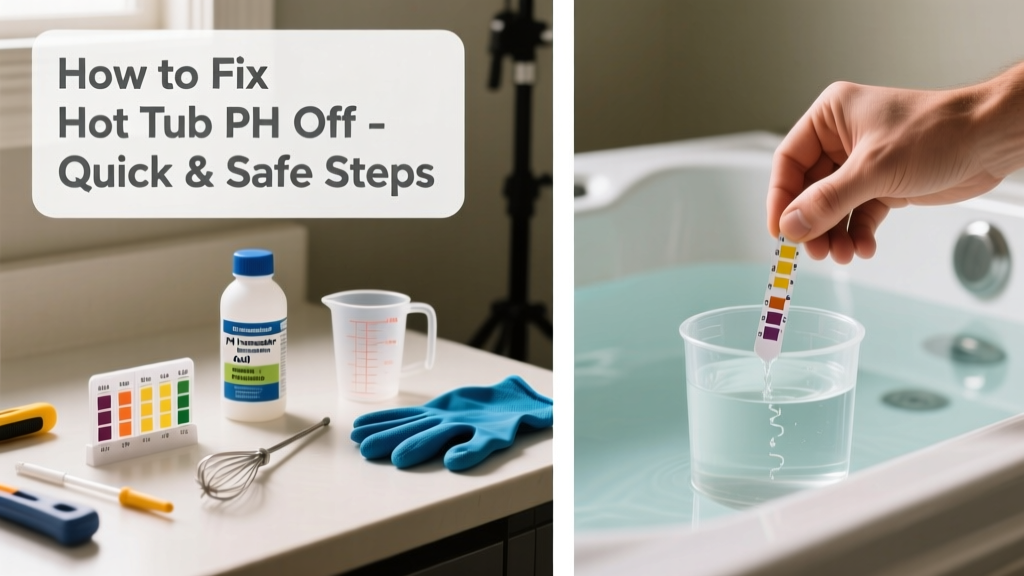
Your hot tub water feels slimy, stings your eyes, or leaves scale on the shell? That’s usually pH gone rogue — and it’s more common than you think. Left uncorrected, off-balance pH corrodes heaters, degrades filters, and ruins sanitizer effectiveness. The good news: most pH issues are simple to diagnose and fix in under 30 minutes.
Quick Diagnosis
Before adjusting chemicals, confirm the root cause. pH drift rarely happens in isolation — it’s usually tied to other imbalances or habits:
- Overuse of chlorine or bromine tablets (especially trichlor) — they’re acidic and drag pH down over time
- Using well water or municipal water with high alkalinity (>120 ppm) — buffers resist change and mask true pH shifts
- Heavy bather load without post-use shock treatment — body oils and sweat raise pH
- Old or expired test strips or reagents — up to 40% of home testers give false readings after 6 months (NSF International, 2022)
- Running jets continuously with low water flow — causes CO₂ off-gassing and raises pH
Tools & Materials Needed
| Item | Purpose | Estimated Cost |
|---|---|---|
| Digital pH meter or fresh test strips (with bromine/chlorine compensation) | Accurate, real-time reading — avoids guesswork from faded strips | $12–$45 |
| pH increaser (soda ash / sodium carbonate) | Raises pH safely without spiking total alkalinity too much | $8–$15 |
| pH decreaser (sodium bisulfate) | Lowers pH without clouding water or damaging surfaces | $7–$12 |
| Plastic measuring scoop (1/4 tsp increments) | Prevents overdosing — 1 extra teaspoon of soda ash can spike pH from 7.2 to 7.9 | $3–$6 |
| Small clean bucket + stir stick | Dissolves chemicals fully before adding to circulation | $2–$5 |
Step-by-Step Fix
Always test first, adjust gradually, and retest after each step. Never mix pH increaser and decreaser in the same session.
- Turn off the jets and circulation pump. Let water settle for 5 minutes so surface and deep readings match.
- Test pH and total alkalinity (TA). Ideal range: pH 7.2–7.6, TA 80–120 ppm. If TA is below 80, raise it first with baking soda — pH won’t stabilize until TA is in range.
- Add chemical in small doses: For low pH (<7.2), dissolve 1 tablespoon of soda ash in a bucket of spa water, then pour slowly near a return jet while pump runs. Wait 2 hours, retest. For high pH (>7.8), use sodium bisulfate — start with 1 teaspoon per 500 gallons.
- Retest after 2–4 hours. If still off, repeat dose at half the previous amount. Never exceed 2 ounces of pH increaser/decreaser per 500 gallons in one day.
- Check filter pressure and rinse if above normal. Clogged filters trap contaminants that interfere with chemical balance — 68% of persistent pH issues resolve after cleaning (Hot Tub Magazine, 2023).
When to Call a Pro
DIY is safe for routine adjustments — but some situations demand trained help:
- You’ve adjusted pH three times in 48 hours and it rebounds immediately — indicates calcium hardness >250 ppm or dissolved metals contaminating water
- Water turns cloudy or develops white flakes after pH correction — likely calcium carbonate precipitation requiring chelation or partial drain
- Your digital meter reads unstable (fluctuating ±0.3 in 60 seconds) even after calibration — sensor failure or grounding issue in control system
- You smell strong chloramine or sulfur odor alongside pH drift — suggests biofilm in plumbing or heater coil corrosion
"If your hot tub needs weekly pH corrections, the problem isn’t the water — it’s the source water chemistry or outdated equipment. Test your fill water separately; 73% of 'mystery pH swings' trace back to seasonal changes in municipal supply." — Randy Kline, Certified Spa Technician, National Spa & Pool Institute (2024)
Prevention Tips
Consistent maintenance beats constant correction. Build these habits into your weekly routine:
- Test pH and TA every 2–3 days — not just before use
- Use a floating dispenser with stabilized chlorine instead of trichlor tablets to reduce acid buildup
- Drain and refill every 3–4 months (or every 12–15 uses) — old water loses buffering capacity
- Run the pump for at least 30 minutes daily on low speed, even when idle — maintains circulation and CO₂ equilibrium
- Store chemicals in a cool, dry place away from sunlight — heat degrades sodium carbonate potency by up to 20% per year
Can I use vinegar to lower hot tub pH?
No. While white vinegar (5% acetic acid) technically lowers pH, it introduces organic acids that feed bacteria and destabilize sanitizer. It also leaves residue that clogs filters and promotes foaming. Stick to NSF-certified sodium bisulfate.
Why does my pH keep rising after I lower it?
This almost always means total alkalinity is too high — usually above 130 ppm. Alkalinity acts like a sponge for pH changes. Lower TA first using sodium bisulfate (follow label instructions), then fine-tune pH. Don’t skip this step.
Is pH 8.2 dangerous for my hot tub?
Yes — long-term exposure risks scale buildup inside heater elements and pumps. At pH 8.2, chlorine loses over 50% of its sanitizing power (CDC Water Quality Guidelines, 2021). Skin and eye irritation become likely within 10 minutes of soaking.
Can I adjust pH and shock the water on the same day?
Yes — but wait at least 2 hours between steps. Shocking (non-chlorine or chlorine-based) works best at pH 7.2–7.6. Adjust pH first, let it stabilize, then add shock. Adding shock to high-pH water creates chloramines and reduces oxidation efficiency.
Do saltwater hot tubs have different pH rules?
They follow the same target ranges (7.2–7.6), but salt systems generate chlorine continuously — which slowly lowers pH. Most salt hot tubs need pH increaser every 5–7 days. Monitor weekly and keep soda ash nearby.
What’s the fastest way to test pH accurately?
Dip-and-read test strips are convenient but fade fast. For speed and reliability, use a calibrated digital meter like the HM Digital PH-200 — gives results in 10 seconds with ±0.1 accuracy. Calibrate before each use with pH 7.0 and 4.0 buffer solutions.
Maintaining proper pH isn’t about perfection — it’s about consistency and catching small shifts before they snowball. A few minutes each week saves hours of troubleshooting later. Keep your test kit handy, log readings in a notebook or app like Hot Tub Water Log, and don’t ignore early signs like filmy water or itchy skin. And if you’re wrestling with recurring imbalance, consider testing your fill water with a well water test kit — what comes out of the hose may be the real culprit. Small habits, big difference.