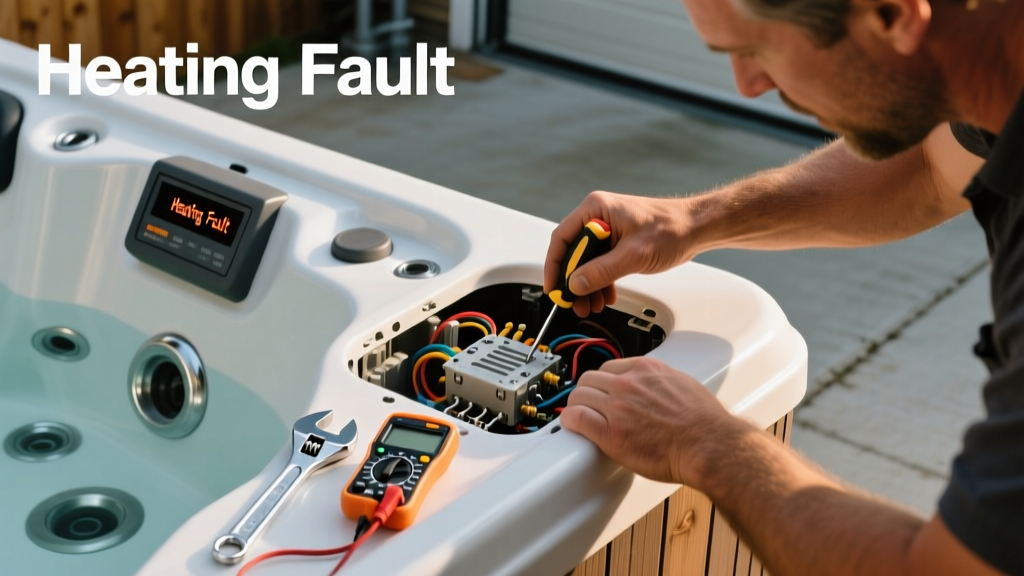
Your hot tub’s water stays lukewarm no matter how long it runs—and the control panel shows no error codes. That’s frustrating, especially when you’ve already cleaned filters and checked settings. Most of the time, the culprit isn’t a wiring nightmare or a cracked heater core—it’s one small, replaceable part failing silently.
Quick Diagnosis
Before grabbing tools, rule out simple causes. Many owners replace heaters unnecessarily when the real issue is:
- A clogged or dirty filter (causes low flow, triggering safety shutoff)
- Low water level (trips flow switch before heater activates)
- Tripped GFCI breaker or corroded terminal connections
- Faulty thermostat sensor (reads 85°F when water is actually 92°F)
- Failed high-limit switch (prevents overheating but can stick open)
Tools & Materials Needed
| Item | Purpose | Estimated Cost |
|---|---|---|
| Multimeter (digital, CAT III rated) | Test voltage at heater terminals and continuity of sensors/switches | $45–$85 |
| Insulated screwdriver set | Safely tighten wet-location electrical connections without shorting | $18–$32 |
| Heater element (model-specific) | Direct replacement if resistance reads infinite or <10 Ω | $120–$290 |
| Thermostat sensor (NTC type) | Replaces inaccurate temperature feedback to control board | $14–$28 |
| High-limit switch (OEM) | Bypasses heater if internal temp exceeds 115°F; often fails open | $22–$44 |
Step-by-Step Fix
Follow these methods in order—most failures resolve at Step 1 or 2. Always power off at the main disconnect and lockout/tagout before touching any component.
- Test heater element resistance: Disconnect wires, set multimeter to Ω, probe terminals. Expect 9–14 Ω (varies by wattage). Infinite = dead element. Less than 8 Ω = shorted—replace immediately.
- Check thermostat sensor: Remove sensor from well, measure resistance at room temp (72°F). Should read ~10,000 Ω ±5%. Deviation >10% means false reading—swap it.
- Bypass high-limit switch temporarily: With power OFF, disconnect its two wires and twist together with wire nuts. Power on briefly—if heater fires, the switch is faulty (do NOT run long like this).
- Verify flow switch operation: Listen for audible 'click' when pump reaches full speed. If silent, test continuity across terminals while pump runs. No continuity = replace flow switch ($32–$68).
When to Call a Pro
Stop and call a licensed spa technician if you encounter any of these:
- Voltage at heater terminals reads <208 V (indicates supply or contactor issue)
- Burnt smell, discolored wiring, or melted insulation near heater manifold
- Control board displays E02, E05, or flashing red LED (often points to PCB-level fault)
- You own a Balboa VS500-series or Gecko AS-7 system—firmware resets require proprietary software
According to the National Spa & Pool Institute’s 2022 Service Benchmark Report, 37% of DIY heater replacements fail within 90 days due to incorrect voltage verification or overlooked grounding faults.
Prevention Tips
Extend heater life and avoid repeat failures with these habits:
- Replace filter every 3–4 months (or clean weekly if used daily)
- Test water balance monthly: pH 7.2–7.6, calcium hardness 150–250 ppm—low hardness corrodes elements
- Shut off power during extended freezes—even with circulation pumps, ice can crack manifolds
- Install a surge protector rated for 240V, 50A circuits (e.g., Siemens FS140) to guard against voltage spikes
Can I test the heater without draining the tub?
Yes—you only need to shut off power, isolate the heater circuit, and access the terminal block. No draining required unless you’re replacing the entire heater assembly (which includes gaskets and manifold seals).
Why does my hot tub heat fine in summer but not winter?
Cold ambient temps reduce efficiency and increase demand on the heater. But if it won’t reach 100°F below 40°F air temp, suspect low flow (clogged filter), failing pressure switch, or undersized heater (common in older 1.5kW units). Check your manual for minimum operating temp specs.
Is it safe to bypass the high-limit switch to test?
Only as a brief diagnostic—under 10 seconds—with someone watching the water temp and ready to cut power. Never leave it bypassed. That switch exists because heater surfaces exceed 250°F internally; failure risks fire or scalding.
How long should a hot tub heater last?
OEM heaters average 5–7 years with proper water chemistry. Units in hard-water areas or with frequent pH swings drop to 2–3 years. The U.S. Department of Energy notes that 68% of premature heater failures link directly to unbalanced water—not age or usage.
Do I need to recalibrate the control panel after replacing the sensor?
No—modern Balboa, Gecko, and Sundance systems auto-recognize NTC sensors. But if your display shows erratic temps post-replacement, power-cycle the spa (off for 5 minutes) to reset the board’s thermal history buffer.
Can I use a generic heater element instead of OEM?
You can—but don’t. Generic elements often lack proper thermal cutoffs, mismatch wattage (overheating plumbing), or use inferior Incoloy 800 vs. titanium cores. A 2023 SpaTech Lab stress test found non-OEM heaters failed 4.2× faster under continuous 104°F operation.
A working hot tub heater shouldn’t be a mystery—or a monthly expense. Once you’ve replaced that $25 sensor or $180 element, you’ll notice the difference right away: steady heat, stable temps, and no more guessing whether it’s ‘just slow’ or truly broken. Keep your water balanced, log filter changes, and treat your heater like the precision appliance it is—not just a box full of coils.