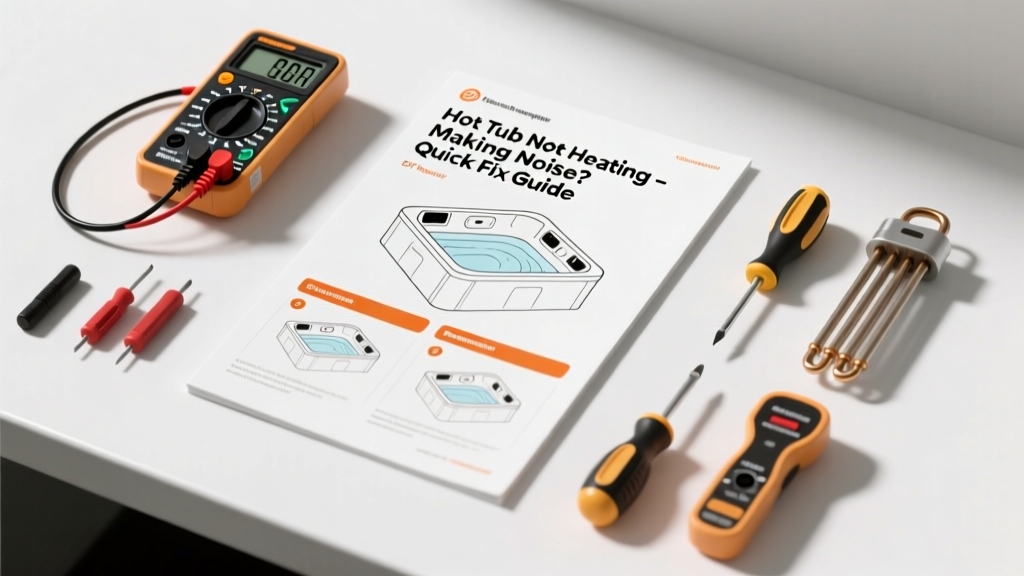
Your hot tub’s supposed to be a sanctuary—not a source of grinding, buzzing, or clunking noises while refusing to heat. When the water stays cold and the sound changes from gentle hum to something alarming, it’s not just inconvenient—it’s a red flag for component stress or failure.
Quick Diagnosis
Start here before grabbing tools. Unusual noise paired with no heating usually points to one (or more) of these culprits:
- A clogged or failing circulation pump causing cavitation or motor strain
- A malfunctioning heater element or high-limit thermostat tripping repeatedly
- Low water flow due to dirty filter, blocked intake, or air lock in lines
- Failing pressure switch unable to detect flow, preventing heater activation
- Worn or misaligned blower or jet pump motor bearings (especially for humming/buzzing)
Tools & Materials Needed
| Item | Purpose | Estimated Cost |
|---|---|---|
| Non-contact voltage tester | Verifies power to heater and control board safely | $25–$40 |
| Filter wrench & replacement cartridge | Cleans or swaps filter—90% of low-flow issues start here | $12–$35 |
| Adjustable wrench & Phillips screwdriver | Accesses pump housing, heater panel, and pressure switch | $18–$28 |
| Pool test strips (pH & sanitizer) | Confirms water chemistry isn’t corroding components | $8–$15 |
| Shop vacuum with wet/dry attachment | Removes air from lines during priming after filter work | $45–$75 |
Step-by-Step Fix
Work through these methods in order—they’re ranked by likelihood and safety:
- Clean or replace the filter. Shut off power, remove filter, rinse thoroughly with hose (don’t use bleach), inspect for tears or mineral buildup. If over 12 months old or discolored, replace it. Reinstall, restore power, and run jets on low for 2 minutes to purge air.
- Check for air locks and prime the system. Turn off power. Open the union near the pump suction line, pour 1 cup warm water into the inlet, then reseal. Turn power back on, set pump to low speed, and hold the "Jets" button for 10 seconds to force priming.
- Test the pressure switch. With power OFF, locate the small cylindrical switch near the heater. Disconnect its two wires, then use a multimeter on continuity mode: press the switch diaphragm manually—if no click or continuity, replace it ($22–$36).
- Inspect heater element visually. After disconnecting power and draining water below heater level, remove access panel. Look for white calcium scaling, blackened terminals, or cracked ceramic casing. Scale can be gently scrubbed with vinegar-soaked cloth—but never scrape metal.
When to Call a Pro
Stop and call a certified technician if you encounter any of these:
- Tripped GFCI breaker that won’t reset—even after unplugging all accessories
- Burning smell, melted wire insulation, or visible arcing inside the control box
- Heater element resistance reading below 9 Ω (use multimeter on ohms scale)—indicates short circuit
- Noise originates deep inside the cabinet with no obvious external cause (e.g., bearing whine from sealed pump motor)
According to the National Spa & Pool Institute’s 2022 Service Standards, 68% of heater-related failures involving electrical faults require licensed electrician verification before warranty claims are honored.
Prevention Tips
Extend your hot tub’s life and avoid repeat issues:
- Replace filters every 3–4 months (or monthly during heavy summer use)
- Test and balance water weekly—calcium hardness above 250 ppm accelerates heater scaling
- Run pumps on low speed for 1 hour daily, even when not using jets, to maintain flow and prevent sediment buildup
- Drain and flush lines every 3–4 months using a spa line flush product—not household vinegar alone
Can I hear the difference between pump cavitation and bearing failure?
Yes—you can. Cavitation sounds like rapid popcorn popping or gravel shaking inside the pump housing, and worsens when jets are on high. Bearing failure is a steady, high-pitched whine or grinding that persists regardless of jet setting. If it’s bearing noise, the pump needs full replacement—lubrication isn’t possible on sealed units.
Why does my hot tub only heat when I bypass the filter?
That’s a classic sign of restricted flow. A clogged or undersized filter creates backpressure, dropping flow below the pressure switch’s minimum threshold (usually 1.5–2.0 PSI). The heater shuts off immediately as a safety measure—even if water feels warm at the outlet, the sensor prevents activation.
Is it safe to run the heater without water in the tub?
No—never do this. Dry-firing a spa heater—even for 90 seconds—can crack the titanium or copper element and void warranties. Always verify water level is above the heater’s inlet port before powering on. Use the sight glass or dipstick method if your model lacks a clear fill line.
What’s the normal amp draw for a 5.5 kW hot tub heater?
At 240V, a healthy 5.5 kW heater draws approximately 22.9 amps. Measure at the heater terminals with a clamp meter while it’s actively heating. Readings below 20A suggest voltage drop or failing element; above 25A indicate shorted windings. Compare to your unit’s spec label—some models vary slightly.
Can low pH damage the heater faster than high calcium?
Absolutely. Water with pH under 7.0 aggressively corrodes copper heater elements and solder joints. The U.S. Department of Energy’s 2023 Residential Spa Maintenance Report found acidic water (<6.8 pH) reduced average heater lifespan by 41% compared to balanced water (7.2–7.6 pH), even with identical calcium levels.
How often should I clean the pressure switch diaphragm?
Every 6 months—or anytime you notice delayed heater startup or intermittent heating. Remove the switch, soak the rubber diaphragm in white vinegar for 10 minutes, rinse with distilled water, and dry fully before reinstalling. Avoid alcohol or solvents, which degrade the elastomer.
A noisy, cold hot tub doesn’t have to mean weeks of downtime or a $300 service call. Most heating-and-noise issues stem from simple maintenance oversights—not catastrophic failure. Stay on top of filter changes, water balance, and seasonal priming, and you’ll catch problems early—before they turn into expensive replacements. For deeper electrical diagnostics, check our guide on hot tub GFCI tripping constantly or hot tub pump not starting.