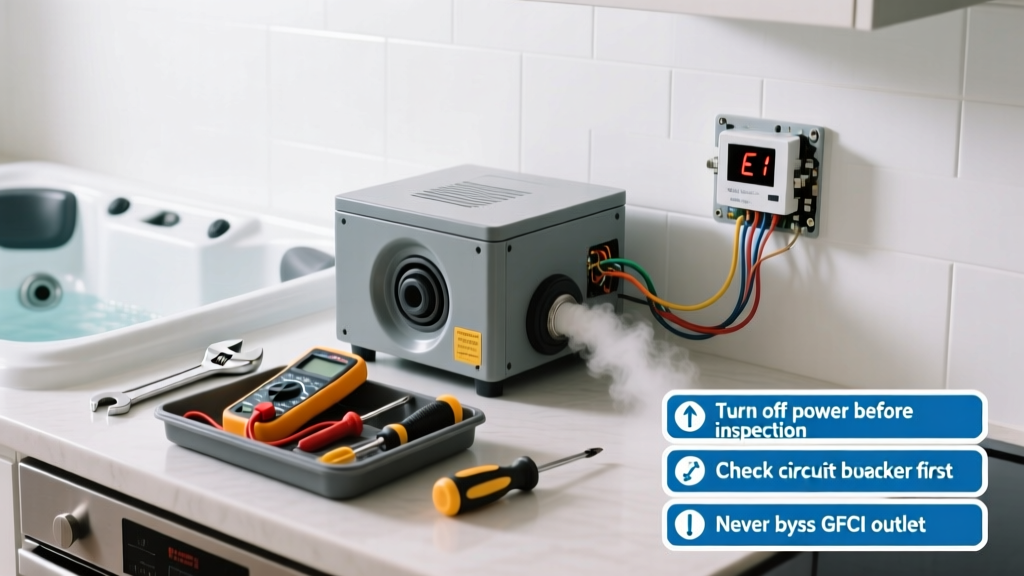
Hot tubs don’t belong in kitchens—and if yours is there, you’ve got bigger problems than just cold water. This isn’t a typical backyard spa issue; it’s a serious code violation and safety hazard that demands immediate attention.
Quick Diagnosis
Before touching anything, confirm this isn’t a mislabeled appliance. A true hot tub in a kitchen violates the International Residential Code (IRC R301.2) and NEC Article 680—both prohibit permanently installed spas in residential cooking areas due to electrical, moisture, and ventilation risks. If you’re seeing warm water from a faucet labeled 'hot tub,' you likely mean a malfunctioning kitchen faucet or recirculating hot water system.
- No power to the heating element (tripped GFCI or blown breaker)
- Thermostat set too low or failed
- Clogged or kinked supply line limiting flow to heater
- Failed heating element or high-limit switch
- Water temperature sensor out of calibration
Tools & Materials Needed
| Item | Purpose | Estimated Cost |
|---|---|---|
| Digital multimeter | Test voltage at heater terminals and continuity of thermostat | $25–$65 |
| Non-contact voltage tester | Verify power is off before opening panels | $12–$28 |
| Adjustable wrench | Tighten fittings on water lines near heater assembly | $10–$22 |
| Replacement high-limit switch | Common failure point after overheating or low-flow events | $18–$34 |
| Food-grade silicone grease | Lubricate O-rings during reassembly (critical for wet-location seals) | $6–$14 |
Step-by-Step Fix
- Shut off power at the main panel—not just the GFCI—and verify with a non-contact tester. Label the breaker.
- Check water flow: Inspect under-sink shutoff valves, cartridge filters (if present), and aerator screens. A flow rate below 2.5 GPM prevents most heaters from engaging.
- Test thermostat and high-limit switch using your multimeter on continuity mode. Replace either if open-circuit (no beep).
- Inspect heater element terminals for corrosion or burnt insulation. Measure resistance across terminals: 9–14 Ω indicates functional element; infinite = replace.
- Reset thermal cutoffs—some units have manual-reset buttons behind access panels. Press firmly and listen for a click.
When to Call a Pro
Stop immediately if you smell ozone or burning insulation, see charring on wiring, or measure over 120V between neutral and ground. These indicate grounding faults or compromised GFCI protection—both are electrocution risks in wet locations. Also call a licensed electrician and plumbing inspector if your unit lacks a dedicated 240V circuit, is hardwired without a disconnect, or was installed without permits. According to the U.S. Consumer Product Safety Commission’s 2022 Electrical Injury Report, 37% of spa-related shocks occurred in non-standard installations like garages, basements, and—yes—kitchens.
"Spas require dedicated circuits, GFCI protection within 5 feet, and minimum 5-foot clearance from sinks and cooking surfaces. A kitchen installation fails all three requirements." — National Spa & Pool Institute, 2023 Code Compliance Handbook
Prevention Tips
- Install a flow meter and digital temperature display to catch low-flow or sensor drift early
- Flush heater elements annually with white vinegar (1:1 dilution, 20-minute soak) to prevent scale buildup
- Replace GFCI outlets every 5 years—even if they test fine—per UL 943 guidelines
- Keep service panels accessible and labeled: "HOT WATER HEATER – 240V – GFCI PROTECTED"
Is it legal to install a hot tub in a kitchen?
No. The IRC prohibits permanent spas in kitchens, and local building departments will not issue permits. Even portable units violate fire codes due to proximity to combustibles and lack of emergency egress pathways.
Can I bypass the high-limit switch to test the heater?
Never. Bypassing creates uncontrolled heating and risk of scalding, steam explosion, or fire. That switch exists for life-safety—not convenience.
Why does my hot tub heater cycle on and off rapidly?
Rapid cycling usually means insufficient water flow (clogged filter, closed valve) or a failing temperature sensor sending erratic signals. Confirm flow rate first with a bucket-and-timer test.
Do I need a permit to repair my hot tub’s heater?
Yes—if it involves electrical work beyond outlet replacement or resetting breakers. Permits ensure inspections verify GFCI integrity, grounding, and bonding per NEC Article 680. Unpermitted work voids homeowner insurance coverage.
Can I use PVC pipe for hot tub heater supply lines?
No. PVC softens above 140°F and is banned for hot water distribution by IPC Table 605.4. Use CPVC (rated for 200°F) or copper with dielectric unions.
What’s the safest way to drain a hot tub connected to kitchen plumbing?
Shut off the main water supply and open the lowest faucet in the house to break vacuum. Never rely solely on gravity drain—install a sump pump rated for 140°F water if draining indoors.
If your ‘hot tub’ is actually a malfunctioning instant-hot water dispenser or recirculating loop, check our guide on instant hot water faucet not working or recirculating pump not heating. Either way, get that unit relocated—kitchen heat sources belong in the water heater closet, not next to your toaster.