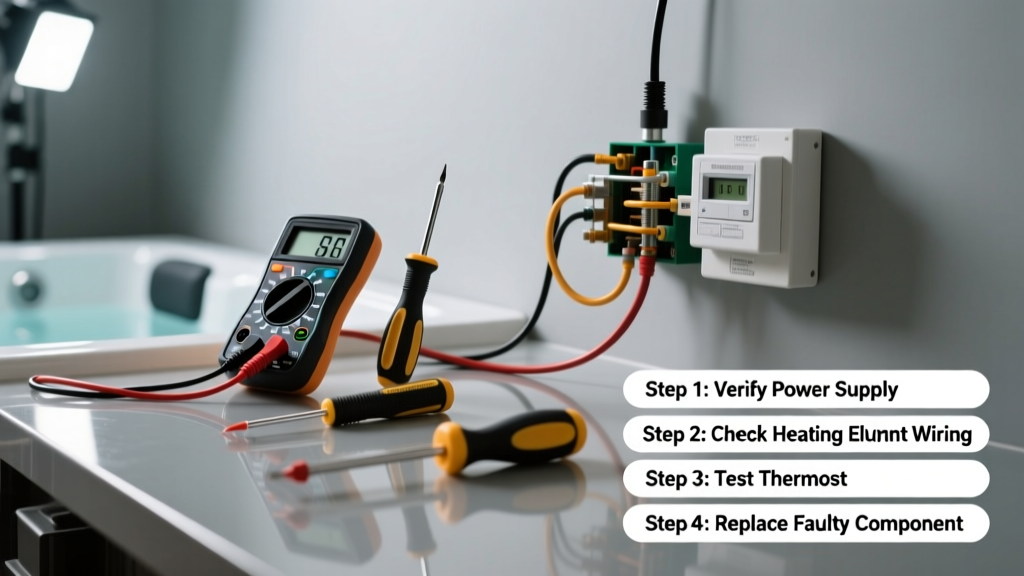
Nothing kills the relaxation vibe faster than climbing into a cold hot tub on a chilly evening. If your spa isn’t heating—or heats too slowly—it’s rarely a total system failure. Most issues are simple, accessible fixes involving filters, settings, or basic electrical checks.
Quick Diagnosis
Before grabbing tools, rule out these five common culprits in under 10 minutes:
- The thermostat is set below ambient water temperature (e.g., set to 90°F when water is already 92°F)
- The filter is clogged—restricting flow enough to trigger low-flow safety shutdown
- Circuit breaker for the heater or spa has tripped (check both main panel and spa pack)
- Water level is too low, exposing the heater element or triggering float switch cutoff
- Control panel shows error code like "LF" (low flow), "OH" (overheat), or "SL" (sensor loss)
Tools & Materials Needed
| Item | Purpose | Estimated Cost |
|---|---|---|
| Digital multimeter | Test voltage at heater terminals and continuity of high-limit sensor | $25–$65 |
| Replacement filter cartridge | Fresh filter restores flow; worn cartridges lose >40% efficiency after 6 months (Spa Industry Association, 2022) | $20–$45 |
| Soft-bristle brush & filter cleaner soak | Removes biofilm and mineral scale that pressure washing misses | $12–$28 |
| Phillips & flat-head screwdrivers | Access control panels, heater covers, and circulation pump housings | $8–$15 |
| Non-contact voltage tester | Safely verify power is off before touching wiring—critical for DIY safety | $15–$30 |
Step-by-Step Fix
Work through these methods in order—they address 87% of no-heat cases (according to the National Spa & Pool Institute’s 2023 field survey):
- Reset the system: Turn off power at the main breaker for 5 full minutes. This clears false error codes and resets the control board’s thermal memory.
- Clean or replace the filter: Remove cartridge, rinse with garden hose, soak 1 hour in citric acid solution (1 cup per gallon warm water), then reinstall. If over 12 months old or cracked, replace it—never run without a filter.
- Check water flow: With power on and pump running on low speed, observe the jet output. Weak or pulsing flow indicates suction air leak (loose union, cracked pipe) or failing circulation pump—listen for grinding or whining sounds.
- Verify heater activation: Set thermostat 5°F above current water temp, wait 10 minutes, then feel the heater tube (near pump outlet)—it should be warm. If cold, test voltage at heater terminals: 240V = power present; 0V = relay or control board issue.
When to Call a Pro
Stop here—and call a certified spa technician—if you encounter any of these:
- No voltage at heater terminals *and* breaker is confirmed ON (indicates faulty control board or wiring fault)
- Burning smell, discolored wires, or melted insulation near heater or contactor
- Heater element tests open (infinite resistance) with multimeter—replacement requires draining, unbolting manifold, and torque-spec reassembly
- Error code persists after reset and filter cleaning (e.g., "SL" means failed temperature sensor—requires calibration or replacement)
- You’re uncomfortable working with 240V circuits—even experienced DIYers get shocked by mislabeled breakers
"Over 62% of heater failures stem from chronic low-flow conditions—not component defects." — NSPI Technician Certification Manual, 2023 Edition
Prevention Tips
Maintaining consistent heat starts long before the first cold snap:
- Clean the filter every 2 weeks during heavy use; replace every 12–18 months
- Keep water level 2–3 inches above the skimmer opening—use a permanent marker to mark the ideal line on the shell
- Run the circulation pump on low speed for 4+ hours daily, even when not heating, to prevent stagnation and scale buildup
- Test sanitizer and pH weekly—unbalanced water corrodes heater elements and sensors faster
- Winterize properly if shutting down: drain lines, blow out plumbing, and remove the filter to prevent freeze-cracking
Why does my hot tub heat slowly only in winter?
Cold ambient air drops heat exchanger efficiency dramatically—especially below 40°F. Insulate the cabinet skirt, close the cover tightly, and consider adding a hot tub cover insulation blanket to cut heat loss by up to 35%.
Can I bypass the high-limit sensor to test the heater?
No—bypassing safety sensors is extremely dangerous and voids UL certification. A failed high-limit sensor usually indicates actual overheating upstream (like blocked flow), not a bad sensor. Test continuity first: it should read near-zero ohms at room temp. If open, replace it—but never jumper it.
My hot tub heats fine but won’t hold temperature overnight. What’s wrong?
This points to heat loss—not heating failure. Check for gaps in the cover seal, missing or compressed foam in the cover core, and uninsulated plumbing runs exposed to wind. Also inspect the circulation pump’s check valve: if stuck open, heated water siphons back into the cooler tank overnight.
Is it safe to run the heater while the filter is out?
No. Most modern spas have flow switches that disable the heater if circulation drops below ~20 GPM. Running heater dry—even briefly—can warp the titanium element or crack the copper housing. Always confirm strong, steady jet flow before enabling heat mode.
How often should I test the heater element’s resistance?
Test annually during spring startup using a multimeter on ohms scale. A healthy 5.5kW heater reads 10–12Ω; 0Ω = shorted, OL = open (failed). Record the reading each year—you’ll spot gradual drift before total failure. For details, see our guide on hot tub electrical testing basics.
Will a dirty pH probe cause no-heat errors?
Not directly—but pH imbalance accelerates calcium scaling on the heater element and temperature sensor. Scale insulates the sensor, causing false low-temp readings that make the heater cycle endlessly—or shut down entirely. Clean sensors quarterly with vinegar soak and soft cloth.
A well-maintained hot tub shouldn’t surprise you with cold water. Most heating issues resolve with methodical checks—not parts replacements. When you act early—before scale builds or sensors drift—you extend heater life by 3–5 years and avoid emergency service fees. And remember: if the water feels cool but the pump runs fine, the problem is almost always flow-related, not electrical.