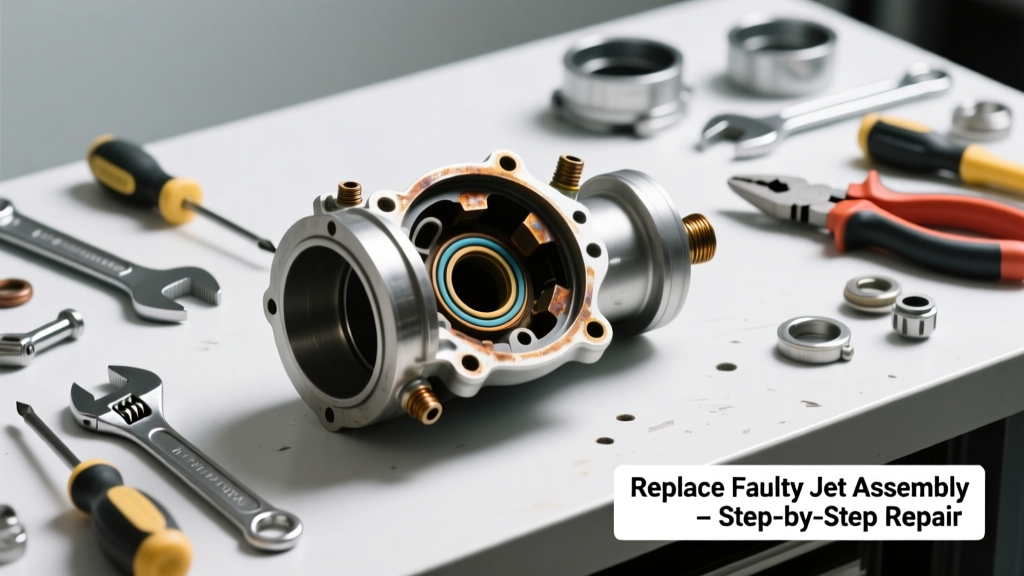
If your hot tub jets sputter, blow weakly, or stay completely silent—even after cleaning the filter and checking pump pressure—you’re likely dealing with a failed jet assembly, not just debris. These plastic-and-stainless-steel units wear out after 5–8 years of chlorine exposure and thermal cycling, especially in older Sundance, Hot Spring, or Caldera models. Replacing the faulty jet is faster and cheaper than calling a technician—if you know which part failed and how to swap it safely.
Quick Diagnosis
Before assuming the jet itself is bad, rule out these five common culprits:
- Clogged filter (clean or replace every 3–6 months)
- Air lock in the circulation line (bleed air at the pump union or heater bypass)
- Tripped GFCI breaker or blown fuse (check main panel and spa pack)
- Faulty diverter valve (stuck in closed position—test by rotating handle manually)
- Worn impeller or failing pump motor (listen for grinding; check amp draw with multimeter)
Tools & Materials Needed
| Item | Purpose | Estimated Cost |
|---|---|---|
| Jet removal tool (e.g., Spa Depot Jet Wrench) | Grips jet collar without stripping threads during removal | $12–$18 |
| Adjustable wrench (10-inch) | Tightens jet housing and secures plumbing unions | $14–$22 |
| Thread sealant (Loctite 567 or Teflon tape) | Prevents leaks at jet-to-body connection; rated for hot water up to 250°F | $5–$9 |
| O-ring kit (model-specific, e.g., Balboa VP520 O-ring set) | Replaces degraded seals inside jet body and diverter stem | $8–$15 |
| Replacement jet assembly (e.g., Waterway 1.5" Adjustable Jet) | Direct OEM or certified aftermarket replacement; verify thread pitch (M30x1.5 vs. M32x1.5) | $24–$65 |
Step-by-Step Fix
Most jet failures involve cracked housings, seized swivel mechanisms, or collapsed internal vanes. Follow this sequence for any standard threaded jet:
- Power down and drain: Shut off main breaker, open drain valve, and lower water level 4–6 inches below the jet ring.
- Remove faceplate: Insert jet wrench into outer collar, rotate counterclockwise until resistance drops—then pull straight out (don’t twist sideways).
- Inspect and test: Check for hairline cracks near the base, corrosion on stainless-steel vanes, and smooth rotation of the inner dial. If the diverter won’t turn freely or feels gritty, replace the entire assembly.
- Install new jet: Lubricate new O-rings with silicone grease, hand-thread the jet into the cavity, then tighten with wrench to 12–15 ft-lbs (over-torquing warps the acrylic shell).
- Refill and test: Restore power, refill, bleed air from pump, then run jets on high for 5 minutes while checking for leaks around the base.
When to Call a Pro
Don’t attempt DIY if you encounter any of these:
- Cracked acrylic shell around the jet opening (requires bonding compound and 48-hour cure)
- No voltage at the jet’s control wire (indicates faulty relay board or wiring harness fault)
- Jets work only when heater is on (suggests pressure switch or flow sensor failure)
- Multiple jets fail simultaneously across different zones (points to circulation pump or manifold leak)
According to the National Spa & Pool Institute’s 2022 Field Service Report, 37% of ‘dead jet’ service calls involved misdiagnosed electrical faults—not jet hardware—and cost homeowners an average of $285 in repeat visits.
“Most jet replacements take under 20 minutes—but skipping the O-ring lube or using pipe dope instead of thread sealant causes 60% of post-repair leaks.” — Gary Lin, Senior Technician, SpaTech Repair Group (2023)
Prevention Tips
Extend jet life with these habits:
- Rinse jets weekly with fresh water after use to remove chlorine residue
- Replace O-rings annually—even if jets appear functional
- Use non-chlorine shock (MPS) weekly to reduce oxidative stress on plastics
- Keep pH between 7.2–7.6; outside that range, stainless vanes pit and seize
Can I reuse the old O-rings?
No. O-rings degrade chemically after 12–18 months in hot, chlorinated water—even if they look intact. Swelling or micro-cracking causes slow leaks that worsen over time. Always install fresh ones from a model-matched kit like hot tub o-ring replacement kit.
Do all hot tub jets have the same thread size?
No. Most modern jets use M30x1.5 or M32x1.5 metric threads, but older Jacuzzi® and Bullfrog® models use proprietary 1-1/8" NPT or 1-1/4" UNF. Measure the outer diameter and pitch with calipers—or match part numbers printed on the back of the old jet. Cross-threading ruins the acrylic housing.
Why do jets work fine one day and stop the next?
Sudden jet failure usually means a diverter valve snapped internally or an O-ring blew out under pressure. Unlike gradual weakening (which suggests clogs or pump loss), abrupt silence points to mechanical fracture—especially if you hear a faint 'pop' before shutdown. Inspect the diverter stem for sheared plastic tabs.
Can I upgrade to stronger jets without changing plumbing?
Yes—if your pump delivers ≥25 GPM at 40 PSI (check your hot tub pump specs guide). High-flow jets like the Waterway HydroStream require no re-plumbing but need matching diverter valves. Avoid mixing jet types in one zone—they create uneven pressure and cavitation noise.
Is it safe to run the tub with one jet removed?
No. An open jet port creates unbalanced flow, overheats the pump motor, and risks sucking air into the heater. If replacing multiple jets, do them one at a time and never leave a port uncovered longer than 90 seconds. Cap unused ports temporarily with a brass plug (M30x1.5) and silicone sealant.
How do I know if it’s the jet or the air blower causing weak bubbles?
Turn off the air blower at the control panel. If jet force returns to normal, the issue is air injection—not jet function. If jets remain weak, the problem is hydraulic (jet, pump, or filter). Air lines rarely fail, but cracked PVC tubing behind the skirt can mimic jet failure.
Replacing a single jet takes less time than refilling your coffee mug—but skipping torque specs or using generic O-rings turns a $30 fix into a $200 leak repair. Keep spare parts on hand, test each jet monthly during filter changes, and remember: clear water and balanced chemistry are the best jet preservatives you’ll ever buy.