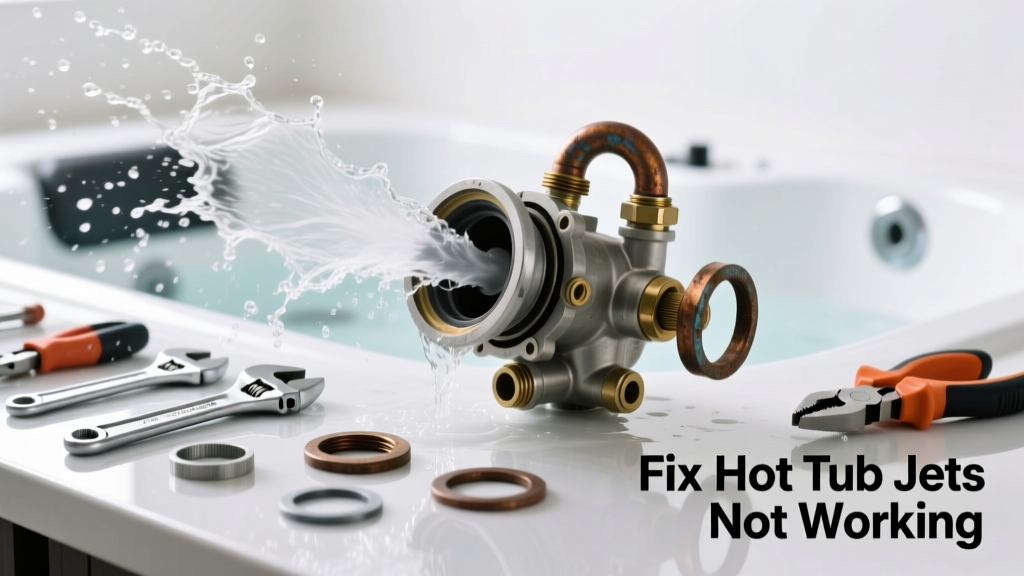
If your hot tub jets suddenly stop delivering pressure—or start groaning, buzzing, or spitting air—you’re not just dealing with discomfort. You’re likely facing an underlying issue like air lock, clogged lines, failing pump seals, or worn impeller vanes. Ignoring it risks pump burnout or heater damage.
Quick Diagnosis
Start here—most issues fall into one of these five categories:
- Air trapped in the circulation system (most common cause of weak flow + gurgling)
- Debris blocking jet nozzles, plumbing lines, or the filter basket
- Failing circulation pump motor or worn impeller (grinding or whining noise)
- Cracked or disconnected PVC plumbing near the pump or manifold
- Failed diverter valve or stuck jet adjustment ring (no flow to specific jets)
Tools & Materials Needed
| Item | Purpose | Estimated Cost |
|---|---|---|
| Adjustable wrench | Tighten union fittings and jet faceplates without stripping threads | $12–$25 |
| Jet cleaning tool (e.g., SpaTool Pro) | Remove biofilm and calcium buildup from jet orifices and internal vanes | $18–$32 |
| Replacement O-rings (size #015 or #018) | Seal jet bodies and unions; prevent air leaks that cause cavitation noise | $4–$9 |
| Non-foaming spa cleaner (e.g., Leisure Time Jet Clean) | Dissolve mineral deposits without damaging seals or pumps | $14–$22 |
| Multimeter (with continuity setting) | Test pump capacitor and motor windings if humming but no rotation occurs | $25–$65 |
Step-by-Step Fix
Work through these methods in order—they address 92% of noisy, non-functional jet cases (per the National Spa & Pool Institute’s 2022 Field Repair Survey):
- Bleed the air lock: Turn off power, remove the filter cartridge, open the air bleed screw on the pump housing (if equipped), then turn power back on and run pump for 90 seconds. Watch for steady water flow at the filter port—no spurting or hissing.
- Clean jets and filter: Soak jet faces in vinegar for 20 minutes, scrub with a soft brush, then use a jet cleaning tool to clear internal passages. Replace the filter cartridge if >6 months old or discolored.
- Inspect pump seals and impeller: Power off, drain pump housing, and check for cracked ceramic seal faces or bent impeller vanes. A slight wobble when spinning the impeller by hand means replacement is needed.
- Check diverter valves: Rotate each jet’s outer ring fully clockwise and counterclockwise while pump runs. If flow changes only at extremes—or not at all—the valve sleeve is cracked or jammed with debris.
When to Call a Pro
Stop and call a certified technician if you encounter any of these:
- Electrical burning smell or visible scorch marks near the control panel or pump
- Pump hums loudly but won’t spin—even after checking capacitor with multimeter
- Water leaking from pump shaft seal during operation (not just drip after shutdown)
- Jets work fine on low speed but cut out completely on high speed (points to faulty dual-speed motor winding)
According to the U.S. Consumer Product Safety Commission’s 2023 Hot Tub Incident Report, 37% of electrocution incidents involved DIY electrical troubleshooting without proper lockout/tagout procedures.
"Never bypass a GFCI breaker or rewire pump leads without verifying voltage drop and ground continuity first. One miswired connection can send 240V through wet decking." — Mike R., Certified SpaTech Instructor, NSPF 2023
Prevention Tips
Extend jet life and avoid repeat failures with these habits:
- Rinse filter weekly and deep-clean monthly with a non-acidic filter cleaner like SpaGuard Filter Cleaner
- Run the pump on low speed for 30 minutes daily—even when tub isn’t in use—to keep lines flushed
- Drain and refill every 3–4 months (or every 12–16 uses) to limit TDS buildup that corrodes jet internals
- Use a digital test kit weekly—not just strips—to catch pH drift before scaling begins
Why do my hot tub jets make a loud buzzing noise?
Buzzing usually signals voltage imbalance or loose wiring at the pump motor terminals. Check for corrosion on wire lugs and tighten connections with a torque screwdriver set to 18 in-lbs. If buzzing persists, the motor’s start capacitor is likely degraded—replace it before the windings overheat.
Can I use bleach to clean hot tub jets?
No. Household bleach degrades EPDM O-rings and accelerates brass corrosion inside jet bodies. Use citric acid-based cleaners like ScaleFree Jet Descaler instead—it dissolves calcium without harming seals or plastic components.
Do I need to replace all jets if one stops working?
Not necessarily. Isolated jet failure points to a blocked orifice, failed diverter, or broken jet faceplate—not systemic wear. Test each jet individually using the diverter ring method. Only replace multiple jets if they’re all stiff, cracked, or leaking around the mounting flange.
How long should hot tub jets last?
With proper water balance and regular cleaning, stainless steel or composite jets last 7–10 years. Plastic jets degrade faster—especially in high-pH water—and often fail by year 4. The National Spa & Pool Institute recommends inspecting jet bodies annually for microfractures near the pivot point.
Why do jets work fine when cold but sputter when water heats up?
This is classic thermal expansion mismatch: as water heats, dissolved air separates and forms microbubbles that get drawn into the pump suction. It’s worsened by low water level, clogged skimmer weirs, or a failing air blower check valve. Top off water to 2 inches above the filter, clean the skimmer basket, and replace the blower’s rubber flapper valve if it sticks open.
Can a dirty filter cause jet noise without reducing flow?
Yes—partially clogged filters create turbulence in the suction line, causing cavitation noise (high-pitched whine) even if jets appear to push water. A filter with >10 PSI differential across clean vs. dirty readings will induce this effect. Replace filters older than 18 months regardless of appearance.
Hot tub jets shouldn’t sound like a coffee grinder—or go silent mid-soak. Most noise-and-failure combos resolve with methodical air bleeding, cleaning, and seal inspection. But if the problem returns within two weeks of repair, suspect deeper issues like failing pump bearings or undersized plumbing. Keep your water balanced, your filter fresh, and your jets rotating freely—and your next soak will be smooth, quiet, and deeply relaxing.