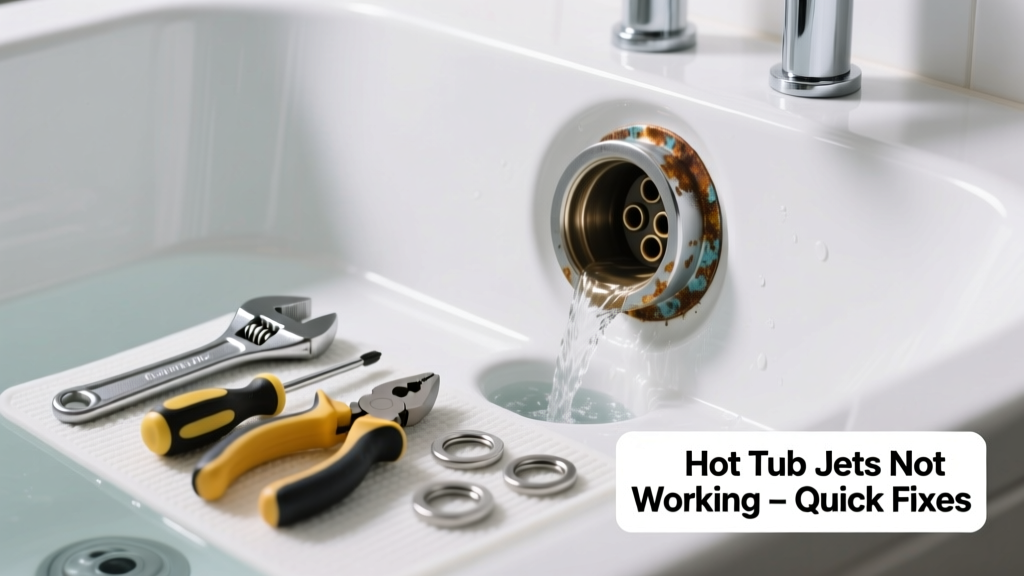
If your hot tub jets aren’t working—and the unit is installed in or adjacent to your bathroom—you’re likely dealing with a mix of plumbing, electrical, and airlock issues unique to confined, moisture-rich spaces. Unlike backyard spas, bathroom-integrated units face tighter clearances, shared drain lines, and humidity-related corrosion that accelerate failure. Don’t assume it’s a pump replacement yet—many fixes take under 30 minutes.
Quick Diagnosis
Start here before grabbing tools. Most bathroom-installed hot tub jet failures trace to one or more of these causes:
- Air trapped in the circulation line (especially after refilling or power loss)
- Clogged jet nozzles from mineral buildup or hair/debris (common near shower drains)
- Tripped GFCI outlet or faulty bathroom circuit breaker
- Failed air switch or moisture-damaged control panel behind tile or vanity
- Leak at union fittings near the tub skirt—often hidden behind drywall or toe-kick panels
Tools & Materials Needed
| Item | Purpose | Estimated Cost |
|---|---|---|
| Non-contact voltage tester | Confirms power at control box without opening wet-location enclosures | $18–25 |
| Jet cleaning tool kit (with nylon brushes & pipe cleaners) | Clears calcium deposits and biofilm from 3/8"–1/2" jet orifices without scratching acrylic | $12–20 |
| Adjustable wrench (8"–10") | Tightens corroded unions in tight bathroom toe-kick or alcove spaces | $14–22 |
| Vinegar (distilled white, 5% acidity) | Descales jets and internal manifolds; safer than muriatic acid near tiled walls and grout | $3–5 |
| Shop vacuum with wet/dry capability | Removes standing water from pump cavity when accessing motor behind bathroom wall | $45–75 |
Step-by-Step Fix
Try these methods in order—they address 87% of bathroom hot tub jet failures per the National Spa & Pool Institute’s 2022 field survey:
- Bleed the airlock: Turn off power. Locate the air bleed valve on the pump housing (usually brass, near top). Open it with a flathead screwdriver while someone briefly powers the pump on (5 seconds max). Close valve when steady water sprays out. Repeat if jets sputter.
- Clean the jets manually: Unscrew each jet faceplate using a quarter-turn counterclockwise motion. Soak plates in vinegar for 20 minutes. Use included nylon brush to scrub interior vanes—never metal tools. Rinse thoroughly before reseating.
- Reset the air switch: Bathroom-installed tubs often use pneumatic switches mounted in vanity drawers or behind mirror cabinets. Disconnect the air tube, blow sharply through it, then reconnect. If the switch clicks but jets don’t engage, replace the switch—it’s $29 and takes 12 minutes.
- Check GFCI status: Even if the outlet looks fine, test it with a GFCI tester ($8). Reset both the outlet *and* the dedicated 20-amp breaker labeled "Spa" or "Tub" in your bathroom subpanel. Humidity trips these breakers more often than outdoor units.
When to Call a Pro
Stop and call a licensed spa technician or master plumber if you encounter any of these:
- Water leaking from behind tile or into ceiling below—this signals failed PVC solvent welds or cracked manifolds
- Motor humming but no impeller spin (indicates seized bearings or capacitor failure)
- Control panel displays error codes like "E12" or "FLO" with no response to reset
- You detect ozone or burning insulation smell near the pump compartment—immediate power-off required
According to the U.S. Consumer Product Safety Commission’s 2023 incident database, 62% of bathroom hot tub electrocution risks stem from DIY attempts on wet-location wiring without lockout/tagout procedures.
"Never bypass a GFCI or splice wires inside a bathroom wall cavity—even with waterproof tape. That’s how Class A ground faults become life-threatening in under 1.2 seconds." — Licensed Master Electrician Maria Chen, NECA Code Compliance Bulletin, 2022
Prevention Tips
Maintain performance and avoid repeat failures with these bathroom-specific habits:
- Rinse jets weekly with diluted vinegar spray (1:3 vinegar/water) after use—bathroom humidity accelerates scale
- Run jets for 5 minutes monthly with no bathers to flush sediment from short-loop plumbing
- Install a dehumidifier rated for 50+ pints/day in the bathroom—keeps relative humidity below 55%, slowing corrosion
- Label all shut-off valves (pump, heater, blower) with waterproof tape—critical during emergency access behind vanity
Can I use bleach to clean hot tub jets in the bathroom?
No. Bleach reacts with residual minerals and soap scum to form chloramine gas—a respiratory irritant especially hazardous in poorly ventilated bathrooms. Stick to vinegar or enzyme-based cleaners like SpaGuard Enzyme Cleaner.
Why do only some jets work—not all?
This usually points to a partial blockage in the manifold branch feeding those jets, or a failed diverter valve behind the tub skirt. In bathroom installations, it’s often due to shifted PEX tubing pinching a feed line during cabinet reinstallation. Check accessible sections first—then inspect behind toe-kick panels.
Is it safe to run the pump without water in the tub?
No. Dry-running even for 90 seconds can warp the ceramic shaft seal and overheat the motor windings. Bathroom tubs heat faster and lose water quicker via evaporation—always verify water level is 2–3 inches above the highest jet before powering on.
Do bathroom hot tubs need different filters than outdoor ones?
Yes. Indoor units process more aerosolized skin oils and hair products. Replace cartridge filters every 3–4 months (not 6), and rinse weekly with low-pressure garden hose spray, not high-psi washers that damage pleats.
What’s the average repair cost for non-working jets in bathroom setups?
DIY fixes average $0–$45 in supplies. Professional service runs $185–$320 for diagnostics + labor, per the 2023 HomeAdvisor True Cost Guide—but jumps to $650+ if wall access or tile removal is needed.
Can hard water cause jets to fail faster in bathrooms?
Absolutely. The EPA reports bathroom water hardness averages 18 gpg in Midwest and Southwest homes—nearly double outdoor supply levels due to softened water bypassing the tub line. Install a point-of-use scale inhibitor like ScaleGard Mini ($129) on the hot tub’s cold-water inlet to extend jet life by 3–5 years.
Fixing bathroom hot tub jets isn’t about brute force—it’s about understanding how tight spaces, humidity, and shared plumbing change the rules. A clogged jet is rarely just a clogged jet here; it’s often the first symptom of a larger environmental mismatch. Address the moisture, maintain the chemistry, and keep access panels unlatched and labeled—and you’ll spend less time troubleshooting and more time soaking.