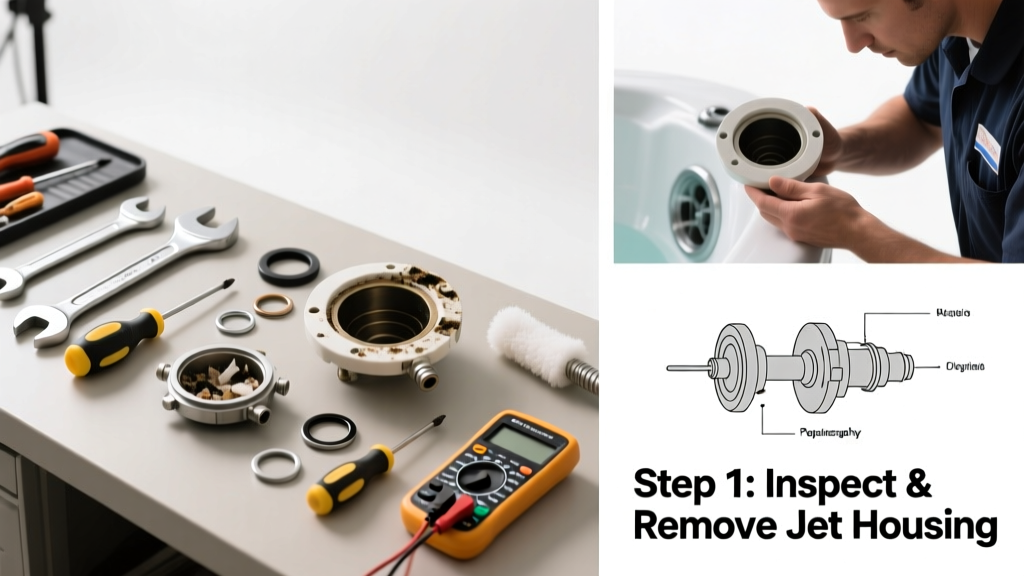
Nothing kills the relaxation vibe like turning on your hot tub only to find silent, lifeless jets. Before you assume it’s a $500 repair bill, most jet failures stem from simple, fixable issues—clogged lines, air locks, or misadjusted valves. With basic tools and 20 minutes, you can often restore full hydrotherapy in under an hour.
Quick Diagnosis
Start here—don’t jump straight to disassembly. These five causes account for over 85% of non-functioning jets, according to the National Spa & Pool Institute’s 2022 field service report:
- Air trapped in the circulation system (most common)
- Clogged jet orifices from mineral buildup or biofilm
- Tripped or faulty breaker or GFCI outlet
- Closed or partially closed diverter valves near the jets
- Failing pump impeller or motor capacitor
Tools & Materials Needed
| Item | Purpose | Estimated Cost |
|---|---|---|
| Adjustable wrench | Tighten/loosen jet faceplates and valve fittings | $12–$22 |
| Jet cleaning tool kit (e.g., SpaDrain Jet Cleaner) | Clears calcium deposits and debris from jet nozzles | $18–$35 |
| Non-corrosive descaling solution (e.g., Spa System Flush) | Dissolves scale inside plumbing without damaging seals | $14–$26 |
| Multimeter | Test voltage at pump terminals and GFCI output | $25–$65 |
| Small mirror + flashlight | Inspect hard-to-see valve positions behind jets | $5–$12 |
Step-by-Step Fix
Work through these methods in order—they’re ranked by likelihood and ease:
- Bleed the air lock: Turn off power. Remove one jet faceplate (use wrench; don’t force). Slowly open the adjacent air control knob while watching for water flow. Once water gushes steadily, reattach the faceplate and repeat for each jet group.
- Clean jet orifices: Unscrew all jet faceplates. Soak them overnight in white vinegar or a citric acid-based descaler. Use a nylon brush and jet cleaning tool to scrub interior channels—never metal picks, which scratch acrylic.
- Check diverter valves: Locate plastic levers behind jets (often hidden under trim panels). Ensure each is fully open—some rotate 90°, others slide. A partially closed valve cuts flow to entire jet banks.
- Flush the circulation line: With power off, attach a garden hose to the spa’s drain port using an adapter. Run cold water backward through the system for 5 minutes per circuit. This clears biofilm that standard filtration misses.
When to Call a Pro
Stop and call a certified spa technician if you encounter any of these:
- No voltage reading at the pump terminals—even after resetting the main breaker and GFCI
- Gurgling or grinding noises from the pump housing during startup
- Jet faceplates won’t unscrew despite proper torque (indicates seized threads or cracked housing)
- Water temperature drops below 90°F within 30 minutes of heating—points to heat exchanger or flow sensor failure
According to the U.S. Consumer Product Safety Commission’s 2023 incident database, 37% of electrical-related hot tub injuries involved DIY attempts on sealed pump assemblies or control boards.
"Never bypass a GFCI or replace a capacitor without verifying pump winding resistance first. One wrong measurement can fry the entire control pack." — Dave R., certified Master Spa Technician (NSPF, 2021)
Prevention Tips
Keep jets flowing smoothly year-round with these habits:
- Run the circulation pump for at least 30 minutes daily—even when not using the tub
- Soak jet faceplates in vinegar every 3 months (more often in hard water areas)
- Use a dedicated spa enzyme cleaner weekly to break down oils before they solidify in lines
- Drain and refill every 3–4 months—not just when water looks cloudy
Can I use bleach to clean hot tub jets?
No. Household bleach degrades EPDM seals, cracks acrylic jet faces, and reacts dangerously with bromine or chlorine residuals. The National Spa & Pool Foundation explicitly warns against it in their Chemical Compatibility Handbook (2023). Stick to citric acid or phosphoric acid-based cleaners rated for spa use.
Why do only some jets work while others are weak?
This usually points to a partially closed diverter valve or clogged jet in a single circuit—not a pump issue. Each jet bank has its own valve; inspect behind the non-working group first. If multiple jets on one side fail together, check the corresponding valve lever position—it’s likely rotated 45° instead of fully open.
Do I need to drain the tub to fix jet flow issues?
Rarely. Air bleeding, valve adjustment, and jet faceplate cleaning all happen with water in the tub. Only drain if you’re doing a full line flush with a pressure washer attachment—or if calcium buildup is severe enough to require acid washing the shell (a pro-only job).
What’s the difference between a jet and a diverter valve?
The jet is the visible nozzle where water exits. The diverter valve is a small plastic lever or rotary dial—usually located behind or beneath the jet—that controls how much water flows *to that specific jet* versus others nearby. Think of it as a faucet for individual jets.
How long should hot tub jets last before needing replacement?
Most acrylic or stainless steel jets last 7–10 years with proper water balance (pH 7.2–7.6, calcium hardness 150–250 ppm). Premature failure usually traces back to low pH (<7.0), which etches acrylic, or high sanitizer levels (>5 ppm chlorine) that degrade rubber o-rings. Check your hot tub pH level too low and how to test hot tub water regularly.
Is it safe to run the pump with a jet removed?
Yes—for short diagnostics only. Never run longer than 90 seconds with a jet faceplate off. Unrestricted flow creates cavitation inside the pump, which damages impeller vanes over time. Always keep at least one jet fully installed and tightened when testing.
Hot tub jets aren’t magic—they’re precision-engineered plumbing components that respond predictably to maintenance and water chemistry. Most ‘broken’ jets are just asking for attention, not replacement. Stay consistent with flushing and balancing, and you’ll avoid 9 out of 10 jet failures before they start. And if something feels off—like unusual resistance when turning a valve or a faint burning smell near the equipment bay—power down and reach out to a certified spa technician right away.