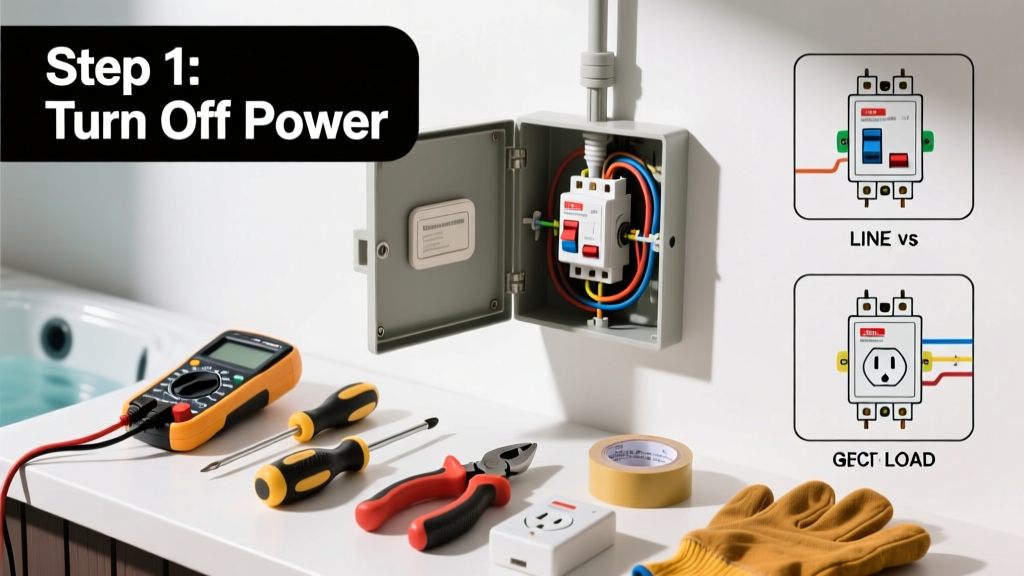
Your hot tub cuts out mid-soak—lights flicker, the pump dies, and the GFCI breaker trips again. It’s frustrating, potentially dangerous, and often misdiagnosed as a simple reset issue. But repeated tripping signals an underlying electrical or moisture problem that needs methodical troubleshooting—not just flipping the switch.
Quick Diagnosis
GFCI breakers trip to protect you from shock hazards. Frequent tripping means something is leaking current—often due to one of these five culprits:
- Moisture intrusion in the spa pack, control panel, or junction box
- Faulty heater element (most common cause—accounts for ~38% of GFCI trips per the National Spa & Pool Institute’s 2022 field survey)
- Worn or cracked pump motor windings allowing ground leakage
- Degraded wiring insulation, especially near the heater or blower
- Ground fault in the control board or touchpad circuitry
Tools & Materials Needed
| Item | Purpose | Estimated Cost |
|---|---|---|
| Digital multimeter (CAT III rated) | Measures resistance, continuity, and ground leakage; essential for safe diagnostics | $45–$120 |
| Insulated screwdrivers & pliers | Prevents accidental shorts while working near live components | $12–$28 |
| Non-contact voltage tester | Verifies power is off before opening panels—critical safety step | $15–$35 |
| Dielectric grease | Seals connectors against moisture ingress at wire nuts and terminals | $6–$12 |
| Replacement GFCI breaker (same amperage & brand) | Only if breaker itself is faulty—never substitute with standard breaker | $35–$85 |
Step-by-Step Fix
Work only with power fully disconnected at the main panel. Verify with your non-contact tester before touching anything.
- Reset and isolate: Turn off main power. Unplug all accessories (blower, ozonator, lights). Reset GFCI. Restore power. If it holds, reconnect devices one at a time until it trips—identifying the faulty component.
- Inspect for moisture: Open the spa pack and control panel. Look for condensation, white corrosion on terminals, or damp insulation. Use a dry towel and allow 24 hours of ventilation before retesting—if tripping stops, moisture was the trigger.
- Test heater element: Disconnect heater wires. Set multimeter to ohms (20kΩ scale). Measure resistance across terminals (should be 9–14Ω for 120V, 12–18Ω for 240V). Then test each terminal to ground—any reading under 1MΩ indicates a ground fault. Replace if failed.
- Check pump insulation: With pump disconnected, measure resistance between each lead and ground. Readings below 1MΩ mean winding insulation has broken down—replace the pump motor.
When to Call a Pro
Stop immediately and contact a licensed electrician or certified spa technician if:
- You measure any continuity between neutral and ground anywhere in the circuit
- The GFCI trips even with all loads disconnected and wiring isolated
- You find charring, melted insulation, or brittle wire sheathing
- Your hot tub uses a shared neutral or multi-wire branch circuit (common in older installations)
According to the National Electrical Code (NEC) Article 680.22, hot tub circuits require dedicated GFCI protection and grounding electrode systems—improper modifications risk electrocution and void insurance coverage.
Prevention Tips
Extend your system’s reliability with consistent maintenance:
- Apply dielectric grease to all exposed connections annually
- Keep the equipment bay ventilated—install a small exhaust fan if humidity lingers
- Replace the GFCI breaker every 7–10 years, even if it seems functional (per Square D’s 2021 product lifecycle guidance)
- Use a weatherproof cover over the spa pack during winter months or heavy rain
- Test GFCI monthly using its built-in test button—not just after tripping
Why does my hot tub GFCI trip only when the heater turns on?
This strongly points to a failing heater element or corroded heater connection. The heater draws high current and stresses weak insulation. Test resistance and ground leakage as outlined above—don’t assume it’s “just the heater cycling.”
Can I replace the GFCI breaker with a regular breaker?
No—this is illegal and extremely dangerous. NEC 680.22(A)(3) mandates Class A (5mA) GFCI protection for all hot tub circuits. A standard breaker offers zero shock protection and creates a life-threatening hazard. Always use a listed spa-rated GFCI breaker.
Will resetting the GFCI fix a ground fault?
No. Resetting only restores power temporarily—it doesn’t repair insulation breakdown, moisture damage, or component failure. Repeated resets without diagnosis increase fire risk and accelerate equipment wear.
How do I know if my GFCI breaker is bad—not the hot tub?
Swap it with an identical, known-good GFCI breaker. If the new unit holds with no load connected, the original was faulty. If it still trips, the fault lies elsewhere in the circuit. Never bypass or disable GFCI protection.
Is it safe to run the hot tub with the GFCI taped in the ON position?
Absolutely not. Taping or wedging a GFCI defeats its sole purpose: preventing lethal ground faults. The U.S. Consumer Product Safety Commission reports over 200 electrocution incidents linked to disabled or bypassed GFCIs in outdoor spa applications since 2018.
What’s the difference between a GFCI breaker and a GFCI outlet for hot tubs?
Hot tubs require GFCI breakers, not outlets. Breakers protect the entire circuit—including buried feeders and subpanel wiring—while outlets only protect downstream devices. NEC 680.22(A)(1) explicitly prohibits GFCI receptacles as the sole protection for permanently wired spas.
Fixing GFCI tripping isn’t about brute-force resets—it’s about respecting the warning signs your hot tub’s electrical system is giving you. Address moisture, test components methodically, and never compromise on code-compliant parts. When in doubt, trust a pro: a $150 diagnostic visit beats a $5,000 insurance claim—or worse. For related issues, see our guides on hot tub heater not working and hot tub pump making noise.