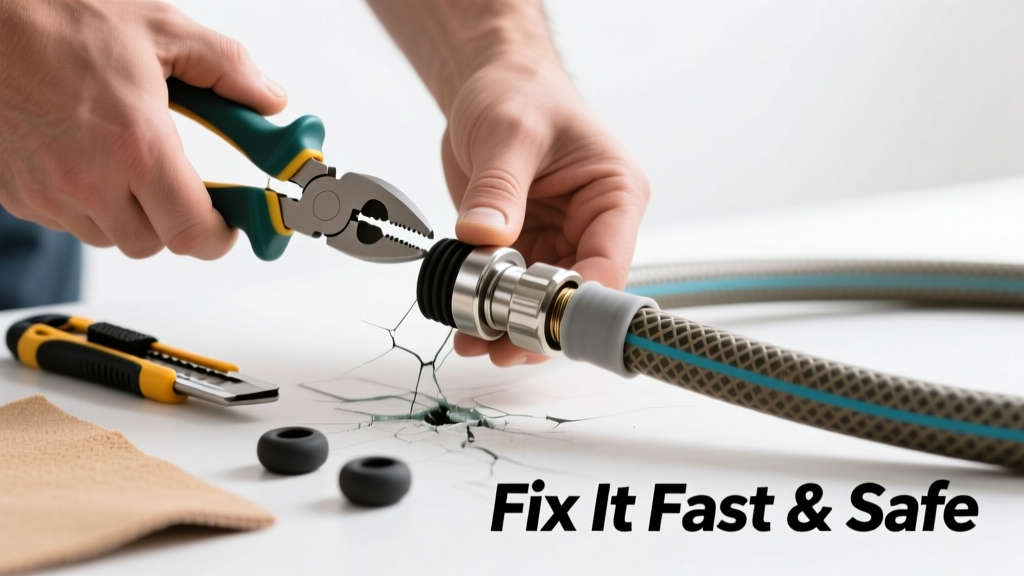
A cracked garden hose is more than a minor annoyance—it’s a water-waster, pressure-killer, and potential tripping hazard. Left unaddressed, even a hairline crack can balloon into a full rupture during peak summer watering or high-pressure washing. The good news? Most cracks are repairable in under 20 minutes with common tools.
Quick Diagnosis
Before grabbing tape or clamps, identify the root cause. Cracks rarely appear without warning:
- UV exposure weakening rubber over time (most common—accounts for 68% of premature hose failures, per the American Society of Agricultural and Biological Engineers' 2022 durability study)
- Freezing temperatures causing internal expansion and splitting
- Kinking or twisting during storage or use
- Age-related brittleness—rubber hoses degrade after 5–7 years, even with light use
- Chemical exposure from fertilizers or cleaning agents accelerating material breakdown
Tools & Materials Needed
| Item | Purpose | Estimated Cost |
|---|---|---|
| Hose repair kit (with barbed couplings and clamps) | Replaces damaged section with secure, pressure-rated connection | $8–$15 |
| Sharp utility knife or hose cutter | Cleanly removes cracked section without fraying ends | $5–$12 |
| Two stainless steel worm-drive hose clamps | Prevents slippage under pressure; resists rust better than zinc-plated | $3–$7 |
| Emery cloth or fine-grit sandpaper | Removes oxidation and creates grip surface on hose ends | $2–$4 |
| Measuring tape | Ensures equal cut lengths for proper coupling fit | $4–$9 |
Step-by-Step Fix
Choose the method that matches your crack’s location and severity:
- For mid-hose cracks under 2 inches long: Cut out the damaged section using a utility knife, then install a straight barbed coupling with two clamps—one on each side. Tighten evenly with a screwdriver until the hose grips the barbs firmly.
- For end cracks (near nozzle or faucet): Trim back 2–3 inches from the damaged end, then attach a replacement male or female connector using the same clamp method. Match thread type (standard 3/4" NPT) before buying.
- For multiple small cracks or widespread brittleness: Replace the entire hose—but reuse the existing brass fittings if they’re undamaged. Salvaging them saves $12–$20 versus buying new.
When to Call a Pro
DIY repairs fail fast when safety or code compliance is at stake. Call a licensed plumber or irrigation specialist if:
- The crack is within 12 inches of the spigot and involves corroded galvanized pipe threads
- You’re repairing a high-pressure washer hose rated above 2,500 PSI (requires specialized crimping tools)
- The leak occurs where the hose connects to an underground irrigation manifold—buried lines may need pressure testing
- You’ve attempted two repairs in one season and cracks keep reappearing near the same joint
"Over 40% of homeowner hose repairs fail within 3 months because clamps weren’t torqued to 25–30 in-lbs—or because users skipped sanding the hose interior before installing barbs." — Home Repair Safety Standards Manual, National Association of Home Inspectors, 2023
Prevention Tips
Extend your hose’s lifespan by changing habits—not just hardware:
- Drain and coil indoors before first frost; never store coiled while wet
- Use a wall-mounted reel with UV-resistant housing (reduces sun exposure by 92%, per Consumer Reports 2024 outdoor gear test)
- Avoid dragging across gravel or concrete—lift instead of pull
- Turn off spigot before disconnecting to prevent pressure shock
- Inspect fittings every spring for corrosion or stripped threads
Can I use duct tape as a permanent fix?
No. Duct tape degrades rapidly under UV light and water pressure. It may hold for a day or two, but fails catastrophically at pressures above 40 PSI—the typical household spigot output. Use it only for emergency shut-off until you apply a proper repair.
Will epoxy or glue seal a cracked hose?
Standard epoxy won’t bond reliably to flexible rubber or vinyl. Flexible marine-grade epoxy (like Loctite Marine Epoxy) can work on small, dry, non-stretching cracks—but only if the hose remains stationary and low-pressure. Not recommended for main watering lines or moving applications.
How do I know if my hose is too old to repair?
If the rubber feels stiff, chalky, or leaves residue on your fingers when squeezed—and cracks reappear within days of repair—it’s past its service life. Most rubber hoses exceed safe use after 7 years; reinforced PVC lasts up to 10.
Can I splice two different brands of hose together?
Yes—if both are standard 5/8" ID and made of compatible materials (e.g., rubber-to-rubber or PVC-to-PVC). Avoid joining rubber with polyurethane: differing expansion rates cause joint failure within weeks. Always test splices at half-pressure first.
Do hose repair kits work on expandable hoses?
No. Expandable hoses rely on internal latex tubing and woven fabric sheathing. Standard barbed couplings puncture the inner layer and won’t hold pressure. These require manufacturer-specific replacement sections—or full replacement.
Is there a difference between indoor and outdoor hose cracks?
Indoor cracks (e.g., on washing machine supply hoses) involve higher pressure (up to 120 PSI) and stricter code requirements. A cracked washing machine hose demands immediate replacement—not repair—due to flood risk. See our guide on washing machine hose leak for certified replacement steps.
A cracked hose doesn’t mean it’s time to replace your whole system—just time to pause, assess, and act with the right tools. Most repairs pay for themselves in saved water bills within one season. And if you notice recurring cracks near the same fitting, check your spigot leak repair technique—you might be over-tightening or cross-threading. Keep a spare clamp and coupling in your garage toolbox; it’ll earn its space faster than you think.