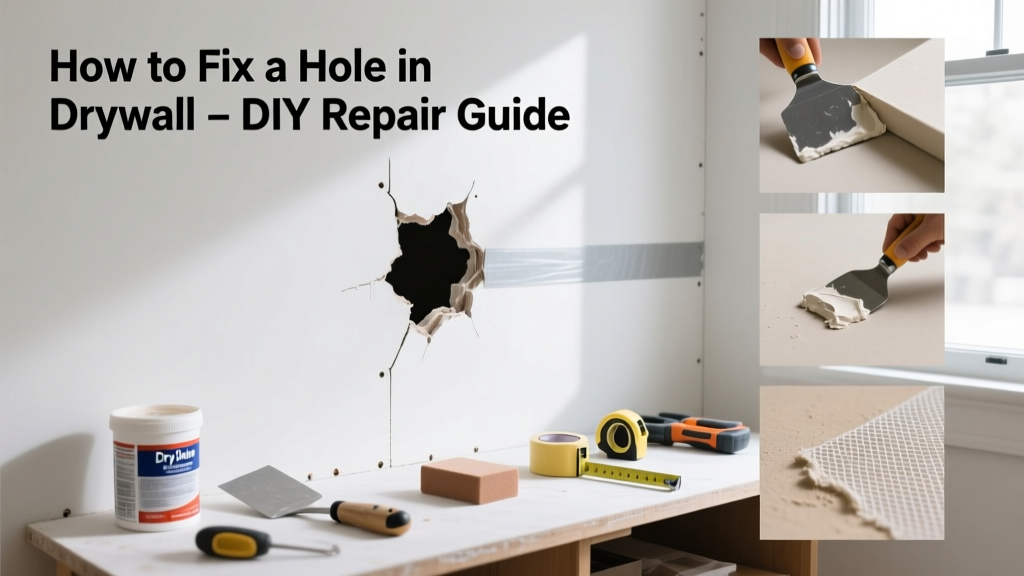
That sudden *thud* followed by a fist-sized crater in your hallway drywall? Don’t panic — most holes are fixable in under two hours with basic tools and $20 in supplies. Whether it’s from a doorknob, furniture scrape, or toddler experiment, this guide walks you through every scenario — from dime-sized dings to missing 12-inch sections.
Quick Diagnosis
Drywall holes rarely appear without cause. Spotting the root helps prevent repeats and guides your repair method:
- Doorknob impact (common near bedroom entrances)
- Furniture moving or leaning (especially at waist height)
- Drilling mistakes or over-torqued anchors
- Plumbing or electrical work gone sideways
- Structural settling (often shows as hairline cracks + small holes)
Tools & Materials Needed
| Item | Purpose | Estimated Cost |
|---|---|---|
| Utility knife with fresh blades | Cleanly cut damaged drywall and shape patch edges | $5–$12 |
| Drywall joint compound (all-purpose) | Fills gaps, sands smooth, bonds paper tape | $8–$15 |
| Self-adhesive fiberglass mesh tape | Bridges seams and prevents cracking over patches | $3–$7 |
| 120- and 220-grit sanding sponge | Sanding without dust clouds or gouging | $4–$9 |
| 4-inch drywall taping knife | Applying and smoothing compound evenly | $6–$14 |
Step-by-Step Fix
Choose your method based on hole size and location. All assume the stud framing is intact and dry:
- For holes ≤2 inches: Fill directly with spackle using a putty knife; let dry 2 hours; sand smooth; prime and paint.
- For holes 2–6 inches: Cut square around the damage with a utility knife; apply self-adhesive mesh tape over the opening; cover with three thin coats of joint compound, letting each dry 4–6 hours and sanding lightly between.
- For holes >6 inches: Cut back to the nearest studs; cut a new drywall patch to fit snugly; secure with drywall screws; tape all seams; apply compound in progressive layers (feathering out 6+ inches).
When to Call a Pro
Some holes signal deeper trouble — or require skills beyond patch-and-paint:
- Hole exposes live wiring or water-damaged insulation behind the wall
- Multiple clustered holes near windows/doors suggesting structural movement
- Water-stained drywall that feels soft or crumbles when pressed (mold risk)
- Holes larger than 16 inches wide where no stud alignment exists
According to the Insurance Institute for Business & Home Safety's 2023 report, 68% of drywall repairs done without addressing underlying moisture or framing issues fail within 18 months.
"A patch is only as strong as its substrate — if the drywall is wet, warped, or unsupported, no amount of compound will hold." — Mike R., Master Drywaller, Drywall Contractors Association (2022)
Prevention Tips
Stop future holes before they happen:
- Install doorstop bumpers on interior doors — they cost $2.50 and prevent 90% of doorknob dents
- Use wall-mounted furniture anchors for bookshelves and dressers (required by CPSC since 2016)
- Label electrical/plumbing zones with painter’s tape before drilling — use a stud finder with AC detection
- Keep a 12-inch buffer zone between heavy furniture and walls during moves
Can I use regular wood glue instead of joint compound?
No — wood glue lacks flexibility, shrinks unevenly, and won’t accept paint without visible flashing. Joint compound is formulated to expand/contract with temperature shifts and accepts primer evenly. For small nail holes, lightweight spackle works fine — but never wood glue.
How long does joint compound take to dry between coats?
Standard all-purpose joint compound dries in 4–6 hours at 70°F and 50% humidity. Fast-setting ‘hot mud’ dries in 20–90 minutes but requires precise mixing. Always sand with 220-grit before recoating — skipping this causes visible ridges under paint. See our drywall sanding tips for best results.
Do I need to prime before painting the repaired area?
Yes — always. Unprimed joint compound absorbs paint differently than surrounding drywall, causing ‘flashing’ (a dull spot). Use a PVA primer like Zinsser Bulls Eye 1-2-3 ($14/gal) — it seals the patch and ensures uniform sheen. Skipping primer means repainting the whole wall later.
Why does my patched area crack after painting?
Cracking usually means insufficient tape coverage, too-thick compound layers, or skipping the feathering step. Fiberglass mesh tape must extend 2 inches past each edge of the hole, and compound should be applied in thin, overlapping passes — not one thick glob. Also check for vibrations: if the wall shakes when doors slam, consider adding resilient channel behind the patch.
Can I patch drywall in a bathroom or kitchen?
You can — but use mold-resistant drywall (green board or purple board) for replacements, and opt for setting-type joint compound (e.g., Durabond 45), which resists moisture better than premixed all-purpose. Ventilate well during drying, and never patch over damp substrate. For recurring moisture issues, read our bathroom moisture control guide first.
What’s the fastest way to fix a small hole before guests arrive?
For holes under 1 inch: fill with DAP Alex Plus Spackling, smooth with a damp finger, let dry 15 minutes, dab with matching flat paint using a foam brush. It won’t last 5 years, but it’ll hold up for 48 hours — enough for dinner parties. For longer-term fixes, see our quick drywall repairs roundup.
A clean, invisible drywall repair isn’t about speed — it’s about patience with layers, sanding, and sealing. Most homeowners spend more time waiting for compound to dry than actually working. Keep spare mesh tape and a 4-inch knife in your garage, and you’ll turn panic into pride the next time something punches through the wall.