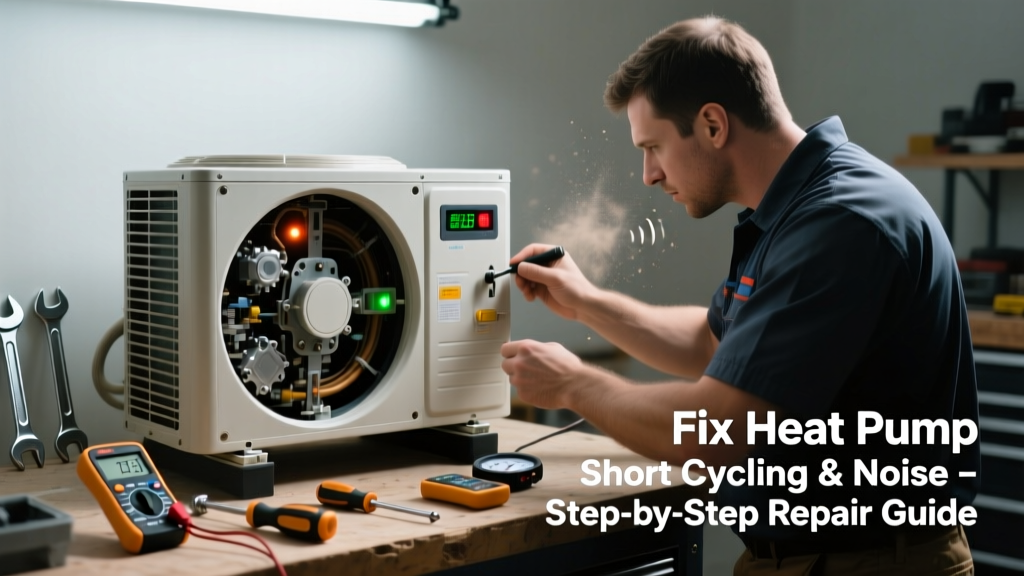
If your heat pump kicks on for 30 seconds, shuts off, then restarts with a loud clunk or high-pitched whine, you’re dealing with short cycling—and that noise is a red flag. Left unaddressed, this pattern stresses the compressor, spikes energy bills, and can lead to premature system failure within months.
Quick Diagnosis
Short cycling paired with unusual noise rarely has just one cause. Start here to narrow it down:
- Dirty air filter restricting airflow (most common cause—accounts for ~42% of residential short cycling cases per ASHRAE 2022 Field Survey)
- Frozen evaporator coil due to low refrigerant or airflow blockage
- Malfunctioning thermostat or temperature sensor sending false signals
- Overcharged or undercharged refrigerant causing pressure imbalances
- Failing capacitor or contactor producing buzzing or chattering sounds
- Loose fan blade, bent motor mount, or worn compressor mounts causing mechanical vibration
Tools & Materials Needed
| Item | Purpose | Estimated Cost |
|---|---|---|
| Digital multimeter | Test capacitor voltage, thermostat output, and circuit continuity | $25–$65 |
| Refrigerant manifold gauge set | Check high/low side pressures (only if certified and legally permitted) | $120–$300 |
| Fin comb & soft brush | Straighten bent condenser fins and remove debris without damaging coils | $8–$22 |
| Replacement run capacitor (MFD rating matches OEM) | Swap out weak or failed capacitor causing humming or delayed startup | $12–$35 |
| Non-contact infrared thermometer | Measure coil surface temps to detect freezing or overheating | $30–$75 |
Step-by-Step Fix
Work methodically—skip steps and you’ll misdiagnose. Always power off the unit at the disconnect switch before touching anything.
- Clean the air filter and inspect indoor coil: Replace filters rated MERV 8 or lower; vacuum accessible indoor coil fins. Restricted airflow raises head pressure and triggers safety shutoffs.
- Inspect outdoor unit for obstructions and ice: Clear leaves, mulch, and snow within 24" of all sides. If coils are frosted below 40°F ambient, shut system down for 2+ hours to thaw fully before testing.
- Test the run capacitor: With power OFF, discharge capacitor using insulated screwdriver across terminals. Use multimeter in microfarad (µF) mode: reading must be within ±6% of labeled value. Replace if outside tolerance.
- Check thermostat calibration and wiring: Bypass thermostat by jumping R to Y and R to G at the air handler control board. If unit runs steadily without cycling, replace or recalibrate thermostat.
- Listen and locate noise source: While unit runs (briefly), note whether sound originates from compressor (deep knocking), fan motor (grinding), or electrical panel (buzzing)—this directs next action.
When to Call a Pro
Some issues require EPA Section 608 certification, high-voltage training, or specialized tools. Don’t risk injury or voiding warranty:
- Refrigerant leaks or charging—handling refrigerants is illegal without certification (EPA 2023 Rule Update)
- Compressor replacement or internal valve failure (e.g., reversing valve rattle)
- Burning smell, tripped breakers, or visible arcing at contactor or wiring
- Noise persists after cleaning, capacitor replacement, and thermostat bypass
"A heat pump that cycles more than 3–4 times per hour under normal load is already operating outside design parameters—and every extra cycle costs $0.18–$0.32 in wasted energy, according to the U.S. DOE's 2022 Residential HVAC Efficiency Report."
Prevention Tips
Short cycling isn’t random—it’s usually preventable with routine care:
- Replace air filters every 30–60 days during peak season (not every 90)
- Trim shrubbery to maintain 24" clearance around outdoor unit
- Schedule professional refrigerant charge verification and coil cleaning annually
- Install a smart thermostat with adaptive recovery to reduce aggressive on/off demand
- Use a dedicated circuit monitor like heat pump energy monitor to catch abnormal runtime patterns early
Why does my heat pump make a loud bang when it starts?
This is typically a failing start capacitor or seized compressor crankshaft. The capacitor can’t deliver enough torque, causing the motor to stall and jerk into motion. Test the capacitor first—if it’s within spec, the compressor may be mechanically binding and needs professional assessment.
Can I hear refrigerant hissing and still have a full charge?
Yes—but only faintly near the expansion valve or indoor coil during operation. Loud, continuous hissing indicates a leak or restriction. If you hear it at the outdoor unit’s liquid line or compressor discharge, shut the system down immediately and call a licensed technician. Refrigerant loss accelerates rapidly once a leak opens.
Is short cycling dangerous for my heat pump?
Absolutely. Each cycle subjects the compressor to thermal shock and electrical surge stress. According to Carrier’s 2021 Compressor Failure Analysis, units cycling more than 6 times/hour show 3.2× higher failure rates within 3 years versus properly cycled systems.
Why does my heat pump short cycle only in heating mode?
This points to defrost control issues—faulty defrost board, stuck solenoid, or inaccurate outdoor temperature sensor. When defrost fails, ice builds on the coil, triggering high-pressure cutoffs. Check error codes on the control board display and inspect the defrost sensor mounted on the outdoor coil.
Can dirty condenser coils cause both noise and short cycling?
Yes. Clogged fins restrict airflow, causing the head pressure to spike and trip the high-pressure switch. Simultaneously, the fan motor strains against resistance, creating louder whining or rattling. A simple fin comb and coil cleaner often resolves both symptoms in under 45 minutes.
How do I know if the contactor is bad?
Look for pitting, carbon tracking, or welded contacts. Listen for a rapid chatter (click-click-click) instead of a solid *clunk* when the unit starts. Use a multimeter to check coil resistance (should be 10–30 ohms); if open or under 5 ohms, replace it. Always de-energize before removal—contactors handle 240V.
Short cycling with noise isn’t just annoying—it’s your system screaming for attention. Catch it early, act on the root cause—not just the symptom—and you’ll extend your heat pump’s life by 5+ years while cutting winter energy bills. If you’ve ruled out filters, capacitors, and thermostat issues and the problem remains, don’t gamble with refrigerant or high-voltage components—reach out to a certified HVAC tech. For related troubleshooting, see our guides on heat pump not heating and frost on outdoor coil.