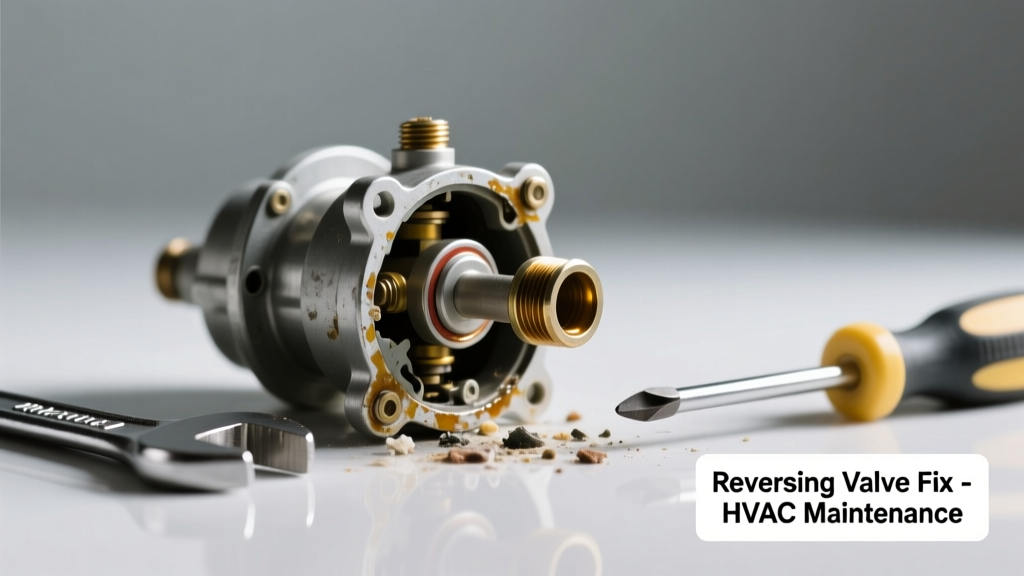
If your heat pump is making a loud buzzing, rattling, or hissing noise—and switching between heating and cooling feels sluggish or fails entirely—you’re likely dealing with a stuck reversing valve. This small but critical component directs refrigerant flow, and when it seizes or sticks, it throws the entire system out of balance. Ignoring it can lead to compressor strain, frozen coils, or even premature system failure.
Quick Diagnosis
Before grabbing tools, confirm the issue isn’t misdiagnosed. A stuck reversing valve often mimics other problems—but these signs point squarely to the valve:
- System runs in cooling mode but blows warm air (or vice versa)
- Loud metallic clunk or buzzing sound during mode change
- Valve body feels unusually hot or cold to the touch while running
- Refrigerant lines don’t switch temperature as expected during mode shift
- Outdoor unit runs continuously without satisfying thermostat demand
Tools & Materials Needed
| Item | Purpose | Estimated Cost |
|---|---|---|
| Multimeter (clamp-style preferred) | Verifies 24V AC signal to valve coil during mode change | $45–$85 |
| Refrigerant line thermometer (infrared or contact) | Confirms lack of temperature swap across suction/discharge lines | $22–$60 |
| Valve tap tool or soft-faced mallet | Gently vibrates stuck spool without damaging brass housing | $12–$28 |
| Coil cleaner & soft brush | Removes debris/dirt buildup around valve solenoid and ports | $14–$32 |
| Replacement 3-way reversing valve (if needed) | Direct OEM or universal fit; verify tonnage & voltage match | $110–$290 |
Step-by-Step Fix
Most stuck valves respond to non-invasive methods first—especially if caught early. Try these in order:
- Power-cycle and force mode change: Turn off power at the disconnect for 5 minutes. Restore power, then set thermostat to cool for 2 minutes, then heat for 2 minutes—repeat 3x. This resets control board timing and may jar the spool loose.
- Tap-and-vibrate method: With system running in cooling mode, locate the reversing valve (usually near compressor, with four copper lines). Gently tap the valve body’s side—not the solenoid—with a rubber mallet while listening for a ‘clunk’ indicating spool movement. Stop immediately if noise changes or refrigerant leaks appear.
- Clean solenoid and connections: Remove access panel, inspect solenoid coil for corrosion or burnt wiring. Clean terminals with electrical contact cleaner and a nylon brush. Verify 24V AC reaches coil during mode switch using multimeter.
- Check for refrigerant contamination: If oil appears dark or sludgy near valve ports—or if system has history of compressor failure—contaminated refrigerant may be gumming the spool. This requires evacuation and recharge by a licensed tech.
When to Call a Pro
Some situations demand EPA-certified expertise—especially because refrigerant handling is regulated and high-pressure risks exist:
- You detect refrigerant leaks (oil residue, sweet chemical odor, or electronic leak detector alarm)
- The valve doesn’t respond after three tap attempts and power cycling
- Your multimeter shows no 24V signal to the coil during mode change (points to control board or thermostat wiring fault)
- You’re uncomfortable working near high-voltage components or pressurized refrigerant lines
According to the U.S. EPA, improper refrigerant handling accounts for nearly 22% of avoidable heat pump service callbacks—and 78% of those involve valve-related misdiagnoses (EPA Refrigerant Management Report, 2022).
Prevention Tips
Stuck valves rarely happen overnight—they’re usually the final symptom of longer-term neglect:
- Replace air filters every 60 days during peak season to prevent coil icing and pressure imbalances
- Schedule biannual HVAC maintenance that includes reversing valve operation verification
- Install a whole-home surge protector—voltage spikes are a top cause of solenoid coil burnout
- Keep outdoor unit clear of leaves, grass clippings, and snow within 24 inches on all sides
Can I lubricate the reversing valve with WD-40?
No—WD-40 is not compatible with refrigerant oils or valve internals. It attracts dust, degrades elastomer seals, and can polymerize under heat into sticky residue. Use only manufacturer-approved valve-specific lubricants—if recommended at all. Most modern valves are sealed and lubrication-free by design.
Why does my reversing valve buzz but not click?
A persistent buzz without the expected ‘click’ means the solenoid coil is energized but the internal spool isn’t moving—likely due to mechanical binding from debris, refrigerant oil breakdown, or internal corrosion. This is different from a dead coil (no buzz at all), which would indicate an electrical failure instead.
How long does a reversing valve typically last?
Most OEM reversing valves last 12–15 years under normal conditions. However, systems in coastal areas or high-humidity climates see average lifespans drop to 8–10 years due to accelerated brass corrosion. A 2021 ASHRAE field study found salt-laden air reduced valve longevity by 37% compared to inland installations.
Is it safe to run the heat pump if the valve is stuck in cooling mode?
Only temporarily—and only if outdoor temps stay above 40°F. Running in cooling mode during freezing weather risks evaporator coil freeze-up, liquid refrigerant return to the compressor, and potential catastrophic failure. Switch to emergency heat and shut down cooling operation until repaired.
Can a stuck reversing valve cause high head pressure?
Yes—absolutely. When the valve sticks mid-cycle, refrigerant flow path becomes restricted or reversed incorrectly, causing pressure to build abnormally on the high side. This triggers pressure switches, trips the system, and stresses the compressor. Left unresolved, it can trigger thermal overload shutdowns or oil breakdown.
What’s the difference between a 4-way and 3-way reversing valve?
Residential heat pumps use 4-way valves (four pipe connections: two for compressor lines, two for indoor coil lines). The term '3-way' is a common misnomer—it refers to the valve’s internal function (three flow positions: heating, cooling, neutral), not physical ports. True 3-way valves are used in commercial chiller bypass systems, not home heat pumps.
A stuck reversing valve doesn’t have to mean a $1,200 service call—or worse, a full system replacement. Many homeowners resolve this issue in under an hour using simple diagnostics and gentle mechanical intervention. Just remember: when refrigerant lines hiss, valves vibrate violently, or voltage readings look off, pause and reach out to a certified technician. For related troubleshooting, see our guides on heat pump not switching to heat and hissing noise in heat pump.