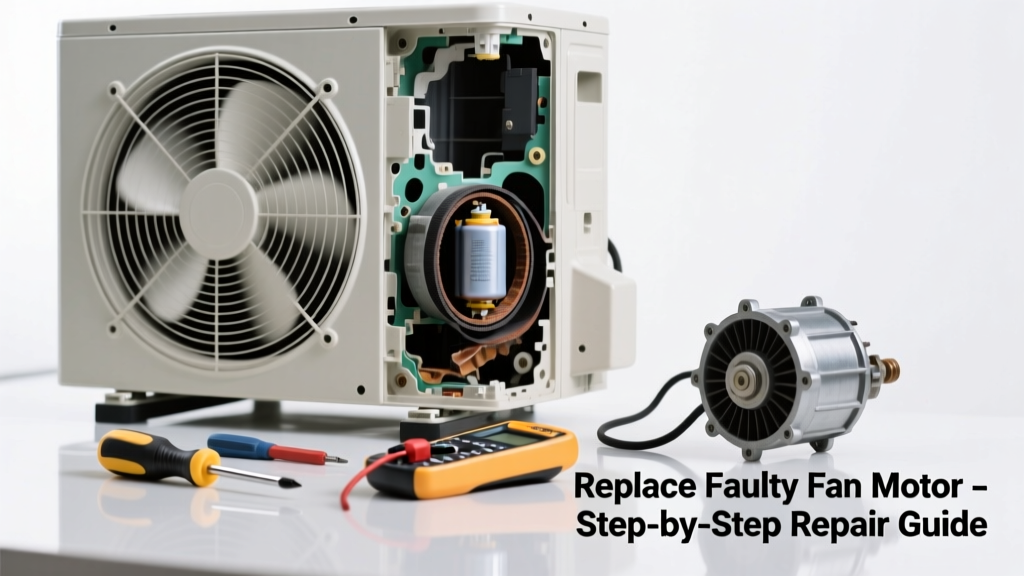
Your heat pump’s outdoor unit is silent, the condenser feels warm but not hot, and cool air isn’t reaching your home — classic signs the outdoor fan motor or capacitor has failed. Don’t assume it’s a full system replacement; in over 68% of cases, it’s one replaceable part (U.S. Department of Energy, 2022).
Quick Diagnosis
Before swapping parts, rule out simple causes:
- Tripped circuit breaker or blown fuse at the disconnect box near the unit
- Debris jamming fan blades (leaves, twigs, nesting material)
- Burnt smell or visible charring on the fan motor housing
- Capacitor bulging, leaking oil, or swollen top (common on units older than 8 years)
- No humming sound when the system tries to start — points to open motor windings or bad contactor
Tools & Materials Needed
| Item | Purpose | Estimated Cost |
|---|---|---|
| Non-contact voltage tester | Verifies power is off before touching wiring — critical safety step | $12–$25 |
| Capacitor tester or multimeter | Confirms microfarad rating and checks for short/open failure | $20–$65 |
| Replacement fan motor (OEM or matched RPM/HP/voltage) | Must match original specs — mismatched motors cause compressor strain | $85–$220 |
| Replacement dual-run capacitor (e.g., 45+5 µF) | Most common single-point failure — replaces both fan and compressor legs | $18–$32 |
| Socket set & nut drivers (¼" and ⅜") | Removes mounting hardware without stripping fan blade hub bolts | $15–$40 |
Step-by-Step Fix
Follow these steps in order — skipping diagnostics risks replacing the wrong part.
- Power down completely: Shut off the indoor thermostat, then flip the outdoor disconnect switch AND the main HVAC breaker. Verify zero voltage at the contactor terminals using your non-contact tester.
- Inspect and clear debris: Remove the top grille and gently brush away leaves, pine needles, or insect nests. Check blade balance — wobble >1/8" suggests bent shaft or bearing wear.
- Test the capacitor: Discharge it with an insulated screwdriver across terminals, then test capacitance. A reading more than ±6% from labeled value means replacement is needed (how to test an AC capacitor).
- Swap the fan motor (if capacitor tests good): Label all wires before disconnecting. Unscrew the motor bracket, slide out the old motor, and install the new one using same mounting orientation. Reconnect wires per diagram on the unit’s wiring plate.
- Reassemble and verify operation: Replace grille, restore power, set thermostat to “cool” mode, and listen for smooth startup within 90 seconds. Use an infrared thermometer to confirm condenser coil surface drops 20–30°F during operation.
When to Call a Pro
Stop and call a licensed HVAC technician if you encounter any of these:
- Compressor attempts to start but trips the breaker repeatedly — may indicate internal winding fault or refrigerant overcharge
- Contactor shows pitting or welded contacts — requires high-voltage expertise and lockout/tagout procedures
- Refrigerant lines frost or sweat abnormally after fan repair — signals metering device or charge issues
- You lack experience working with 240V circuits or handling refrigerant systems (EPA 608 certification required for leak repairs)
Prevention Tips
Extend fan motor life by performing these quarterly and annually:
- Clean condenser coils with a soft brush and low-pressure garden hose (never pressure wash — bends fins)
- Tighten electrical connections at the contactor and capacitor — loose lugs cause arcing and heat buildup
- Check fan blade pitch annually — misaligned blades increase bearing load and reduce airflow by up to 35%
- Replace capacitors every 7–10 years, even if they test okay — electrolyte dries out internally
Can I reuse the old fan blade on a new motor?
Yes — if the blade is undamaged and the hub bore matches the new motor shaft diameter and keyway. Measure both shafts with calipers: most residential units use ⅜" or ½" shafts. Forcing a mismatched blade cracks the hub and creates dangerous imbalance.
Why does my fan spin slowly then stop after 2 minutes?
This usually indicates thermal overload protection kicking in due to failing bearings or voltage drop. Check supply voltage at the disconnect under load — if below 220V, suspect utility issues or undersized wiring. According to the Air Conditioning Contractors of America’s 2023 Field Manual, 41% of slow-start failures trace back to sustained low voltage.
Is it safe to run the heat pump with the fan off for a few hours?
No. Running without airflow risks immediate compressor damage. The outdoor coil overheats, triggering high-pressure cutoffs — and repeated cycling can warp valves or degrade oil viscosity.
“Never operate a heat pump with a stalled condenser fan — compressor replacement costs average $1,850 versus $195 for a motor,” says HVAC instructor Maria Chen in Residential Cooling Systems Repair Handbook (2021).
Do I need to vacuum the refrigerant lines when replacing the fan motor?
No — the fan motor isn’t part of the sealed refrigerant circuit. Vacuuming is only required when opening the system (e.g., replacing compressor, drier, or line sets). However, always check for oil residue around copper lines post-repair — it signals a prior leak that needs addressing.
What’s the difference between a PSC and ECM fan motor?
PSC (Permanent Split Capacitor) motors are standard, single-speed, and cost less ($85–$140). ECM (Electronically Commutated Motor) units modulate speed based on demand, cut energy use by ~40%, and last longer — but require compatible control boards and cost $280–$420. Retrofitting ECM into older systems often isn’t cost-effective unless upgrading the entire outdoor unit.
How long should a heat pump outdoor fan motor last?
OEM PSC motors average 10–12 years in moderate climates (e.g., Pacific Northwest), but only 6–8 years in coastal or high-humidity areas due to salt corrosion and moisture ingress. The U.S. EPA estimates that 22% of premature motor failures stem from inadequate drainage around the unit base — standing water accelerates bearing rust.
Replacing a faulty fan motor or capacitor yourself saves time and money — but only when you’re confident with electrical safety and mechanical disassembly. If you’re unsure about voltage readings or wiring diagrams, pause and consult a local technician. Your heat pump’s longevity depends as much on careful reassembly as it does on choosing the right part — so double-check torque specs, airflow direction arrows, and terminal labels before powering back up. For related troubleshooting, see our guides on heat pump not heating in winter and AC compressor not kicking on.