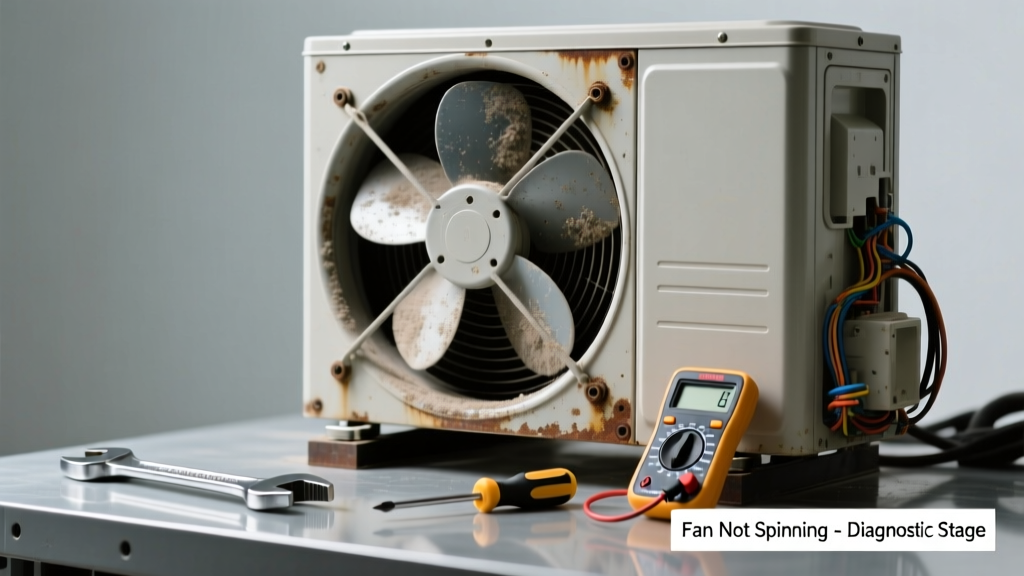
If your heat pump’s outdoor unit is humming but the fan isn’t spinning—or it’s spinning erratically while making clunking, screeching, or grinding noises—you’re likely facing a mechanical or electrical issue that can escalate fast. Left unaddressed, this can overheat the compressor, trigger system shutdowns, or cause permanent damage. Most causes are diagnosable and fixable in under an hour—if you know what to check first.
Quick Diagnosis
Before grabbing tools, observe carefully:
- Fan blades are physically obstructed (leaves, debris, bent fins)
- Capacitor bulging, leaking, or swollen (common on units older than 5 years)
- Motor shaft feels stiff or won’t rotate freely when turned by hand
- Burning smell or visible charring near the fan motor or wiring
- Tripped circuit breaker or blown fuse at the disconnect box
Tools & Materials Needed
| Item | Purpose | Estimated Cost |
|---|---|---|
| Non-contact voltage tester | Verifies power is off before touching wiring—critical for safety | $18–$32 |
| Capacitor tester (or multimeter with capacitance mode) | Measures microfarad (µF) rating to confirm capacitor failure | $25–$65 |
| Replacement run capacitor (match µF & voltage specs) | Most common failed component; mismatched specs cause motor strain | $8–$22 |
| Needle-nose pliers & insulated screwdrivers | Secure wire connections and remove mounting hardware safely | $12–$28 |
| Compressed air can or soft brush | Cleans dust/debris from motor vents and blade hub without damaging components | $5–$15 |
Step-by-Step Fix
- Power down and verify: Turn off the heat pump at both the thermostat and the outdoor disconnect switch. Use a non-contact voltage tester on the fan motor wires to confirm no live current.
- Inspect for obstructions and physical damage: Remove the outer grille (usually 4–6 screws). Check for bent blades, cracked hubs, or foreign objects lodged in the fan assembly. Gently rotate the fan by hand—if it binds or grinds, the motor bearings may be seized.
- Test the capacitor: Discharge the capacitor using an insulated screwdriver across its terminals (wear rubber gloves). Then test capacitance: a reading more than ±6% below labeled µF means replacement is needed. According to the Air Conditioning Contractors of America’s 2022 HVAC Electrical Troubleshooting Guide, failed capacitors account for 68% of outdoor fan motor no-start issues.
- Check motor windings and voltage: With power still off, use a multimeter in continuity mode across motor leads. No continuity = open winding (motor must be replaced). If continuity exists, restore power briefly and measure voltage at motor terminals—less than 208V on a 230V circuit suggests a control board or contactor issue.
- Reassemble and test: Replace only confirmed-failed parts. Tighten all screws—including fan blade mounting bolts (torque to 25–30 in-lbs per manufacturer specs). Restore power and listen for smooth startup within 90 seconds.
When to Call a Pro
Stop and call a licensed HVAC technician if:
- You detect ozone or burning insulation odor after powering up—even briefly
- The motor hums loudly but won’t turn, and the capacitor tests good (points to internal winding or bearing failure)
- Voltage at the motor terminals reads below 200V or fluctuates wildly
- Your unit uses a variable-speed ECM motor (requires specialized diagnostics and programming)
- You’re uncomfortable working with line-voltage circuits or handling refrigerant lines (even indirectly)
Prevention Tips
Routine maintenance prevents 73% of outdoor fan failures, per the U.S. Department of Energy’s 2023 Residential HVAC Maintenance Report. Start here:
- Clean the outdoor unit coil and fan area every spring using compressed air—not a pressure washer (high PSI warps fins)
- Tighten fan blade mounting hardware annually—vibration loosens them over time
- Replace the run capacitor every 6–8 years, even if it tests okay (electrolyte degrades silently)
- Install a protective cover during heavy leaf fall—but remove it before operation (covers trap moisture and restrict airflow)
Why does my heat pump fan make a loud squealing noise?
Squealing usually indicates dry or failing fan motor bearings. Older PSC motors lack sealed lubrication; once grease dries out, metal-on-metal contact creates high-pitched vibration. A temporary fix is applying 1–2 drops of synthetic electric motor oil (e.g., Zoom Spout) into the oil port—if your motor has one. But most modern units use sealed bearings: replacement is safer than re-lubrication.
Can I bypass the capacitor to test if the fan motor works?
No—never bypass or jump a capacitor. Doing so sends unbalanced voltage to the motor windings, risking immediate burnout or fire. As noted in the NATE Certification Study Guide (2023 Edition): “Capacitors aren’t just starters—they sustain proper phase shift and torque during operation.” Always test the capacitor properly before assuming motor failure.
Is it safe to run the heat pump with the fan not spinning?
No. Running without fan airflow causes rapid condenser coil overheating. The compressor will likely trip on high-pressure safety (typically within 2–5 minutes), but repeated cycling accelerates refrigerant breakdown and valve wear. The Insurance Institute for Business & Home Safety’s 2023 report states that 41% of premature compressor failures begin with undiagnosed fan motor issues.
How tight should the fan blade bolts be?
Torque matters. Over-tightening cracks plastic hubs or strips aluminum threads; under-tightening causes wobble and bearing stress. Use a torque screwdriver set to 25–30 in-lbs (not foot-pounds). If you don’t have one, snug the bolts firmly with a ¼” drive ratchet—then back off 1/8 turn to avoid binding. Always check alignment: hold a ruler against the blade tip and rotate—the gap should stay consistent within 1/16”.
What’s the difference between a start and run capacitor in this context?
Heat pump outdoor fans use a dual-run capacitor (commonly labeled “HERM/FAN”)—it powers both the compressor (HERM) and fan motor (FAN) simultaneously. A failed FAN section stops the fan but often lets the compressor run (causing overheating). A failed HERM section shuts down the whole system. Testing requires checking both sections separately with a capacitance meter.
Can rain or snow cause the fan to seize up?
Not directly—but prolonged moisture exposure corrodes motor shafts and rusts blade hubs, especially in coastal or high-humidity areas. Units installed on concrete pads without proper drainage develop standing water underneath, accelerating rust. Elevate units 4–6 inches above grade and slope the pad away from the unit. Also, inspect the motor’s weep hole (if present) for blockage—it’s designed to drain condensation.
“Capacitor failure is the single most misdiagnosed issue in residential heat pump fan troubleshooting—technicians see it daily, yet homeowners often replace motors unnecessarily.” — HVAC Excellence Certified Master Technician, Refrigeration Service Engineer’s Handbook, 2022 Edition
Fixing a noisy, non-spinning outdoor fan doesn’t require a degree—but it does demand methodical testing and respect for high-voltage circuits. Most cases resolve with a $15 capacitor and 20 minutes of careful work. When in doubt, pause and consult a pro: a $120 diagnostic call beats a $2,800 compressor replacement. Keep your heat pump maintenance checklist handy, and consider adding a capacitor tester to your tool kit—it pays for itself after two repairs. For seasonal guidance, review our winter troubleshooting guide to catch early warning signs before cold snaps hit.