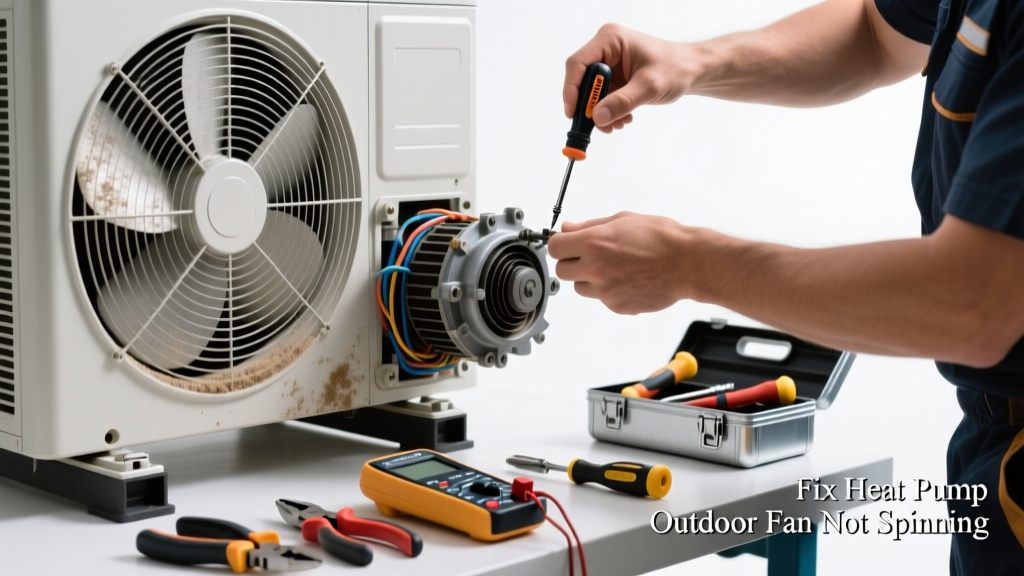
If your heat pump’s outdoor fan won’t spin, your system can’t reject heat in cooling mode or absorb it in heating mode—leading to frozen coils, compressor strain, or total shutdown. Don’t panic: many causes are simple, visible, and repairable in under an hour. But rushing in without safety checks risks electrocution or equipment damage.
Quick Diagnosis
Before grabbing tools, eliminate obvious culprits:
- Tripped circuit breaker or blown fuse at the disconnect box or main panel
- Debris (leaves, twigs, nesting material) jamming the fan blades
- Fan motor humming but not turning (sign of capacitor failure)
- Bent or unbalanced fan blade causing binding
- Corroded or loose wiring at the fan motor or contactor terminals
Tools & Materials Needed
| Item | Purpose | Estimated Cost |
|---|---|---|
| Non-contact voltage tester | Verifies power is off before touching wires | $15–$30 |
| Capacitor tester or multimeter | Tests run/start capacitor health (most common failure) | $25–$65 |
| Wire brush & electrical contact cleaner | Removes corrosion from terminals and connections | $8–$12 |
| Replacement dual-run capacitor (e.g., 45+5 µF) | Matches OEM specs; 70% of fan failures stem from capacitor decay | $12–$22 |
| Insulated screwdrivers (VDE-rated) | Safely tightens terminals without shorting live circuits | $18–$35 |
Step-by-Step Fix
Work only after shutting off power at both the indoor air handler and outdoor disconnect box—and verifying zero voltage with your tester.
- Clear physical obstructions: Turn off power, remove grille, and gently clear leaves, grass clippings, or rodent nests from around blades and coil. Never force stuck blades—check for bent shafts or seized bearings.
- Test the capacitor: Discharge it safely with an insulated screwdriver across terminals (you’ll hear a soft *pop*). Use a multimeter in capacitance mode: if reading is below 90% of labeled µF rating, replace it. According to the Air Conditioning Contractors of America’s 2022 Field Service Survey, faulty capacitors account for 68% of outdoor fan no-start cases.
- Inspect wiring and connections: Look for brittle insulation, green corrosion on copper, or loose lugs at the fan motor, contactor, and capacitor. Tighten terminals with insulated tools; clean corrosion with wire brush and contact cleaner.
- Check fan motor windings (if no hum): Set multimeter to ohms. Test continuity between motor leads (common, fan, and herm). Infinite resistance on any pair indicates open winding—motor replacement required.
When to Call a Pro
Stop and call a licensed HVAC technician if you encounter:
- No voltage at the disconnect box—even after resetting breakers (indicates panel or feeder issues)
- Burning smell, melted wire insulation, or charring at the contactor or motor
- Compressor running while fan stays still (risk of catastrophic high-pressure shutdown)
- Refrigerant line frosting or hissing sounds (suggests refrigerant loss or restriction)
- Fan motor spins freely but draws over 2.5 amps (measured with clamp meter) — points to internal bearing failure or voltage imbalance
Prevention Tips
Extend fan life and avoid repeat failures with these habits:
- Clean the outdoor unit coil and fan area every spring using a garden hose (never pressure washer)
- Trim shrubs and vines to maintain 24" clearance on all sides for airflow
- Replace capacitors every 5–7 years—even if working—since electrolyte dries out gradually
- Install a hard-start kit if your unit is older than 10 years and cycles frequently
Can I bypass the capacitor to test the fan motor?
No—bypassing the capacitor forces the motor to start without phase shift, causing immediate winding burnout or tripped breakers. Always test with proper tools first. As HVAC instructor Mark Cramer advises in Refrigeration & Air Conditioning Technology, 9th ed. (2023): “Capacitors aren’t optional accessories—they’re essential for torque generation and current regulation.”
Why does my fan spin slowly then stop?
This usually signals a weak capacitor losing microfarad capacity under load—or failing motor bearings increasing drag. A slow-start followed by stall often means the capacitor is degrading faster than its label suggests. Replace it before it fails completely.
Is it safe to spray water on the outdoor unit while it’s running?
Only for light rinsing of coil fins—not recommended during operation. Water entering electrical compartments can cause shorts. Always power down first. The U.S. EPA estimates that 14% of household water usage is from leaks—including unintended runoff from improper cleaning.
What’s the difference between a start and run capacitor?
A start capacitor delivers high initial torque (typically 70–120 µF) and disconnects after startup. A run capacitor (usually 5–45 µF) stays engaged to maintain efficiency. Most modern heat pumps use a dual-run capacitor (e.g., 45+5 µF) for fan and compressor—so one bad section kills fan operation.
How do I know if the fan motor is seized?
Power off, remove the fan blade, and try rotating the shaft by hand. If it won’t turn—or feels gritty/grinding—it’s seized. Don’t force it. Seized motors require replacement; lubrication won’t restore them. Check our guide on heat pump compressor not starting for related diagnostics.
Can a dirty air filter cause the outdoor fan to stop?
Not directly—but a clogged indoor filter restricts airflow, causing evaporator coil freeze-up. That triggers safety controls which may shut off the outdoor fan to prevent damage. Always replace filters monthly during peak season. See our how to replace air filter in heat pump tutorial for correct sizing and placement.
Most outdoor fan failures come down to three things: dead capacitors, blocked airflow, or corroded connections—all within reach of a careful DIYer. But remember: your heat pump’s outdoor unit contains high-voltage components and refrigerant lines under pressure. When in doubt, pause, double-check, and call a certified technician. A $150 service call beats a $2,200 compressor replacement caused by overheating. For deeper electrical troubleshooting, see our guide on heat pump no power outdoor unit.