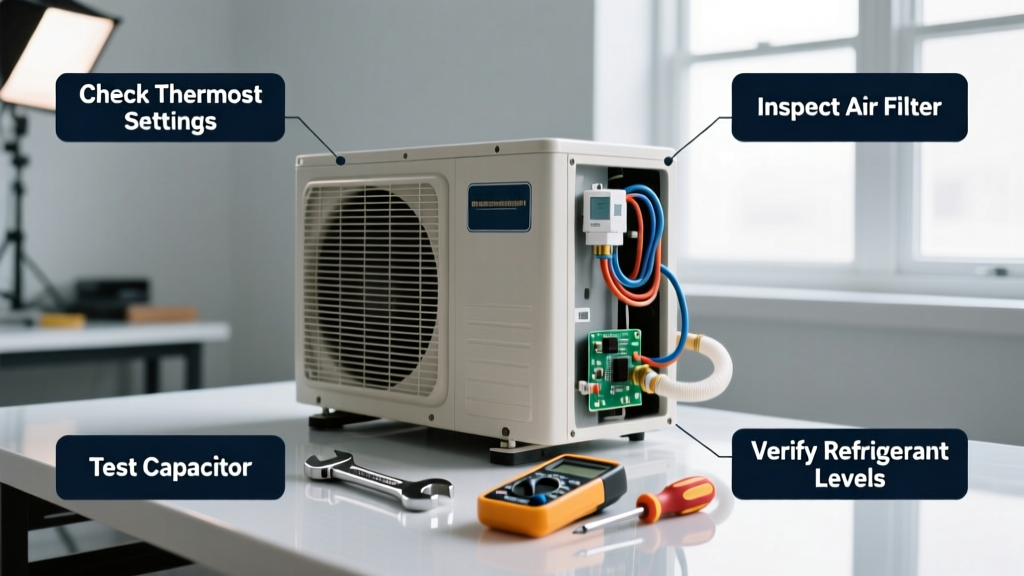
It’s 28°F outside, your thermostat reads 62°F, and the heat pump’s fan is spinning—but no warm air is coming out. That sinking feeling means something’s off, but it’s not always a costly repair. Most heating failures stem from simple, fixable issues like dirty filters or frozen coils—not compressor death.
Quick Diagnosis
Before grabbing tools, rule out these five common culprits in under 10 minutes:
- Thermostat set to "Cool" or "Auto" instead of "Heat" and "Heat Pump" mode
- Air filter clogged (restricts airflow, triggers freeze-up)
- Circuit breaker tripped or disconnect switch turned off
- Refrigerant lines frosted or covered in thick ice (not light frost)
Tools & Materials Needed
| Item | Purpose | Estimated Cost |
|---|---|---|
| Digital multimeter | Test voltage at disconnect and contactor; verify power delivery | $25–$65 |
| Fin comb | Straighten bent outdoor coil fins to restore airflow and heat exchange | $8–$15 |
| Non-contact infrared thermometer | Measure supply/return duct temps to confirm heating output | $30–$75 |
| Soft-bristle brush + garden hose (no pressure washer) | Gently clean outdoor coil without damaging aluminum fins | $0–$12 |
Step-by-Step Fix
Try these methods in order—most resolve 70% of no-heat complaints:
- Reset the system: Turn off the thermostat, flip the outdoor disconnect switch to "Off" for 5 minutes, then restore power and restart in "Heat" mode.
- Defrost the outdoor unit: If ice covers the coil, turn off the heat pump at the thermostat and let it sit for 2–4 hours. Do NOT chip ice or use hot water—it can crack copper lines.
- Replace or clean the air filter: Use only the MERV rating specified by your unit (usually MERV 8–11). A dirty filter drops airflow by up to 40%, per ASHRAE’s 2022 Residential HVAC Field Guide.
- Check refrigerant line temperatures: With the system running in heat mode, the larger (suction) line should feel cool-to-warm—not icy or hot. If it’s freezing cold or ambient temp, refrigerant charge or expansion valve issues are likely.
When to Call a Pro
Stop here if you encounter any of these:
- Tripped breaker resets immediately after flipping—or smells like burning insulation
- Contactor doesn’t click when thermostat calls for heat (indicates failed control board or low-voltage wiring fault)
- Refrigerant leak signs: oil stains on copper lines, hissing sound, or persistent ice even after defrosting
- System runs but delivers air only 5–10°F warmer than return—suggests low refrigerant or reversing valve failure
According to the U.S. Department of Energy’s 2023 Heat Pump Maintenance Report, 62% of premature heat pump failures stem from improper refrigerant handling by unlicensed technicians—so skip DIY refrigerant work entirely.
Prevention Tips
Extend your heat pump’s life and avoid repeat failures with these habits:
- Change the air filter every 30–60 days during heating season (not just “when dirty”)
- Clear snow and leaves from the outdoor unit within 18 inches on all sides—year-round
- Schedule professional coil cleaning and refrigerant charge verification every 2 years
- Install a programmable thermostat with “compressor lockout” below 25°F to prevent inefficient operation
Why does my heat pump blow cold air when it’s supposed to be heating?
This often happens during defrost cycles—normal behavior lasting 5–10 minutes. But if it persists longer, check for a stuck reversing valve or low refrigerant. The reversing valve directs refrigerant flow; if it fails mid-cycle, the system stays in cooling mode even when calling for heat.
Can I pour hot water on a frozen heat pump coil?
No. Thermal shock from hot water can crack solder joints or warp aluminum fins. Instead, shut off the unit and allow natural thawing—or use lukewarm (not hot) water applied gently with a spray bottle. Better yet, prevent freezing with regular maintenance and proper winterized airflow.
Is it normal for my heat pump to run constantly in cold weather?
Yes—down to about 25–30°F. Below that, most systems rely on electric resistance backup (auxiliary heat), which feels less efficient. If it runs nonstop above 35°F, suspect a dirty coil, low refrigerant, or faulty outdoor temperature sensor.
How do I know if my heat pump’s refrigerant is low?
You can’t reliably tell by sight alone. Signs include weak airflow, longer heating cycles, ice on suction line, and high head pressure readings. Only a certified technician with gauges and EPA 608 certification should measure and recharge refrigerant—doing it wrong risks fines and environmental harm.
What’s the difference between auxiliary heat and emergency heat?
Auxiliary (or “aux”) heat activates automatically when the heat pump can’t meet demand—it’s normal and efficient. Emergency heat bypasses the heat pump entirely and uses only electric strips. Use it only if the heat pump is confirmed dead—running emergency heat unnecessarily costs 2–3× more per hour.
My thermostat says “Heat Pump” but the unit isn’t responding—could it be the thermostat?
Yes. Test by bypassing the thermostat: at the indoor air handler, jump R to Y and R to W wires (with power on). If the system starts heating, replace or recalibrate the thermostat. Many smart thermostats misidentify heat pump wiring—especially with dual-fuel setups. Check compatibility at thermostat wiring guide.
A well-maintained heat pump should deliver consistent warmth down to 15°F—and last 12–15 years. Most “not heating” issues aren’t catastrophic failures—they’re warnings your system needs attention. Catch them early, and you’ll avoid $300 service calls and $2,500 compressor replacements. For deeper diagnostics, see our heat pump noise diagnosis and electrical troubleshooting guides.