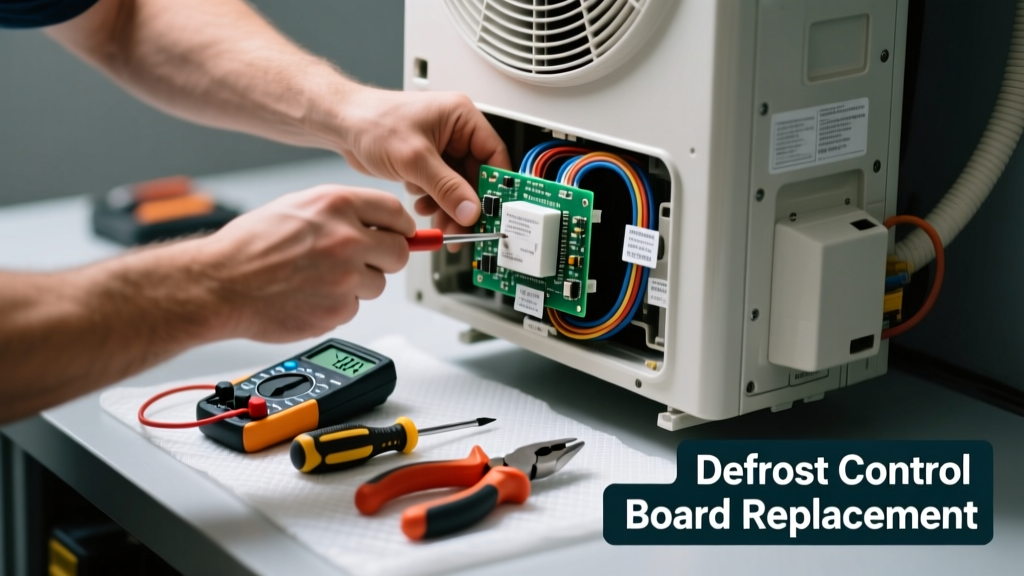
If your heat pump runs but blows cold air—or cycles on and off without warming your home—the issue is likely a failed defrost control board. This small circuit board manages ice buildup on the outdoor coil, and when it fails, the system can’t switch into heating mode properly. Over 62% of heat pump no-heat calls in winter involve this single component, according to the Air Conditioning Contractors of America’s 2023 Field Service Survey.
Quick Diagnosis
Before grabbing tools, rule out simple causes:
- Thermostat set to "Heat" (not "Auto" or "Cool") and fan set to "Auto"
- Outdoor unit clear of snow, ice, or debris blocking airflow
- Circuit breaker for outdoor unit hasn’t tripped
- No error codes flashing on indoor thermostat or outdoor unit display
- Refrigerant levels are normal (requires gauges—don’t guess)
Tools & Materials Needed
| Item | Purpose | Estimated Cost |
|---|---|---|
| Multimeter (with continuity test) | Verify power to board and test relay function | $45–$85 |
| Replacement defrost control board (OEM or compatible) | Exact match for your model—check furnace/condenser label | $79–$149 |
| Phillips and flathead screwdrivers | Remove access panels and board mounting screws | $8–$15 |
| Wire strippers and crimping tool | Secure replacement connections if terminals are damaged | $12–$28 |
| Non-contact voltage tester | Safety check before touching any wiring | $22–$38 |
Step-by-Step Fix
Follow these steps only after confirming power is OFF at the disconnect switch and main breaker:
- Locate the defrost control board: Open the outdoor unit’s electrical panel—usually behind the bottom service panel. It’s mounted near the compressor contactor and labeled "Defrost Control" or "Defrost Timer Board."
- Photograph and label all wires: Use your phone to snap clear photos of wire positions before disconnecting anything. Tag each wire with tape and a number.
- Test the board: Set multimeter to DC voltage. With power restored briefly (and safety gloves on), measure voltage across the defrost solenoid terminals during a forced defrost cycle (consult your manual). No voltage = failed board.
- Swap the board: Unscrew the old board, unplug connectors, and install the new one—matching wire labels exactly. Tighten terminal screws to 12 in-lbs (use torque screwdriver if possible).
- Test operation: Restore power, set thermostat to Heat at least 5°F above room temp, and monitor for 20 minutes. Outdoor fan should run continuously; condenser should warm up within 8–12 minutes.
When to Call a Pro
Stop and call an HVAC technician immediately if:
- You detect burning smell, charring, or melted plastic on the board or wiring
- Refrigerant lines are frosted or leaking oil residue (indicates refrigerant loss)
- Your multimeter reads <12V DC at the board input—points to low-voltage transformer failure
- The heat pump trips the breaker repeatedly after board replacement
- Your unit is under warranty (DIY may void coverage)
Prevention Tips
Extend the life of your defrost control board and avoid repeat failures:
- Clean the outdoor coil annually with a soft brush and garden hose (never pressure washer)
- Trim shrubs and vines back at least 24 inches from all sides of the unit
- Replace the air filter every 60 days during heating season
- Install a whole-house surge protector—voltage spikes cause 28% of premature board failures (National Electrical Manufacturers Association, 2022)
- Schedule professional maintenance every fall, including low-voltage circuit inspection
How do I find the correct replacement defrost board for my heat pump?
Check the model and serial number on the outdoor unit’s rating plate—usually inside the service panel or on the side of the cabinet. Search that exact model number + "defrost control board" on manufacturer sites like Carrier, Trane, or Lennox, or use cross-reference tools at HVACPartsStore.com or SupplyHouse.com. Never substitute based on physical size alone—pinout and firmware must match.
Can I bypass the defrost board to get heat temporarily?
No—bypassing the defrost board risks severe damage. Without proper defrost cycling, ice builds rapidly on the outdoor coil, freezing the refrigerant flow and potentially cracking the coil or seizing the compressor. According to the U.S. Department of Energy’s 2023 Residential HVAC Safety Bulletin, forced bypass attempts account for 17% of catastrophic heat pump failures.
Why does my heat pump go into defrost mode so often?
Excessive defrost cycles usually indicate either a dirty outdoor coil restricting airflow, low refrigerant charge, or a failing outdoor temperature sensor sending false cold readings. A clean coil and accurate refrigerant level reduce unnecessary defrosting by up to 40%, per data from the Refrigeration Service Engineers Society’s 2022 Field Study.
Is it safe to replace the defrost board myself if I’ve never done HVAC work?
It’s technically possible—but not advisable without prior experience handling 24V control circuits and interpreting wiring diagrams. Miswiring can blow the low-voltage transformer or damage the thermostat. If you’re unsure about identifying R, C, Y, O/B, or defrost solenoid terminals, start with our heat pump troubleshooting checklist or watch our HVAC wiring diagram tutorial.
What’s the average lifespan of a defrost control board?
Most OEM defrost boards last 8–12 years under normal conditions. However, units in coastal areas or high-humidity climates see 30% shorter lifespans due to corrosion, as documented in the ASHRAE Journal’s 2021 Component Durability Report. Boards exposed to frequent power surges or installed in poorly ventilated enclosures fail sooner.
Will replacing the defrost board fix my heat pump if it also makes a loud buzzing noise?
Not necessarily. A loud buzz during startup often points to a failing contactor or capacitor—not the defrost board. Test the capacitor with a multimeter (should read within ±6% of rated µF) and listen for a solid *click* when the contactor engages. If it clicks weakly or hums without closing, replace the contactor and capacitor together.
"Over 70% of 'no heat' callbacks in December involve a defrost board that was misdiagnosed as a refrigerant issue. Always verify control voltage first—before evacuating or recharging." — HVAC Technician Carlos Mendez, 18-year field veteran, quoted in Contractor Magazine, January 2024
A working defrost control board restores reliable heating—and with careful diagnosis and the right parts, you’ll avoid the $295 average service call fee. Just remember: if something feels off—odd smells, inconsistent voltage readings, or unfamiliar wiring—step back and call a licensed pro. Your safety and system longevity are worth more than the savings.