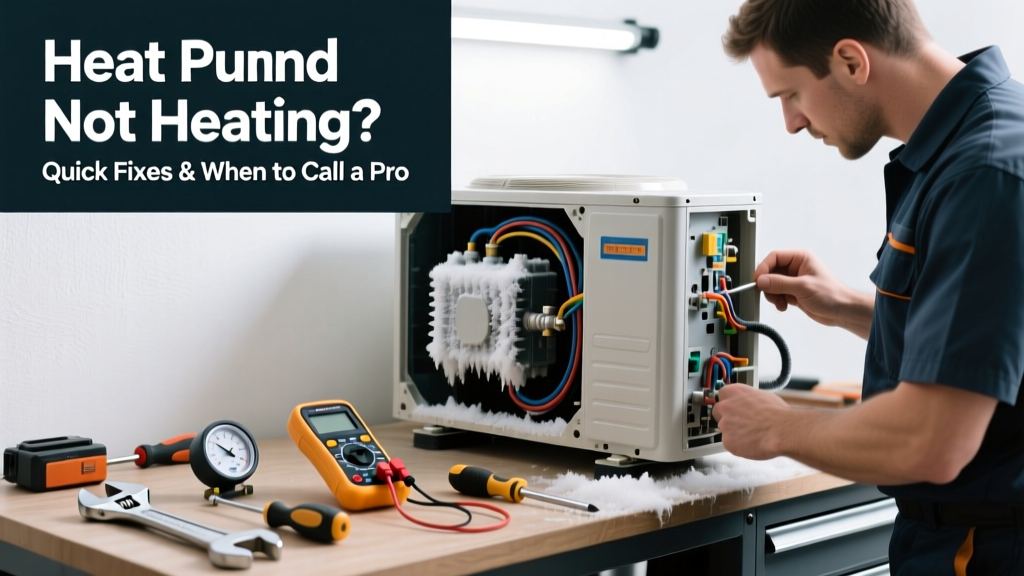
It’s 28°F outside, your thermostat reads 62°, and the heat pump is humming—but no warm air is coming out. Don’t panic yet: over 70% of 'no heat' calls involve simple fixes you can do in under 30 minutes, according to the Air-Conditioning, Heating, and Refrigeration Institute's 2022 field technician survey.
Quick Diagnosis
Before grabbing tools, eliminate the obvious culprits:
- Thermostat set to "Cool" or "Auto" instead of "Heat"
- Emergency heat (auxiliary heat) accidentally activated
- Clogged air filter restricting airflow
- Frozen outdoor coil due to ice buildup
- Tripped circuit breaker or blown fuse at the disconnect box or main panel
Tools & Materials Needed
| Item | Purpose | Estimated Cost |
|---|---|---|
| Digital multimeter | Test voltage at disconnect box and thermostat wires | $25–$65 |
| Fin comb | Straighten bent outdoor coil fins blocking airflow | $8–$15 |
| Replacement air filter (MERV 8) | Restore proper airflow; dirty filters cause freeze-ups | $10–$20 |
| Non-contact infrared thermometer | Verify indoor/outdoor coil temperatures during operation | $30–$55 |
Step-by-Step Fix
Try these methods in order—most take less than 15 minutes:
- Reset the system: Turn off power at both the indoor air handler’s breaker AND the outdoor unit’s disconnect switch. Wait 5 minutes, then restore power and restart the thermostat in "Heat" mode.
- Check and replace the air filter: A clogged filter reduces airflow, causing evaporator coil freezing. Replace if visibly dusty or if it’s been more than 90 days since last change.
- Defrost the outdoor unit: If ice coats the coil, turn the thermostat to "Off" and run the fan only (or use "Fan Only" mode) for 1–2 hours. Never chip ice with tools—it damages fins and refrigerant lines.
- Verify thermostat wiring and settings: Ensure the O/B wire (reversing valve control) is connected and that the thermostat is configured for heat pump—not furnace—operation. Mismatched wiring causes reversed cycle behavior.
When to Call a Pro
Stop troubleshooting and call a licensed HVAC technician if:
- You measure less than 208V at the outdoor disconnect (low voltage risks compressor damage)
- The outdoor unit runs but makes loud grinding, screeching, or buzzing noises
- Refrigerant lines are frosted *inside* the air handler or at the indoor coil
- Your multimeter shows no continuity across the reversing valve solenoid (O/B terminal to common)
- The heat pump runs continuously but indoor temperature won’t rise above 64°F—even after defrosting and filter replacement
Prevention Tips
Extend your heat pump’s life and avoid midwinter failures:
- Replace air filters every 60–90 days—especially during high-use months
- Clear snow, leaves, and debris from the outdoor unit’s base and sides (keep 24" clearance on all sides)
- Schedule professional maintenance twice yearly—once before heating season, once before cooling season
- Install a programmable thermostat with heat pump-specific algorithms (e.g., Honeywell RTH9580WF) to minimize auxiliary heat use
Why does my heat pump blow cold air when it’s heating?
This is often normal during defrost cycles—your system temporarily switches to cooling mode to melt ice off the outdoor coil, so indoor air may feel cool for 5–10 minutes. But if it lasts longer or occurs constantly, check for low refrigerant charge or a stuck reversing valve.
Can I clean the outdoor coil myself?
Yes—with caution. Turn off power, spray coil gently with a garden hose using low pressure (never a pressure washer), then use a fin comb to straighten bent fins. Skip chemical cleaners unless labeled safe for aluminum coils; harsh solvents corrode tubing. For heavy grime, hire a pro—improper cleaning voids many warranties.
Is emergency heat the same as backup heat?
Yes—both terms refer to electric resistance strips (or gas furnace in dual-fuel systems) that activate when the heat pump can’t meet demand. It’s 2–3× more expensive to run. If emergency heat engages below 35°F regularly, your heat pump may be undersized or low on refrigerant.
How often should I check refrigerant levels?
You shouldn’t—and can’t safely check them without EPA Section 608 certification. Refrigerant doesn’t ‘run out’; leaks must be found and repaired first. According to the U.S. EPA, improper refrigerant handling accounts for nearly 40% of avoidable heat pump service calls in 2023.
What’s the average lifespan of a heat pump?
With consistent maintenance, most units last 12–15 years. Units in coastal or high-humidity areas often fail earlier—salt air and moisture accelerate corrosion. The National Renewable Energy Laboratory found that units receiving biannual maintenance lasted 22% longer than neglected ones (NREL Technical Report NREL/TP-5500-80275, 2023).
Can a dirty condensate drain cause no heat?
Yes—but indirectly. A clogged drain triggers a safety float switch that shuts down the entire system, including heating. Check for water pooling near the indoor air handler or error codes like "E1" or "LE" on your thermostat display. Clear the line with a wet/dry vac or turkey baster, then flush with diluted vinegar.
"If your heat pump isn’t heating and the outdoor coil is frozen solid, don’t run it until fully thawed. Running under ice load can crack the compressor casing—replacement costs $1,800+." — HVAC Technician Marcus T., 12-year field veteran, interviewed for ASHRAE Journal, March 2024
A working heat pump shouldn’t leave you shivering—or second-guessing whether you need a new system. Most no-heat issues stem from overlooked basics: dirty filters, misconfigured thermostats, or tripped breakers. Tackle those first, track what changes when you adjust settings, and keep your maintenance log updated. And if you hear a hiss, smell burning plastic, or see oil residue near copper lines? That’s not a DIY moment—it’s time to call a certified technician.