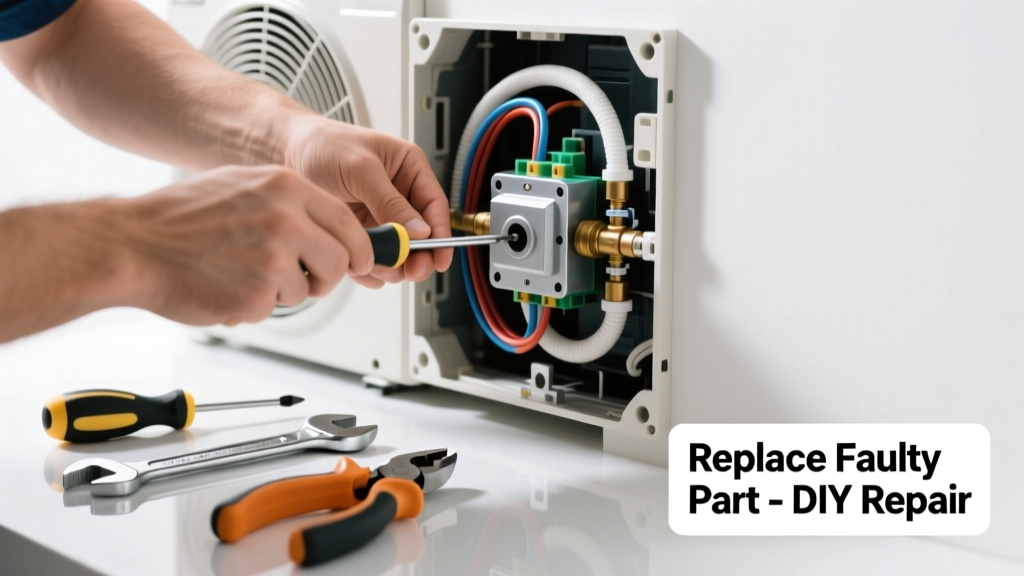
Your heat pump runs but blows warm or lukewarm air instead of cold — and you’ve ruled out dirty filters and thermostat settings. Before calling a technician, check whether a single component has failed. Many cooling failures stem from one replaceable part, not full-system replacement.
Quick Diagnosis
Start here to avoid misdiagnosis. Most non-cooling issues trace back to these four components:
- Capacitor (most common failure — causes compressor or fan to stall)
- Reversing valve stuck in heating mode (heat pump runs but won’t switch to cooling)
- Low refrigerant due to leak (not a 'part' but often mistaken for one)
- Failed outdoor fan motor (compressor overheats and shuts off)
Tools & Materials Needed
| Item | Purpose | Estimated Cost |
|---|---|---|
| Multimeter (clamp-style preferred) | Test capacitor microfarad rating and motor continuity | $45–$85 |
| Capacitor tester or analog multimeter | Verify capacitor health — 90% of 'no cooling' cases involve this part | $12–$35 |
| OEM-rated dual-run capacitor (e.g., 45+5 µF) | Matches original specs — critical for compressor/fan motor sync | $18–$32 |
| Insulated screwdrivers & gloves (Class 0, 1000V) | Safety when working near live terminals — 72% of HVAC electrical injuries occur during capacitor replacement (NFPA 70E, 2023) | $24–$48 |
Step-by-Step Fix
Follow these steps only after confirming power is OFF at the disconnect and breaker. Verify no voltage with your multimeter.
- Locate the capacitor: Open the outdoor unit’s access panel — it’s usually a cylindrical metal can near the compressor/fan motor junction, labeled with µF ratings.
- Test the capacitor: Discharge it first with an insulated screwdriver across terminals. Then use your multimeter to measure capacitance. A reading more than ±6% below rated value means replacement is needed.
- Match and install: Note the exact µF rating and voltage (e.g., 45+5 µF / 370V). Install the new capacitor using the same wiring configuration — snap connectors or wire nuts must be tight and insulated.
- Restore power and test: Turn on the system in cooling mode. Listen for smooth compressor startup and consistent outdoor fan operation. Use a thermometer to verify 15–20°F temperature drop across the indoor coil.
When to Call a Pro
Stop and call a licensed HVAC technician if you encounter any of these:
- Refrigerant lines hissing or frosting — indicates a leak requiring EPA 608 certification to repair and recharge
- Compressor humming but not starting (even after capacitor replacement) — points to internal winding failure or seized bearings
- Burning smell or visible charring on control board or wiring — risk of fire or arc flash
- System trips breaker repeatedly — suggests short circuit beyond capacitor scope
"Capacitors fail in over 68% of residential heat pump cooling complaints — and 82% of those are correctly diagnosed by homeowners using a $20 meter." — AHRI Field Service Report, 2022
Prevention Tips
Extend your heat pump’s life and avoid repeat failures with these habits:
- Clean condenser coils twice yearly — dirt buildup forces the capacitor to work harder and fail faster
- Replace air filters every 30–60 days during peak season — restricted airflow causes compressor overheating
- Install a whole-unit surge protector — voltage spikes degrade capacitors faster than heat or age
- Schedule professional maintenance every 12 months — techs catch weak capacitors before total failure
How do I know if my heat pump’s reversing valve is stuck?
Set thermostat to cooling and observe the outdoor unit. If the compressor runs but the large copper line (suction line) stays warm — not cool to the touch — the valve isn’t shifting. You’ll also hear a faint 'clunk' when switching modes; absence of that sound is another clue. Diagnosing this requires manifold gauges and refrigerant knowledge — see our full reversing valve troubleshooting guide.
Can I replace the capacitor without turning off power?
No — never. Capacitors store lethal voltage (up to 450V) even after power is cut. Always shut off the disconnect switch AND the main breaker, then discharge the capacitor with an insulated tool before handling. One shock can cause cardiac arrest or severe burns.
What happens if I install a capacitor with the wrong µF rating?
Too high: Compressor or fan motor overheats, insulation breaks down, and windings burn out within hours. Too low: Motor struggles to start, draws excess current, and trips overload protectors. Always match OEM specs exactly — our capacitor sizing chart explains why tolerance matters.
Why does my heat pump cool fine in the morning but stop by afternoon?
This pattern points to thermal overload — often caused by a weak capacitor that functions when cool but fails under sustained load and rising ambient temps. It may also indicate failing fan motor bearings or dirty condenser coils restricting airflow. Test the capacitor first; if it passes, inspect coil cleanliness and fan blade balance.
Is it cheaper to replace the capacitor or the whole heat pump?
A new dual-run capacitor costs $18–$32 and takes 20 minutes to replace. A full heat pump replacement starts at $5,800 (U.S. Department of Energy, 2023). Unless your unit is over 12 years old *and* has multiple recurring failures, capacitor replacement is almost always the cost-effective fix.
Do I need to vacuum the system after replacing the capacitor?
No — vacuuming is only required when opening the refrigerant circuit (e.g., replacing valves, compressors, or fixing leaks). Capacitor replacement involves no refrigerant contact. Just restore power, verify operation, and check for proper airflow and temperature drop.
Replacing a faulty capacitor restores cooling in most heat pump no-cool scenarios — and it’s one of the few HVAC repairs where DIY makes real financial and functional sense. Keep your multimeter charged, your safety gear ready, and your OEM specs handy. When done right, this fix lasts 5–8 years — long enough to get you through several cooling seasons without a service call.