If your heat pump is icing over—especially in winter—and blowing cold air or shutting down repeatedly, it’s not just inconvenient—it’s a sign of reduced efficiency and potential compressor damage. Most freezing issues stem from simple, fixable causes like airflow blockage or refrigerant imbalance, not total system failure. Catching it early can prevent $1,200+ service calls or premature replacement.
Quick Diagnosis
Before grabbing tools, confirm the issue isn’t seasonal or operational:
- Outdoor unit covered in thick, uniform ice (not light frost)
- Indoor airflow weak or lukewarm despite thermostat setting
- System cycles on/off every 5–10 minutes
- Frost forms only on the outdoor coil—not lines or indoor unit
- No error codes, but defrost mode fails to activate
Tools & Materials Needed
| Item | Purpose | Estimated Cost |
|---|---|---|
| Fin comb (aluminum) | Realigns bent condenser fins to restore airflow | $8–$15 |
| Digital thermometer (infrared) | Measures coil surface temp during operation | $25–$45 |
| Manifold gauge set | Checks refrigerant pressure (requires EPA 608 certification to use) | $120–$300 |
| Soft brush + garden hose (no nozzle) | Cleans debris without damaging fins or fan blades | $0–$12 |
| Replacement air filter (MERV 8) | Ensures proper indoor airflow; clogged filters cause evaporator freeze-ups | $5–$12 |
Step-by-Step Fix
Try these fixes in order—most freezing issues resolve at Step 1 or 2:
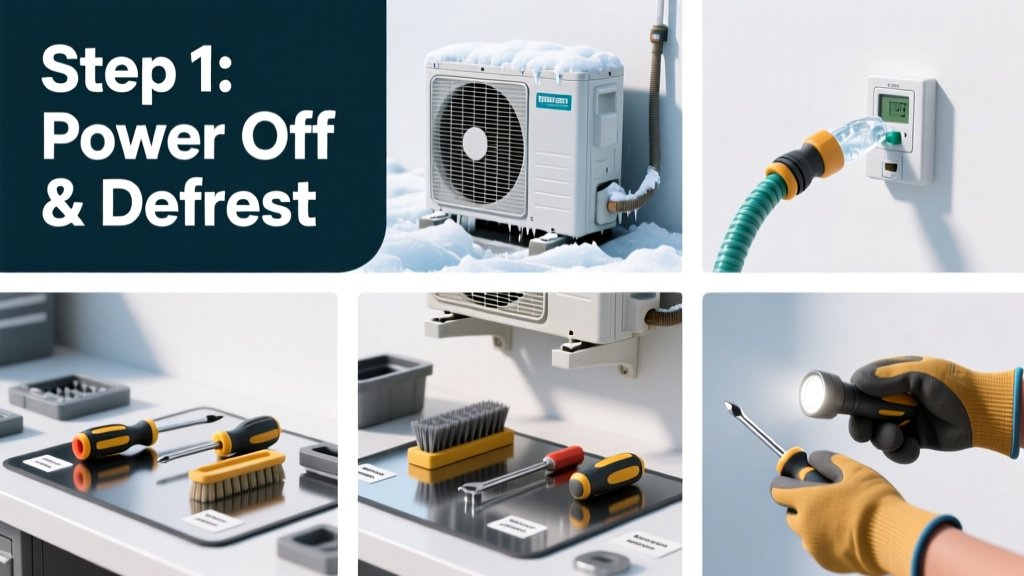
- Power down and thaw completely: Turn off the heat pump at the thermostat AND disconnect power at the outdoor disconnect box. Let ice melt naturally—never chip or pour hot water. This takes 2–6 hours depending on ambient temperature.
- Replace the indoor air filter and inspect ducts: A MERV 8 filter costs under $10 and should be changed every 60 days in winter. Also check for collapsed ducts, closed registers, or blocked return grilles—these restrict airflow enough to drop evaporator coil temps below freezing.
- Clean the outdoor unit: Remove leaves, grass clippings, and snow buildup. Use a soft brush to loosen dirt, then rinse gently with a garden hose (low pressure only). Never use a pressure washer—it bends fins and damages coils.
- Check defrost control board operation: On most units, you’ll see a small LED flash pattern during defrost. Refer to your model’s manual (e.g., Carrier 24ABB36A060 flashes green twice = normal defrost cycle). If no flash occurs after 30+ minutes of operation, suspect a faulty sensor or board.
When to Call a Pro
Stop DIY if you encounter any of these:
- Refrigerant leaks (oil stains on copper lines, hissing sound, or gauge readings outside manufacturer specs)
- Ice returns within 2 hours of full thaw and cleaning
- Compressor runs continuously but no heat output
- Electrical burn smell, tripped breakers, or visible corrosion on wiring terminals
- Defrost sensor reads <28°F when ambient is >35°F (requires multimeter and technical manual)
According to the Air-Conditioning, Heating, and Refrigeration Institute’s 2022 Field Service Report, 68% of repeat heat pump freeze-ups involved undetected refrigerant loss or faulty defrost controls—both requiring certified technicians.
Prevention Tips
Maintain performance year-round with these habits:
- Change indoor air filters every 60 days November–March
- Trim shrubs and fences to maintain 24" clearance around outdoor unit
- Schedule professional coil cleaning and refrigerant verification every 2 years
- Install a smart thermostat with freeze protection alerts (e.g., Nest or Ecobee)
- Use a programmable timer to run fan-only mode for 10 minutes before heating cycles—prevents moisture buildup
Why does my heat pump freeze only at night?
Nighttime cooling increases relative humidity and drops ambient temps—both trigger faster coil frosting if airflow or refrigerant charge is marginal. Combine that with longer runtime during colder hours, and even minor inefficiencies compound. Check your thermostat’s “circulate” setting: running the blower continuously at low speed helps stabilize coil temps.
Can I pour warm water on a frozen heat pump?
No—thermal shock can crack aluminum fins or solder joints. Worse, rushing thaw risks water intrusion into electrical components. Always power down first and let ice melt naturally. If urgent, use a hair dryer on cool setting at 24" distance—but this is a last-resort workaround, not a fix.
Does a dirty air filter really cause freezing?
Absolutely. A clogged filter reduces airflow by up to 40%, according to ASHRAE’s 2021 Residential HVAC Performance Study. That forces the evaporator coil to operate at subfreezing temps—even in 50°F weather—causing moisture to freeze instead of draining. Replace filters monthly during peak season.
How long should defrost mode last?
Typical defrost cycles run 30–90 seconds and occur every 30–90 minutes of heating operation. If yours lasts longer than 2 minutes or triggers more than once every 20 minutes, suspect a stuck reversing valve, failed defrost sensor, or misconfigured control board. Consult your unit’s service manual—downloadable models are available by brand.
Is it safe to run the heat pump in emergency heat mode while frozen?
Yes—but only temporarily. Emergency (auxiliary) heat bypasses the heat pump and uses electric resistance strips. It won’t worsen freezing, but it’s 3–5× more expensive to run. Use it only until the unit thaws and you’ve addressed root causes. Prolonged reliance indicates deeper issues like low refrigerant or a failing compressor.
What’s the difference between frost and ice on my heat pump?
Frost is thin, white, and appears only on the outdoor coil during humid, near-freezing conditions—it’s normal and clears during defrost. Ice is thick, opaque, spreads to lines or cabinet edges, and persists beyond 10 minutes of defrost. Ice signals a system-level problem; frost usually doesn’t.
Freezing heat pumps rarely mean imminent failure—if caught early and diagnosed correctly. Most homeowners resolve the issue with basic maintenance and observation. But don’t ignore recurring patterns: a unit that freezes three times in one season has likely developed a hidden refrigerant leak or control fault. Address it now, or face higher repair bills—and possibly a full system replacement sooner than expected.