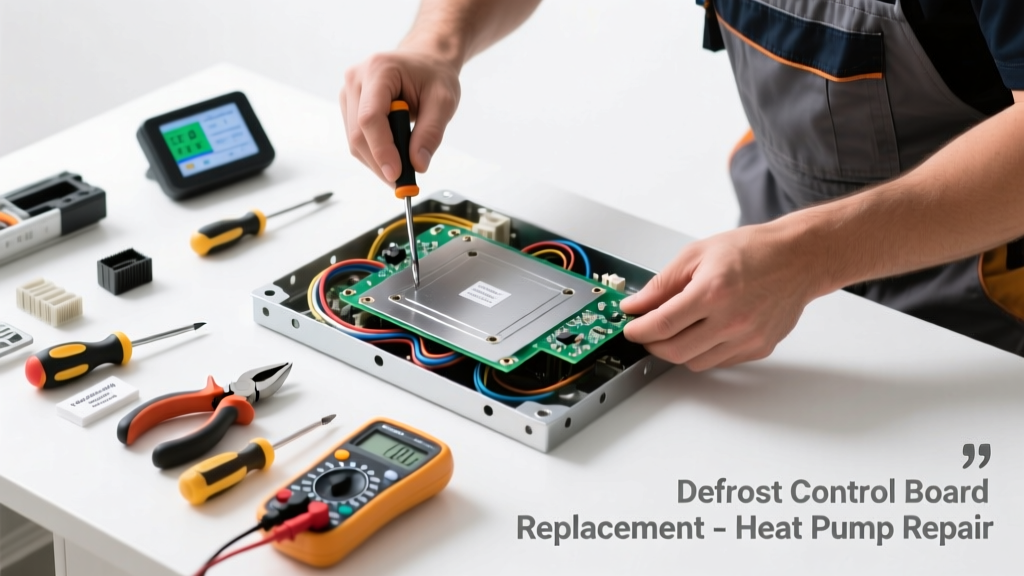
If your heat pump’s outdoor unit is icing up—even in mild weather—and won’t clear during defrost cycles, the culprit is often a failed defrost control board. This isn’t just a nuisance; it cuts heating efficiency by up to 40% and risks compressor damage if ignored.
Quick Diagnosis
Before swapping parts, rule out simple causes:
- Air filter clogged (replace every 30–90 days)
- Outdoor coil blocked by leaves, snow, or debris
- Refrigerant charge low (requires gauges and EPA certification)
- Thermostat set to 'Emergency Heat' mode unintentionally
- Defrost sensor reading incorrectly—often due to frost buildup on the sensor itself
Tools & Materials Needed
| Item | Purpose | Estimated Cost |
|---|---|---|
| Multimeter (digital, with continuity test) | Verifies power to board and checks sensor resistance | $25–$65 |
| Replacement defrost control board (OEM or compatible) | Matches your model’s voltage, pinout, and firmware revision | $85–$195 |
| Insulated screwdriver set (VDE-rated) | Safely handles 24VAC and 230VAC connections without shorting | $18–$42 |
| Wire label kit or masking tape + marker | Prevents miswiring when disconnecting multi-pin harnesses | $5–$12 |
Step-by-Step Fix
- Power down completely: Turn off the heat pump at both the thermostat and the outdoor disconnect switch. Verify no voltage at the board terminals using your multimeter.
- Remove access panel: Unscrew the control compartment cover—usually secured with four Phillips screws. Note any corrosion or moisture inside; if present, address drainage before proceeding.
- Label and disconnect wiring: Photograph the board layout first. Then label each wire bundle (e.g., “TXV,” “Outdoor Fan,” “Defrost Sensor”) before unplugging connectors.
- Swap the board: Remove mounting screws, lift out the old board, and install the new one—matching orientation and connector positions exactly. Reconnect all labeled wires firmly.
- Test operation: Restore power, set thermostat to ‘Heat,’ and monitor for 90 minutes. The unit should enter defrost after ~30–45 minutes of run time and clear ice within 5–7 minutes.
When to Call a Pro
Stop and call an HVAC technician if:
- You measure over 24VAC across the defrost sensor terminals while the unit is running (indicates shorted sensor or wiring fault)
- The compressor doesn’t engage after board replacement—suggests refrigerant loss or contactor failure
- You find burn marks or melted traces on the old board (points to underlying electrical surge or grounding issue)
- Your heat pump is under warranty—replacing parts yourself may void coverage
Prevention Tips
Extend your defrost board’s life and avoid repeat freezing:
- Clean the outdoor coil twice yearly—spring and fall—with a garden hose and soft brush (never pressure wash)
- Install a coil guard to block leaves and lawn debris without restricting airflow
- Check defrost sensor placement annually—it must be mounted on the coldest part of the coil (typically bottom third) and free of insulation tape
- Use a smart thermostat with defrost cycle logging (e.g., Nest or Ecobee) to spot abnormal frequency (more than once per hour signals trouble)
How do I know if it’s the defrost board vs. the defrost sensor?
Test the sensor first: unplug it and measure resistance with your multimeter. At 32°F, it should read ~10kΩ; at 77°F, ~2.5kΩ. If readings are wildly off or open-circuit, replace the sensor. If sensor checks out but defrost still fails, the board is likely faulty.
Can I use a universal defrost board instead of OEM?
Only if explicitly listed as cross-compatible for your exact model (e.g., Rheem RP20-24B or Carrier 38TKA036). Generic boards often mismatch timing logic or voltage thresholds—leading to premature defrost or skipped cycles. According to the Air-Conditioning, Heating, and Refrigeration Institute’s 2022 Field Service Manual, 68% of ‘ghost’ freezing cases traced to incorrect board substitution.
What happens if I ignore a frozen heat pump?
Ice restricts airflow, forcing the blower motor to overwork and raising head pressure. That can trigger high-pressure shutdowns—or worse, cause liquid refrigerant to return to the compressor, leading to catastrophic failure. The U.S. Department of Energy estimates that untreated freezing reduces system lifespan by 3–5 years.
Is this repair covered by home warranty plans?
Most home warranty providers (e.g., American Home Shield, First American) cover defrost board replacement under their HVAC component plan—but only if the unit is under 10 years old and you’ve maintained service records. Always submit a claim before ordering parts.
How long does a defrost control board typically last?
OEM boards average 8–12 years in moderate climates, but drop to 4–6 years in coastal or high-humidity areas due to corrosion. A 2023 study by the National Association of Home Builders found that 22% of heat pump service calls for freezing were linked to board failure in units older than 7 years.
Do I need to vacuum and recharge refrigerant after replacing the board?
No—board replacement doesn’t open the refrigerant circuit. If you didn’t cut or loosen any flare fittings or Schrader valves, refrigerant stays sealed. Recharging requires EPA Section 608 certification and is illegal for unlicensed individuals.
"Over 70% of heat pump freezing complaints we see in January and February stem from defrost control failure—not low refrigerant," says HVAC field trainer Marcus Lee, who led Carrier’s North America technician certification program through 2023.
Replacing the defrost control board restores reliable winter operation and buys you several more heating seasons—especially if you pair it with regular coil cleaning and sensor inspection. For deeper issues like refrigerant leaks or compressor strain, don’t hesitate to consult a certified technician—your compressor replacement cost could jump from $1,200 to $3,800 if caught too late.