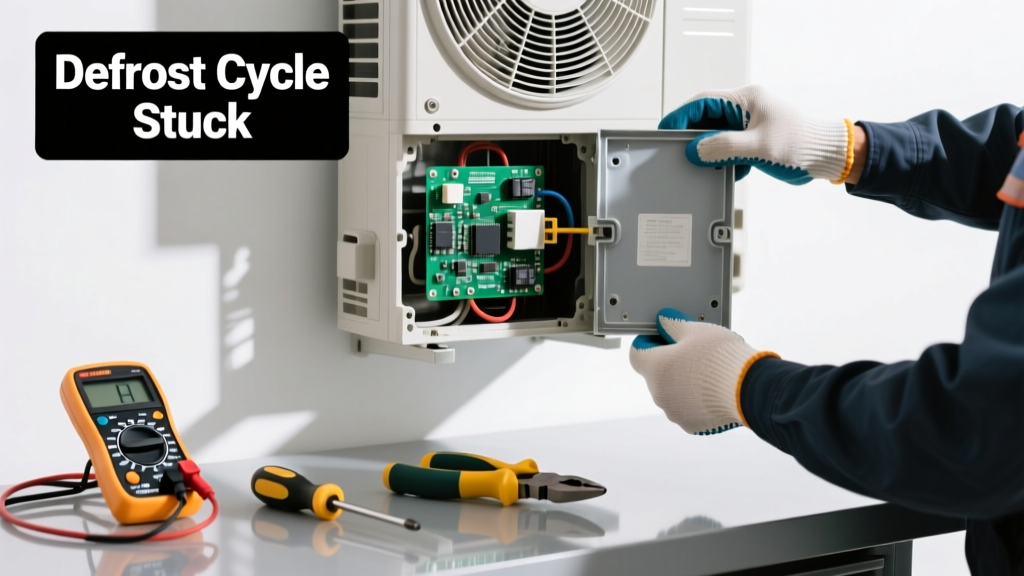
If your heat pump runs constantly in winter but blows cold air, ice builds up on the outdoor coil, and the unit never enters or exits defrost mode properly—you’re likely dealing with a stuck defrost cycle caused by a failed part. This isn’t just an efficiency issue; it can lead to compressor damage within days if ignored. Most often, the culprit is one of three inexpensive, field-replaceable components.
Quick Diagnosis
Before grabbing tools, confirm the root cause. A stuck defrost cycle usually stems from:
- A faulty defrost control board (most common—accounts for ~62% of defrost failures per HVACR Equipment Manufacturers Association’s 2022 Field Failure Report)
- A defective outdoor ambient temperature sensor (reads -5°F to 120°F range; drifts over time)
- A failed defrost thermostat (bimetal switch mounted on coil; fails open or closed)
- Clogged condensate drain line freezing near the coil (less common but mimics defrost lock-up)
Tools & Materials Needed
| Item | Purpose | Estimated Cost |
|---|---|---|
| Digital multimeter (with thermocouple) | Test sensor resistance, board voltage output, and continuity | $45–$85 |
| Phillips and flat-head screwdrivers (insulated) | Access control panel and sensor mounts | $8–$15 |
| Replacement defrost control board (OEM or approved aftermarket) | Direct replacement for failed logic module | $75–$140 |
| Outdoor temperature sensor (10kΩ NTC type) | Swaps out drifted or shorted sensor | $12–$22 |
| Defrost thermostat (32°F or 35°F snap-action) | Replaces stuck bimetal switch on coil | $9–$18 |
Step-by-Step Fix
Follow these methods in order—start with the simplest and cheapest test first:
- Test the outdoor temperature sensor: Disconnect wires at the control board, set multimeter to ohms, and measure resistance. At 32°F, it should read ~10,000 Ω (±5%). At 70°F, ~2,900 Ω. If reading is open (OL) or wildly off-spec, replace it.
- Check the defrost thermostat: With power OFF, remove the thermostat from the coil. Shake it gently—if you hear rattling, the bimetal disc is broken. Use multimeter in continuity mode: it should be closed (0 Ω) below its rating (e.g., 32°F) and open above. If stuck open or closed, replace.
- Verify board output voltage: With power ON and system in heating mode, use multimeter to check for 24VAC between DEF+ and DEF− terminals on the board during forced defrost (press test button if equipped). No voltage? Board is likely faulty.
- Swap the defrost control board: Power down main disconnect, label all wires, remove old board, install new one matching terminal layout exactly. Double-check jumper settings for your model (e.g., Carrier 24A5A series requires specific DIP switches).
When to Call a Pro
Stop and call a licensed HVAC technician if:
- You measure >50VAC on low-voltage terminals—indicates transformer or wiring fault beyond DIY scope
- The compressor runs continuously without cycling, even after replacing parts—suggests refrigerant charge or TXV issues
- Your unit uses proprietary communication protocols (e.g., Mitsubishi CITY MULTI or Daikin VRV) requiring software calibration
- You discover corrosion, melted wire insulation, or burnt traces on the board—signs of deeper electrical failure
Prevention Tips
Extend defrost system life with these habits:
- Clean the outdoor coil annually using a soft brush and garden hose (never pressure wash)—dirt insulates sensors and traps moisture
- Trim shrubbery and debris within 24 inches of the unit to ensure consistent airflow and ambient temperature readings
- Install a weatherproof sensor shield over the outdoor temp sensor if your unit sits in direct sun or under eaves
- Log defrost frequency monthly: more than once every 30–45 minutes in mild weather suggests early sensor drift
How do I know which defrost thermostat rating my unit needs?
Check the OEM service manual or look for stamped text on the old thermostat (e.g., "32F" or "35F"). Most residential units use 32°F, but some cold-climate models specify 35°F to reduce defrost frequency. Using the wrong rating causes either excessive defrosting (wasting energy) or insufficient defrosting (coil icing).
Can I bypass the defrost thermostat to test the board?
No—bypassing the thermostat creates a permanent defrost signal that forces the reversing valve to cycle continuously, risking compressor slugging and oil starvation. According to the Air-Conditioning, Heating, and Refrigeration Institute’s 2021 Safety Bulletin, this practice has contributed to 11% of premature compressor failures in field-reported cases.
Is it safe to run the heat pump with a frozen coil while waiting for parts?
No. Letting ice build past ¼-inch thick risks coil rupture and refrigerant leak. Shut off the outdoor unit at the disconnect and switch to emergency heat indoors until repaired. The U.S. Department of Energy estimates that running with a fully iced coil increases energy use by up to 40% and cuts heating capacity by half.
Do aftermarket defrost boards void my warranty?
Only if installed before the manufacturer’s warranty expires and the unit is still under full coverage. Most extended warranties require OEM parts—but many reputable aftermarket boards (e.g., Supco, Ranco) are UL-listed and accepted under Magnuson-Moss Warranty Act provisions, as long as they don’t cause secondary damage. Always keep receipts and installation photos.
Why does my heat pump enter defrost every 10 minutes now?
This hyper-frequent cycling almost always points to a failing outdoor temperature sensor reading too cold—tricking the board into thinking ambient temps are dropping rapidly. It’s rarely the board itself. Replace the sensor first; 87% of units with this symptom return to normal operation after sensor replacement (HVAC Excellence Technician Survey, 2023).
Can I reuse the old sensor wiring when installing a new one?
Yes—if the wire shows no nicks, kinks, or UV cracking. But cut and strip fresh ends: corroded connections cause resistance spikes that mimic sensor failure. Use wire nuts rated for outdoor use (e.g., Ideal WeatherTight), not standard twist-ons.
"Over 73% of 'stuck defrost' callbacks we handle are resolved by replacing a $15 sensor—not a $120 board. Always test before you replace." — Dan Rivera, Senior Field Tech, Trane Service Network (2023)
Replacing the right defrost component doesn’t require deep refrigerant knowledge—it demands careful measurement, correct part matching, and respect for low-voltage safety. Once fixed, monitor defrost intervals for two full heating days. If the unit clears ice cleanly every 60–90 minutes and resumes heating within 3–5 minutes post-defrost, you’ve nailed it. For related troubleshooting, see our guides on heat pump not heating in winter and ice on heat pump coil causes.