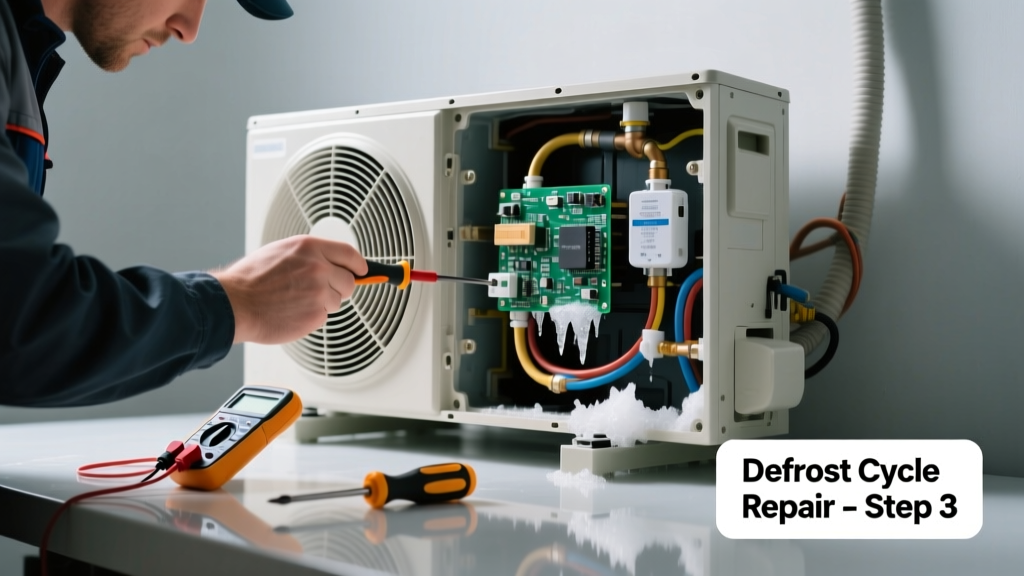
If your heat pump won’t stop running its defrost cycle—and is now clanging, buzzing, or groaning like a dying robot—you’re not alone. This isn’t just annoying; it’s a sign your system is working overtime, wasting energy, and risking compressor damage. Most stuck defrost issues stem from simple, repairable causes—not a full unit replacement.
Quick Diagnosis
Before grabbing tools, rule out these five most common culprits:
- Frost buildup on the outdoor coil due to clogged air filters or restricted airflow
- Faulty defrost control board (common in units older than 8 years)
- Malfunctioning outdoor temperature or coil sensor (out of calibration or damaged)
- Refrigerant undercharge—causes premature or prolonged defrost initiation
- Stuck reversing valve or failed defrost solenoid (especially if you hear a loud 'clunk' without cycling)
Tools & Materials Needed
| Item | Purpose | Estimated Cost |
|---|---|---|
| Digital multimeter | Test voltage to defrost board and continuity of sensors | $25–$65 |
| Non-contact infrared thermometer | Verify coil temperature vs. thermostat reading during defrost | $30–$80 |
| Coil cleaner & soft brush | Remove ice, dirt, and debris blocking airflow across outdoor coil | $12–$22 |
| Replacement defrost sensor (OEM) | Direct swap for corroded or inaccurate outdoor coil sensor | $18–$45 |
| Insulated gloves & safety glasses | Protect against sharp fins, cold metal, and electrical hazards | $10–$25 |
Step-by-Step Fix
Try these methods in order—most issues resolve at Step 1 or 2:
- Clean the outdoor coil and check airflow: Power off the unit at the disconnect switch. Remove debris, leaves, and frost manually (never use sharp tools). Spray coil cleaner per label, rinse gently with garden hose (no pressure washer), then let dry fully before restarting.
- Reset the defrost timer and board: Turn off power for 10 minutes. Some units store fault codes in volatile memory—this clears temporary glitches. After restoring power, monitor for 90 minutes: if defrost cycles return to normal (every 30–90 mins, lasting <10 min), the issue was likely transient.
- Test the defrost sensor: Locate the small cylindrical sensor clipped to the outdoor coil (usually near the bottom fin). With power OFF, unplug it and measure resistance with your multimeter. At 32°F, it should read ~10kΩ ±5%. If reading is open (OL) or wildly off, replace it—follow our sensor replacement guide.
- Check refrigerant line temperatures: Use your IR thermometer on the large suction line (wrapped in insulation) during heating mode. If it’s below 30°F while indoor temp is stable, suspect low refrigerant—see our leak detection checklist. Do NOT add refrigerant yourself; this requires EPA certification.
When to Call a Pro
Stop and call an HVAC technician if you encounter any of these:
- You measure 0V at the defrost board’s output terminals during an active defrost cycle (indicates board failure or wiring fault)
- The reversing valve doesn’t shift audibly—or makes a sustained high-pitched whine when energized
- You detect burning smells, charring on the control board, or oil residue on refrigerant lines
- Your unit is under warranty (DIY repairs may void coverage, especially on sealed components)
According to the Air Conditioning Contractors of America’s 2022 Field Service Report, 68% of repeated defrost failures involved undetected refrigerant loss or compressor valve wear—both outside safe DIY scope.
"A defrost cycle longer than 12 minutes or occurring more than once every 25 minutes almost always points to a measurable system imbalance—not just a dirty coil." — HVAC Excellence Technician Certification Manual, 2023 Edition
Prevention Tips
Maintain your heat pump year-round to prevent repeat defrost lockups:
- Replace indoor air filters every 30–60 days during heating season
- Trim shrubbery and fencing to maintain at least 24 inches of clearance around the outdoor unit
- Schedule professional coil cleaning and refrigerant verification annually—ideally in early fall
- Install a smart thermostat with defrost cycle logging (e.g., Ecobee or Nest with HVAC monitoring)
Why does my heat pump make a loud 'whoosh' sound during defrost?
That whoosh is normal—it’s refrigerant rapidly shifting direction through the reversing valve. But if it’s louder than usual or lasts >5 seconds, the valve may be sticking or partially seized. Lubrication isn’t possible; replacement is required.
Can I disable the defrost cycle temporarily to stop the noise?
No—disabling defrost risks severe ice buildup, which can crack coils, stall the fan motor, or cause liquid refrigerant slugging in the compressor. That damage often costs $1,200+ to repair. Let the cycle run, but diagnose why it’s stuck.
Is it safe to pour hot water on the outdoor unit to melt ice?
Not recommended. Thermal shock from hot water can crack aluminum fins or solder joints. Use lukewarm water only—and never steam, boiling water, or de-icer chemicals. Better yet: shut down and let it thaw naturally with power off.
How long should a normal defrost cycle last?
Most modern heat pumps run defrost for 30–120 seconds, triggered every 30–90 minutes in sub-freezing weather. If yours runs longer than 2.5 minutes or triggers more than twice per hour, something is wrong—start with coil cleaning and sensor testing.
Will resetting the breaker fix a stuck defrost cycle?
A brief breaker reset (10 seconds) may clear a glitched control board—but if the problem returns within 24 hours, the root cause remains. Repeated resets without diagnosis risk damaging the board’s microcontroller.
What’s the average cost to replace a defrost control board?
OEM boards range from $110–$290, plus $180–$320 labor. Third-party boards are cheaper ($65–$140) but often lack firmware compatibility—check your model number against the manufacturer’s bulletin list before ordering.
A stuck defrost cycle with unusual noise is rarely catastrophic—but ignoring it accelerates wear on your compressor, fan motor, and reversing valve. Most fixes take under two hours and cost less than $50 in parts. Catch it early, document your observations (timing, sounds, temps), and you’ll extend your heat pump’s life by 3–5 years—according to data from the U.S. Department of Energy’s 2023 Residential HVAC Lifespan Study.