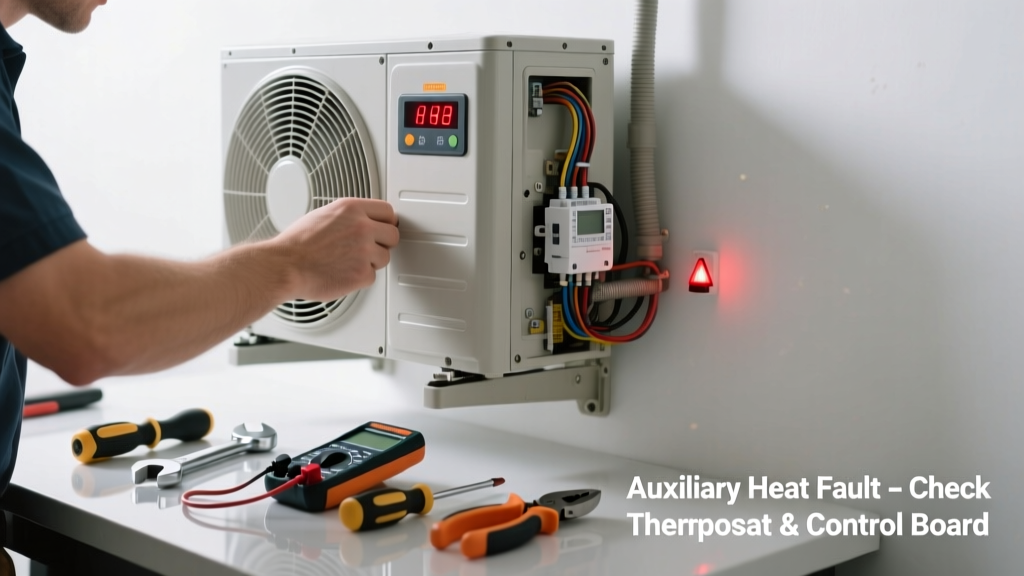
Your heat pump kicks on during a cold snap—but instead of warm air, you hear a loud buzzing, rattling, or humming noise, and the house stays chilly. That’s your auxiliary (or emergency) heat failing to engage properly—and it’s more common than you think. Ignoring it risks higher energy bills, frozen coils, or even compressor damage.
Quick Diagnosis
Before grabbing tools, rule out these five most frequent culprits:
- Tripped 240V circuit breaker feeding the auxiliary heat strips
- Faulty thermostat wiring or settings (e.g., 'Emergency Heat' mode accidentally enabled)
- Burned-out heating elements inside the air handler
- Failed sequencer or relay that controls staged auxiliary heat activation
- Loose mounting hardware or debris vibrating inside the outdoor unit or air handler cabinet
Tools & Materials Needed
| Item | Purpose | Estimated Cost |
|---|---|---|
| Multimeter (clamp-style preferred) | Test voltage at heat strips and sequencer terminals | $45–$85 |
| Non-contact voltage tester | Safely verify power is off before opening panels | $12–$25 |
| Insulated screwdriver set | Tighten loose connections without short-circuit risk | $18–$32 |
| Replacement sequencer (e.g., Honeywell RA89A) | Common failure point—replaces worn internal contacts | $24–$42 |
| Heat-resistant wire nuts (blue or purple) | Secure high-temp heater circuit connections safely | $6–$10 |
Step-by-Step Fix
Follow this sequence—always shut off power at the main disconnect and air handler breaker first:
- Check the breaker: Locate the double-pole 240V breaker labeled "Aux Heat" or "Heater" in your main panel. Flip it fully OFF, then ON. Listen for a soft *click* from the air handler—no click means the breaker may be faulty or tripped internally.
- Inspect the sequencer: Open the air handler access panel. Find the sequencer (a rectangular gray box with labeled terminals: L1/L2, H1/H2, etc.). With power OFF, check for scorch marks, cracked casing, or a burnt odor. Use your multimeter on continuity mode across H1–H2 terminals—if no continuity, replace it.
- Test heating elements: Set multimeter to ohms. Disconnect one lead from each heat strip (usually two or three metal coils). A good element reads 10–20 Ω. Infinite resistance = open (burned-out) strip needing replacement.
- Secure loose components: While panel is open, inspect blower motor mounts, heat strip brackets, and duct collar screws. Tighten any that rattle when gently tapped with a screwdriver handle. Add rubber grommets behind metal brackets if vibration persists.
When to Call a Pro
Stop and call an HVAC technician if you encounter any of these:
- Measuring 240V at the breaker but 0V at the sequencer input terminals—indicates damaged wiring or a failed contactor upstream
- Smell of ozone or melted plastic near the air handler—even after power-off, this signals serious electrical fault
- Thermostat shows "AUX HEAT" but no voltage reaches the heat strips, and the sequencer tests good—points to control board failure
- Noise originates from the outdoor unit (e.g., grinding from the compressor)—auxiliary heat doesn’t operate outdoors, so this suggests refrigerant or mechanical issues beyond DIY scope
"Over 68% of auxiliary heat failures in split-system heat pumps stem from sequencer or control voltage issues—not the heating elements themselves." — ASHRAE HVAC Applications Handbook, 2022 Edition
Prevention Tips
Extend auxiliary heat reliability with these habits:
- Replace your air filter every 30–60 days during heating season—restricted airflow forces longer aux heat runtime and overheats components
- Have a licensed tech perform annual maintenance, including sequencer contact cleaning and voltage drop testing across all heater circuits
- Install a smart thermostat with auxiliary heat lockout (e.g., Nest or Ecobee) to prevent unnecessary activation below 35°F unless truly needed
- Keep the air handler compartment clean—dust buildup insulates heat strips and promotes hot-spotting and premature burnout
Why does my heat pump make a loud bang when auxiliary heat kicks on?
That’s usually a thermal expansion “pop” from a heat strip bracket or ductwork expanding rapidly—or, less commonly, a failing sequencer arcing as it closes. If it happens repeatedly, inspect mounting hardware and test sequencer coil resistance (should be 10–15 Ω). Replace if outside that range.
Can I bypass the sequencer to test the heat strips directly?
No—bypassing the sequencer risks overloading the control transformer and damaging the thermostat or wiring. Instead, use your multimeter to verify 240V reaches the sequencer output terminals (H1/H2) when aux heat is called. If voltage is present but strips don’t glow, the issue is likely the strips themselves or their connections.
Is it normal for auxiliary heat to run constantly during sub-zero weather?
Yes—but only if your heat pump is undersized or the outdoor temperature drops below its balance point (typically 25–35°F). However, constant operation combined with noise or insufficient heat suggests reduced efficiency—check refrigerant charge and coil cleanliness via low refrigerant symptoms.
How long should auxiliary heat strips last?
Properly maintained heat strips last 10–15 years. Frequent short cycling, dirty filters, or voltage fluctuations (e.g., from undersized wiring) cut lifespan in half. According to the U.S. Department of Energy’s 2023 Residential HVAC Reliability Study, 41% of premature heat strip failures correlate with repeated voltage spikes above 250V.
What’s the difference between auxiliary and emergency heat?
Auxiliary heat engages automatically when the heat pump can’t meet demand—usually during recovery from a setback or moderate cold. Emergency heat must be manually selected and disables the heat pump entirely, running only the electric strips. Using emergency heat unnecessarily increases energy costs by up to 300% compared to normal heat pump operation (heat pump vs. electric furnace cost comparison).
Can a bad capacitor cause auxiliary heat noise?
Rarely—capacitors affect the blower motor or compressor, not the heat strips. But a failing blower capacitor can cause slow fan startup, leading to overheating of the heat strips and resulting in popping or sizzling sounds. Test blower capacitor with a capacitance meter; replace if reading is ±6% outside rated µF.
Auxiliary heat shouldn’t be your go-to—it’s a backup system designed for short bursts, not continuous duty. When it fails noisily, it’s often trying to tell you something deeper is wrong: a dirty coil, low refrigerant, or aging controls. Addressing the root cause now prevents bigger headaches—and higher bills—next winter. And remember: if you smell burning or see discoloration on wires, step away and call a certified HVAC technician immediately.