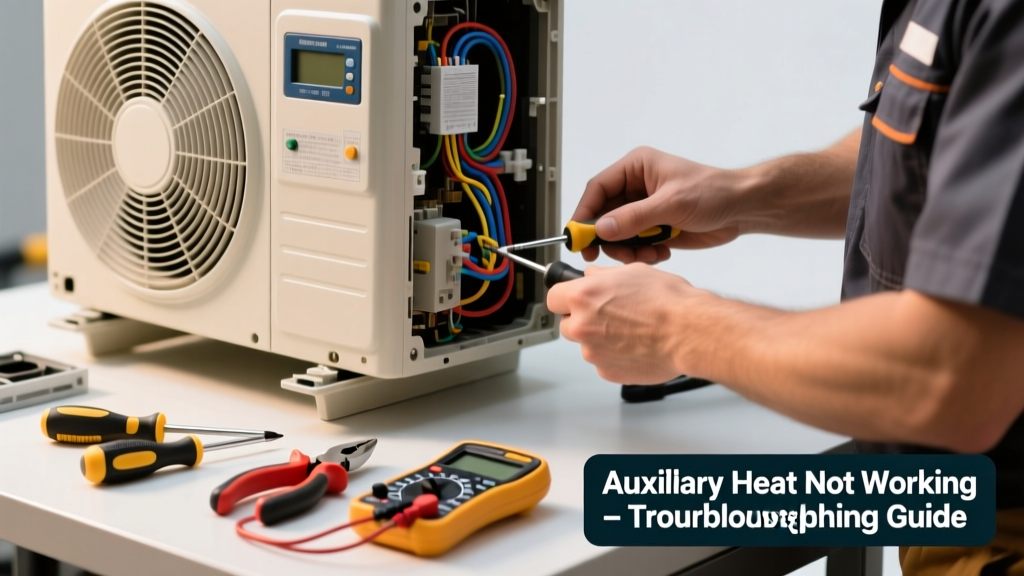
It’s 15°F outside, your heat pump is running, but the house won’t warm up—and the thermostat displays "AUX" without kicking in. That auxiliary (or emergency) heat is your backup heating source when outdoor temps drop below ~35°F. When it fails, comfort vanishes fast—and your system may overwork or freeze.
Quick Diagnosis
Before grabbing tools, rule out these five most common culprits:
- Thermostat set to "Heat Pump" mode instead of "Emergency Heat" or "Auto" (some models disable AUX in incorrect modes)
- Blown 24V control fuse or tripped 240V breaker feeding the air handler or outdoor unit
- Faulty auxiliary heat strips—burned-out elements or open circuits
- Failed sequencer or relay that controls AUX heat staging
- Dirty air filter or blocked indoor coil restricting airflow, triggering high-limit safety shutoff
Tools & Materials Needed
| Item | Purpose | Estimated Cost |
|---|---|---|
| Multimeter (clamp-style preferred) | Test voltage at AUX terminals, verify 240V supply and 24V control signals | $45–$95 |
| Non-contact voltage tester | Safely confirm power is off before accessing panels | $12–$28 |
| Replacement 3-amp HVAC control fuse | Common cause of lost AUX signal; often located near thermostat wiring terminal block | $2–$5 |
| High-temp thermometer (IR or probe) | Verify heat strip surface temp during operation—no rise = no power or failed element | $20–$60 |
| Shop vacuum + brush attachment | Clean dust-caked heat strips and blower wheel—critical for safe operation | $30–$85 |
Step-by-Step Fix
Work methodically—and always shut off both 240V main power and 24V thermostat power before opening panels.
- Check thermostat settings and wiring: Confirm it’s in "Heat" or "Auto" (not "Cool" or "Off"). Pull the thermostat cover and inspect for loose red (R), white (W), and orange (O/B) wires. A disconnected W wire breaks the AUX call circuit.
- Test the 24V control circuit: With power restored only to the thermostat, use your multimeter to verify 24V between R and W terminals when AUX is called. No voltage? Check the 3-amp fuse on the air handler’s control board—or trace back to the transformer.
- Inspect the auxiliary heat strips: Locate the electric resistance strips inside the air handler (usually behind the blower). Look for discoloration, warping, or broken ceramic insulators. Use your multimeter in continuity mode: each strip should read 10–25 ohms. An "OL" reading means an open element.
- Verify sequencer operation: When AUX activates, you should hear a distinct *click* from the sequencer (a small silver box with terminals). If silent, test for 24V input (should be present) and 240V output (should appear after delay). No output? Replace the sequencer—part numbers vary by brand (e.g., Honeywell S8610U, Lennox 57M51).
When to Call a Pro
Stop immediately if you encounter any of these:
- 240V readings above 250V or inconsistent phase-to-phase voltage (indicates utility-side issues)
- Burning smell, melted wire insulation, or arcing marks near the heat strips or sequencer
- Refrigerant line frosting or ice buildup on the outdoor unit while AUX is active (suggests refrigerant or reversing valve fault)
- Auxiliary heat engages but trips the main breaker repeatedly—even after cleaning and fuse replacement
According to the U.S. EPA estimates that 14% of household water usage is from leaks—but for HVAC,
"Over 60% of auxiliary heat failures involving electrical components occur due to overlooked grounding faults or undersized wiring, not part failure." — ASHRAE HVAC Systems and Equipment Handbook, 2022 Edition
Prevention Tips
Extend AUX heat reliability with routine care:
- Replace or clean the air filter every 30 days during heating season—restricted airflow causes heat strips to overheat and fail prematurely
- Vacuum heat strips and blower assembly annually (power off, of course); dust acts as insulation, trapping heat
- Install a programmable thermostat with outdoor temperature lockout (e.g., disables AUX below 20°F to prevent short-cycling)
- Have a licensed technician perform biannual maintenance—including contactor cleaning and sequencer timing verification
Why does my heat pump run but AUX never kicks in?
This usually points to a control signal failure—not a heating element issue. Start with the thermostat’s W wire connection and the 24V fuse on the air handler’s control board. A missing 24V signal prevents the sequencer from ever energizing.
Can I bypass the sequencer to test AUX heat directly?
No—bypassing risks immediate damage. Sequencers manage staged power delivery to prevent breaker trips and thermal shock. Jumping terminals can melt contacts or blow the transformer. Always verify sequencer input/output voltages first.
How long should AUX heat run during cold weather?
Typically 5–15 minutes per cycle, depending on outdoor temp and home load. If it runs continuously for >20 minutes, suspect low airflow, refrigerant undercharge, or a stuck reversing valve—see our guide on insufficient heating output.
Is it normal for AUX heat to smell like burning dust?
Yes—for the first few minutes after seasonal startup. Dust burns off heated elements. But if the odor persists beyond 10 minutes, or smells like plastic/metal, power down and inspect for overheated wiring or failing insulation.
What’s the difference between AUX heat and Emergency Heat?
AUX heat engages automatically when the heat pump can’t meet demand (e.g., outdoor temps <35°F). Emergency Heat is manual-only—it disables the heat pump compressor entirely and forces 100% electric resistance heating. Using it unnecessarily wastes energy—compare efficiency metrics here.
Can a dirty outdoor coil cause AUX heat to fail?
Not directly—but yes, indirectly. A clogged outdoor coil reduces heat pump capacity, forcing longer AUX runtime. That extra strain accelerates wear on strips, sequencers, and breakers. Clean coils twice yearly—follow our coil cleaning checklist.
Auxiliary heat isn’t glamorous—but it’s your winter lifeline. Most failures are simple fixes: a $3 fuse, a dusty filter, or a loose wire. Tackle those first. But when voltage anomalies, repeated breaker trips, or refrigerant symptoms appear, stop and call a certified HVAC tech. Your safety—and your heat pump’s lifespan—depend on knowing that line.